Beyond the GW Horizon: Hunting for Kilonovae with KNTraP

Beyond the GW Horizon: Hunting for Kilonovae with KNTraP

Kilonovae (KNe) are bright, rapidly fading astronomical events believed to be caused by the radioactive decay of heavy elements produced during the merger of neutron stars or a neutron star and a black hole.

While there are several candidate KNe events observed in association with short gamma-ray bursts (GRBs), there is only one confirmed KN associated with a gravitational wave (GW) event, AT2017gfo, detected in 2017.

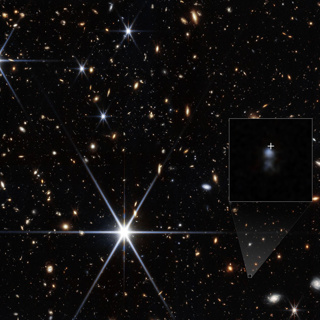
The Kilonova and Transients Program (KNTraP) is a new survey project using the Dark Energy Camera (DECam) to search for KNe independent of GW and GRB triggers.

KNTraP is designed to be a deep, wide-field survey with a nightly cadence in the g and i filters, allowing it to probe a large volume of the sky and identify rapidly evolving transients. The first KNTraP observing run, conducted over 11 nights in 2022, did not detect any convincing KNe candidates but did identify several other interesting fast-evolving transients, including AT2022kak, a rapidly fading transient, and SN2022dmf, an early Type Ia supernova.

The KNTraP project offers several advantages over traditional GW and GRB follow-up searches:

  • It can probe volumes beyond the current detection range of GW detectors.
  • It can search for KNe regardless of the merger orientation, unlike GW and GRB detectors that are sensitive to orientation.
  • It allows for early detection of KNe, capturing their rise, peak, and fade, providing valuable data for theoretical models.
  • Future KNTraP observing runs are expected to be more sensitive due to improved observing conditions and the availability of template images from this first run.
  • Upcoming instruments like the Keck Wide-Field Imager (KWFI) could further enhance KNTraP's efficiency in detecting KNe.


Reference Article: Van Bemmel, N., Zhang, J. et al. "An Optically Led Search for Kilonovae to z∼0.3 with the Kilonova and Transients Program (KNTraP)". MNRAS 000, 1–16 (2024).


Acknowledements: Podcast prepared with Google/NotebookLM. Illustration credits: Dark Energy Camera

Det här avsnittet är hämtat från ett öppet RSS-flöde och publiceras inte av Podme. Det kan innehålla reklam.

Avsnitt(112)

Peering Through the Ice: The Milky Way’s High-Energy Neutrino Signal

Peering Through the Ice: The Milky Way’s High-Energy Neutrino Signal

Peering Through the Ice: The Milky Way’s High-Energy Neutrino Signal Episode Summary: In this episode, we explore a major breakthrough in astrophysics: the IceCube Neutrino Observatory has established...

31 Juli 20min

The Schmidt Observatory System unlocking the Transient Universe

The Schmidt Observatory System unlocking the Transient Universe

In this episode, we dive into the Eric and Wendy Schmidt Observatory System, a groundbreaking initiative designed to pioneer a new paradigm for astronomical research through rapid development, modular...

27 Juli 21min

GUANO, NITRATES, and GLIMPSE: The Pipelines Powering Multi-Messenger Astronomy

GUANO, NITRATES, and GLIMPSE: The Pipelines Powering Multi-Messenger Astronomy

In this episode, we dive into the cutting-edge of time-domain and multi-messenger astrophysics with a deep look at BAT-GLIMPSE, a revolutionary new open-source pipeline developed for the Neil Gehrels ...

20 Juli 20min

The Dynamic Radio Sky: Unveiling Transients with the SKAO

The Dynamic Radio Sky: Unveiling Transients with the SKAO

Welcome to a deep dive into the fast-paced, explosive universe of time-domain astronomy! In this episode, we explore how the upcoming Square Kilometre Array Observatory (SKAO) will revolutionize our u...

13 Juli 19min

X-Raying the Earth: Neutrino Tomography at the South Pole

X-Raying the Earth: Neutrino Tomography at the South Pole

Welcome back to the podcast! Today, we are exploring a groundbreaking new way scientists are looking deep inside our planet. For a century, our understanding of the Earth's interior has relied almost ...

8 Juli 23min

SVOM's First Year: From Gamma-Ray Bursts to Blazars

SVOM's First Year: From Gamma-Ray Bursts to Blazars

In this episode, we dive into the exciting early results from the SVOM (Space-based multi-band astronomical Variable Objects Monitor) mission, which launched in June 2024. Originally designed to hunt ...

6 Juli 20min

SN 2024jlc: Bridging the Gap Between Supernova Classes

SN 2024jlc: Bridging the Gap Between Supernova Classes

In this episode, we dive into the fascinating discovery of SN 2024jlc, one of the closest and least luminous super-luminous supernovae (SLSNe) ever found. We explore how this extraordinary event is ch...

3 Juli 20min

Cosmic Accelerators: Unlocking the Secrets of Microquasar GRS 1915+105

Cosmic Accelerators: Unlocking the Secrets of Microquasar GRS 1915+105

In this episode, we dive into the extreme and fascinating world of microquasars—binary systems where a compact object, like a black hole, feeds off a companion star and launches powerful, relativistic...

26 Juni 20min

Populärt inom Vetenskap

dumma-manniskor
p3-dystopia
allt-du-velat-veta
hacka-livet
bildningspodden
rss-vetenskapsradion
rss-ufobortom-rimligt-tvivel
medicinvetarna
halsorevolutionen
rss-vetenskapsradion-2
svd-nyhetsartiklar
sexet
ufo-sverige
paranormalt-med-caroline-giertz
vetenskapsradion
det-morka-psyket
psykologisk-forskning
rss-kriminologerna
barnpsykologerna
pojkmottagningen