Searching for Nanosecond Optical Transients with the TAIGA-HiSCORE Experiment

Searching for Nanosecond Optical Transients with the TAIGA-HiSCORE Experiment

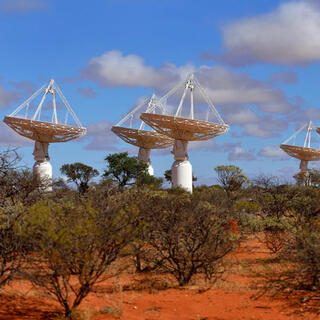
The TAIGA-HiSCORE Cherenkov array, located in Siberia, is a unique instrument designed to study cosmic rays and gamma rays. However, scientists have realized that it can also be used to search for a variety of fascinating astronomical phenomena, including nanosecond optical transients.


What are nanosecond optical transients? These are extremely short bursts of light that last for only a few nanoseconds. The source of these transients is unknown, but there are several intriguing possibilities:

  • Evaporation of primordial black holes: Tiny black holes formed in the early universe could be evaporating today, releasing a burst of energy that includes optical light.
  • Magnetic reconnection in black hole accretion disks: Sudden bursts of energy from these events could produce detectable nanosecond optical flashes.
  • Signals from extraterrestrial civilizations: Advanced civilizations might be using powerful lasers to communicate across vast distances. TAIGA-HiSCORE could be sensitive enough to detect these signals.


he TAIGA-HiSCORE array has a very large field of view (FOV) of about 0.6 steradians, making it ideal for searching for rare events. Researchers have been collecting data for several years and have developed sophisticated techniques to filter out background noise and identify potential transient signals.

So far, no definitive evidence of astrophysical nanosecond optical transients has been found. However, the search continues, and the TAIGA-HiSCORE array is pushing the boundaries of what we know about the universe.


Reference:

A. D. Panov et al. "Four Years of Wide-Field Search for Nanosecond Optical Transients with the TAIGA-HiSCORE Cherenkov Array." arXiv:2412.00159v1 (2024).


Acknowledements: Podcast prepared with Google/NotebookLM. Illustration credits: TAIGA-HiSCORE

Det här avsnittet är hämtat från ett öppet RSS-flöde och publiceras inte av Podme. Det kan innehålla reklam.

Avsnitt(112)

Peering Through the Ice: The Milky Way’s High-Energy Neutrino Signal

Peering Through the Ice: The Milky Way’s High-Energy Neutrino Signal

Peering Through the Ice: The Milky Way’s High-Energy Neutrino Signal Episode Summary: In this episode, we explore a major breakthrough in astrophysics: the IceCube Neutrino Observatory has established...

31 Juli 20min

The Schmidt Observatory System unlocking the Transient Universe

The Schmidt Observatory System unlocking the Transient Universe

In this episode, we dive into the Eric and Wendy Schmidt Observatory System, a groundbreaking initiative designed to pioneer a new paradigm for astronomical research through rapid development, modular...

27 Juli 21min

GUANO, NITRATES, and GLIMPSE: The Pipelines Powering Multi-Messenger Astronomy

GUANO, NITRATES, and GLIMPSE: The Pipelines Powering Multi-Messenger Astronomy

In this episode, we dive into the cutting-edge of time-domain and multi-messenger astrophysics with a deep look at BAT-GLIMPSE, a revolutionary new open-source pipeline developed for the Neil Gehrels ...

20 Juli 20min

The Dynamic Radio Sky: Unveiling Transients with the SKAO

The Dynamic Radio Sky: Unveiling Transients with the SKAO

Welcome to a deep dive into the fast-paced, explosive universe of time-domain astronomy! In this episode, we explore how the upcoming Square Kilometre Array Observatory (SKAO) will revolutionize our u...

13 Juli 19min

X-Raying the Earth: Neutrino Tomography at the South Pole

X-Raying the Earth: Neutrino Tomography at the South Pole

Welcome back to the podcast! Today, we are exploring a groundbreaking new way scientists are looking deep inside our planet. For a century, our understanding of the Earth's interior has relied almost ...

8 Juli 23min

SVOM's First Year: From Gamma-Ray Bursts to Blazars

SVOM's First Year: From Gamma-Ray Bursts to Blazars

In this episode, we dive into the exciting early results from the SVOM (Space-based multi-band astronomical Variable Objects Monitor) mission, which launched in June 2024. Originally designed to hunt ...

6 Juli 20min

SN 2024jlc: Bridging the Gap Between Supernova Classes

SN 2024jlc: Bridging the Gap Between Supernova Classes

In this episode, we dive into the fascinating discovery of SN 2024jlc, one of the closest and least luminous super-luminous supernovae (SLSNe) ever found. We explore how this extraordinary event is ch...

3 Juli 20min

Cosmic Accelerators: Unlocking the Secrets of Microquasar GRS 1915+105

Cosmic Accelerators: Unlocking the Secrets of Microquasar GRS 1915+105

In this episode, we dive into the extreme and fascinating world of microquasars—binary systems where a compact object, like a black hole, feeds off a companion star and launches powerful, relativistic...

26 Juni 20min

Populärt inom Vetenskap

dumma-manniskor
p3-dystopia
allt-du-velat-veta
hacka-livet
bildningspodden
rss-vetenskapsradion
rss-ufobortom-rimligt-tvivel
medicinvetarna
halsorevolutionen
rss-vetenskapsradion-2
svd-nyhetsartiklar
sexet
ufo-sverige
paranormalt-med-caroline-giertz
vetenskapsradion
det-morka-psyket
psykologisk-forskning
rss-kriminologerna
barnpsykologerna
pojkmottagningen