The Search for Orphan Gamma-Ray Bursts with Rubin/LSST and the Fink broker

The Search for Orphan Gamma-Ray Bursts with Rubin/LSST and the Fink broker

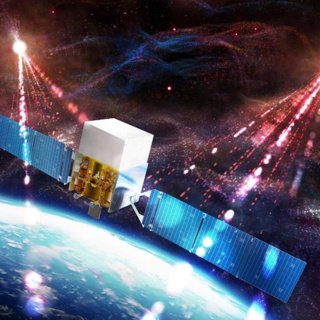
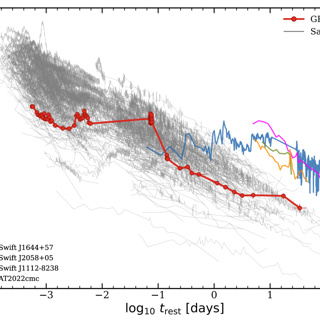
* Orphan gamma-ray burst (GRB) afterglows occur when the gamma-ray emission from a GRB is not directed towards Earth, making the initial burst invisible. However, the afterglow, produced by the interaction of the GRB's blast wave with surrounding material, can be observed.

* Studying orphan afterglows provides valuable insights into GRB physics and their progenitors, and can enhance multi-messenger analyses with gravitational waves.

* The Vera C. Rubin Observatory, with its exceptional sensitivity and wide field of view, is expected to play a crucial role in detecting orphan afterglows.

* The anticipated high volume of alerts from the Rubin Observatory necessitates the use of alert brokers like Fink to filter and categorize events.

* Researchers are developing a machine learning classifier within Fink to identify orphan afterglows based on their distinct light curve characteristics.

* This classifier uses features like the duration, rise and decay rates, color, and fitted parameters of the light curve to distinguish orphan afterglows from other transient events.

* Initial tests using simulated data show promising results, with the classifier effectively excluding most non-orphan events while retaining a significant portion of orphan afterglows.


Reference: Masson, M., & Bregeon, J. (2024). Search for orphan gamma-ray burst afterglows with the Vera C. Rubin Observatory and the alert broker Fink. arXiv preprint arXiv:2412.05061v1.


Acknowledements: Podcast prepared with Google/NotebookLM. Illustration credits: LSST project/NSF/AURA

Det här avsnittet är hämtat från ett öppet RSS-flöde och publiceras inte av Podme. Det kan innehålla reklam.

Avsnitt(112)

Peering Through the Ice: The Milky Way’s High-Energy Neutrino Signal

Peering Through the Ice: The Milky Way’s High-Energy Neutrino Signal

Peering Through the Ice: The Milky Way’s High-Energy Neutrino Signal Episode Summary: In this episode, we explore a major breakthrough in astrophysics: the IceCube Neutrino Observatory has established...

31 Juli 20min

The Schmidt Observatory System unlocking the Transient Universe

The Schmidt Observatory System unlocking the Transient Universe

In this episode, we dive into the Eric and Wendy Schmidt Observatory System, a groundbreaking initiative designed to pioneer a new paradigm for astronomical research through rapid development, modular...

27 Juli 21min

GUANO, NITRATES, and GLIMPSE: The Pipelines Powering Multi-Messenger Astronomy

GUANO, NITRATES, and GLIMPSE: The Pipelines Powering Multi-Messenger Astronomy

In this episode, we dive into the cutting-edge of time-domain and multi-messenger astrophysics with a deep look at BAT-GLIMPSE, a revolutionary new open-source pipeline developed for the Neil Gehrels ...

20 Juli 20min

The Dynamic Radio Sky: Unveiling Transients with the SKAO

The Dynamic Radio Sky: Unveiling Transients with the SKAO

Welcome to a deep dive into the fast-paced, explosive universe of time-domain astronomy! In this episode, we explore how the upcoming Square Kilometre Array Observatory (SKAO) will revolutionize our u...

13 Juli 19min

X-Raying the Earth: Neutrino Tomography at the South Pole

X-Raying the Earth: Neutrino Tomography at the South Pole

Welcome back to the podcast! Today, we are exploring a groundbreaking new way scientists are looking deep inside our planet. For a century, our understanding of the Earth's interior has relied almost ...

8 Juli 23min

SVOM's First Year: From Gamma-Ray Bursts to Blazars

SVOM's First Year: From Gamma-Ray Bursts to Blazars

In this episode, we dive into the exciting early results from the SVOM (Space-based multi-band astronomical Variable Objects Monitor) mission, which launched in June 2024. Originally designed to hunt ...

6 Juli 20min

SN 2024jlc: Bridging the Gap Between Supernova Classes

SN 2024jlc: Bridging the Gap Between Supernova Classes

In this episode, we dive into the fascinating discovery of SN 2024jlc, one of the closest and least luminous super-luminous supernovae (SLSNe) ever found. We explore how this extraordinary event is ch...

3 Juli 20min

Cosmic Accelerators: Unlocking the Secrets of Microquasar GRS 1915+105

Cosmic Accelerators: Unlocking the Secrets of Microquasar GRS 1915+105

In this episode, we dive into the extreme and fascinating world of microquasars—binary systems where a compact object, like a black hole, feeds off a companion star and launches powerful, relativistic...

26 Juni 20min

Populärt inom Vetenskap

dumma-manniskor
p3-dystopia
allt-du-velat-veta
hacka-livet
bildningspodden
rss-vetenskapsradion
rss-ufobortom-rimligt-tvivel
medicinvetarna
halsorevolutionen
rss-vetenskapsradion-2
svd-nyhetsartiklar
sexet
ufo-sverige
paranormalt-med-caroline-giertz
vetenskapsradion
det-morka-psyket
psykologisk-forskning
rss-kriminologerna
barnpsykologerna
pojkmottagningen