Cosmic Messengers: IceCube's Hunt for Extremely High-Energy Neutrinos

Cosmic Messengers: IceCube's Hunt for Extremely High-Energy Neutrinos

* **Introduction:** This episode discusses the search for extremely-high-energy neutrinos (EHEν) using 12.6 years of data from the IceCube Neutrino Observatory. EHEνs are unique messengers from the distant universe, traveling without being deflected by magnetic fields or attenuated by interactions with background photons.

* **IceCube Detector:** The IceCube detector, located at the South Pole, consists of 5160 Digital Optical Modules (DOMs) distributed on 86 strings, instrumenting a cubic kilometer of ice. The detector observes Cherenkov light produced by charged particles from neutrino interactions. A surface array called IceTop measures cosmic-ray air showers.

* **EHEν Detection:** EHEν events in IceCube are observed as tracks (from muon or tau neutrinos) or cascades (from all-flavor neutral-current interactions and electron neutrinos). The search focuses on downgoing or horizontal neutrinos because higher energy neutrinos are absorbed by the Earth.

* **Backgrounds:** The main background is from downgoing atmospheric muon bundles. Other backgrounds include atmospheric neutrinos, which are divided into conventional and prompt components, and astrophysical neutrinos.

* **Analysis:** The analysis uses quality cuts of high-energy events and an IceTop veto to improve the signal-to-noise ratio. The event direction is reconstructed, and energy loss profiles are used to distinguish between single muons and muon bundles.

* **Results:** The non-observation of cosmogenic neutrinos places constraints on the cosmological evolution of ultra-high-energy cosmic ray (UHECR) sources. The study constrains the proton fraction of UHECRs above approximately 30 EeV to be less than 70% at a 90% confidence level, assuming that the source evolution is comparable to or stronger than the star formation rate. This result disfavors the "proton-only" hypothesis for UHECRs.

* **Significance:** This research complements direct air-shower measurements by being insensitive to uncertainties associated with hadronic interaction models. The study also provides the most stringent limit on cosmogenic neutrino fluxes to date.

* **Methodology:** The analysis fits data using a binned Poisson likelihood in the space of reconstructed direction and energy. The study uses the CRPropa package to model cosmogenic fluxes and includes energy losses from photo-pion production and pair production on the cosmic microwave background (CMB) and extragalactic background light (EBL).

* **Event Selection:** The event selection involves several steps including: charge and hit cuts, track quality cuts, muon bundle cuts, and IceTop veto.

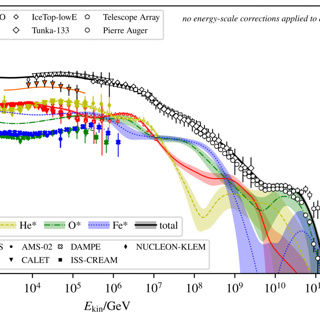
* **Differential Limit**: The differential upper limit on the neutrino flux above 5 x 10^6 GeV is presented in the study and compared to various cosmogenic neutrino models.

* **Systematics**: Systematic uncertainties are taken into account through pseudo-experiments. Parameters considered include: the optical efficiency of the DOMs, the neutrino cross section, average neutrino inelasticity, and atmospheric muon and neutrino fluxes.


* **Reference:** The research is detailed in the article "A search for extremely-high-energy neutrinos and first constraints on the ultra-high-energy cosmic-ray proton fraction with IceCube".


Acknowledements: Podcast prepared with Google/NotebookLM. Illustration credits: NSF, IceCube

Det här avsnittet är hämtat från ett öppet RSS-flöde och publiceras inte av Podme. Det kan innehålla reklam.

Avsnitt(101)

Record-Breaker: Catching Gamma Rays from the Distant Quasar OP 313

Record-Breaker: Catching Gamma Rays from the Distant Quasar OP 313

In this episode, we dive into a groundbreaking astronomical discovery: the detection of very-high-energy (VHE) gamma rays from the quasar OP 313. Located at a redshift of $z = 0.997$, OP 313 has shatt...

1 Juni 20min

Ripples in Spacetime: Unpacking the GWTC-5.0 Catalog

Ripples in Spacetime: Unpacking the GWTC-5.0 Catalog

In this episode, we dive into the monumental release of the Gravitational-Wave Transient Catalog version 5.0 (GWTC-5.0) and the open data from the second part of the fourth observing run (O4b) by the ...

29 Maj 21min

SN 2017egm : Fermi-LAT's Breakthrough Gamma-Ray Detection

SN 2017egm : Fermi-LAT's Breakthrough Gamma-Ray Detection

In today’s episode, we dive into the mystery of superluminous supernovae (SLSNe)—rare, extreme astronomical events that shine 10 to 100 times brighter than standard core-collapse supernovae. For years...

22 Maj 23min

Supernovae on the RISE: Why Dead Stars Wake Up Decades Later

Supernovae on the RISE: Why Dead Stars Wake Up Decades Later

In this episode, we explore the fascinating phenomenon of core-collapse supernovae that refuse to fade away quietly. Years, or even decades, after their initial explosion, some of these stellar deaths...

20 Maj 17min

The SVOM Satellite: A New Era in Multi-Messenger Astronomy

The SVOM Satellite: A New Era in Multi-Messenger Astronomy

In this episode, we dive into the fascinating world of gamma-ray bursts (GRBs) and high-energy transients through the lens of the SVOM (Space-based Multi-band Variable Object Monitor) mission. Launche...

29 Apr 24min

Chasing the Flash: Hunting Neutron Star Mergers with CTAO

Chasing the Flash: Hunting Neutron Star Mergers with CTAO

In this episode, we dive into the thrilling world of multi-messenger astronomy! Ever since the historic detection of GW170817, scientists have known that binary neutron star (BNS) mergers can produce ...

14 Apr 19min

Tiling the Sky: A New Strategy for Finding Elusive GRBs

Tiling the Sky: A New Strategy for Finding Elusive GRBs

In this episode, we dive into the intense and fast-paced world of **Gamma-ray bursts (GRBs)—the most luminous and rapidly evolving transients in the Universe**. While space-based instruments like the ...

13 Apr 19min

Fast Radio Bursts & Magnetar X-Rays: A Peculiar Discovery

Fast Radio Bursts & Magnetar X-Rays: A Peculiar Discovery

In this episode, we dive into the deep cosmos to explore a recent astronomical breakthrough linking Fast Radio Bursts (FRBs)—enigmatic, millisecond-long cosmic transients—to extreme stellar objects kn...

7 Apr 22min

Populärt inom Vetenskap

p3-dystopia
dumma-manniskor
allt-du-velat-veta
kapitalet-en-podd-om-ekonomi
rss-ufobortom-rimligt-tvivel
svd-nyhetsartiklar
rss-vetenskapsradion
det-morka-psyket
rss-spraket
paranormalt-med-caroline-giertz
sexet
halsorevolutionen
rss-vetenskapsradion-2
rss-odla
rss-broccolipodden-en-podcast-som-inte-handlar-om-broccoli
medicinvetarna
dumforklarat
rss-ronden
rss-italiensk-dagbok
vetenskapsradion