Beyond Milliseconds and Minutes: ASKAP Unveiling Intermediate Neutron Stars

Beyond Milliseconds and Minutes: ASKAP Unveiling Intermediate Neutron Stars

* **Introduction:** Astronomers have discovered a new celestial object, PSR J0311+1402, a radio pulsar with an unusual spin period of **41 seconds**. This discovery bridges the gap between normal pulsars (millisecond to seconds) and long-period radio transients (LPTs) (minutes to hours).

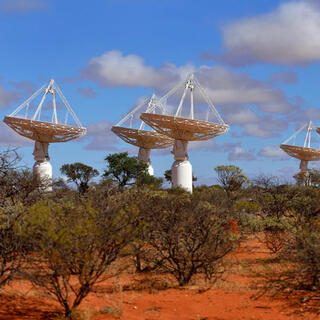
* **The Discovery:** PSR J0311+1402 was first detected by the **Australian Square Kilometre Array Pathfinder (ASKAP)** during commissioning tests of the CRACO system in January 2024. It exhibited pulses with a duration of about 0.5 seconds.

* **Intermediate Nature:** Unlike normal pulsars and LPTs, PSR J0311+1402's **41-second spin period** falls in a previously under-explored range. Traditional pulsar searches were less sensitive to these periods, and image-based LPT searches missed shorter pulses.

* **Pulsar-like Properties:** Despite its long period, PSR J0311+1402 shows characteristics similar to normal pulsars, including **low linear (∼25%) and circular (∼5%) polarisation** and a **steep spectral index (∼ −2.3)**. It also has a double or potentially triple-peaked pulse profile.

* **Below the Death Line:** Intriguingly, its spin-down properties place PSR J0311+1402 **below the pulsar death line**, a theoretical boundary where radio emission is expected to cease due to insufficient particle production. This challenges current understanding of pulsar emission mechanisms.

* **Relation to Long-Period Transients (LPTs):** Known LPTs have much longer periods and often exhibit radio luminosities too high to be powered by rotation alone, along with high polarisation. PSR J0311+1402's properties, such as its luminosity being potentially powered by rotation and its low polarisation, suggest it is more likely a pulsar. Its duty cycle also aligns better with the trend observed in typical pulsars.

* **Implications:** The discovery suggests the existence of a **previously undetected population of neutron stars with intermediate spin periods**. Finding more such objects will help bridge the gap between pulsars and LPTs and improve our understanding of neutron star evolution.

* **Future Research:** Ongoing observations and timing studies are crucial to refine PSR J0311+1402's spin-down properties and shed light on its emission mechanism and evolutionary state. The ASKAP CRACO system is expected to discover more such intermediate period objects.


**Reference:**

* Wang, Y., Uttarkar, P. A., Shannon, R. M., et al. (2025). The discovery of a 41-second radio pulsar PSR J0311+1402 with ASKAP. *arXiv preprint arXiv:2503.07936*.


Acknowledements: Podcast prepared with Google/NotebookLM. Illustration credits: Alex Cherney

Det här avsnittet är hämtat från ett öppet RSS-flöde och publiceras inte av Podme. Det kan innehålla reklam.

Avsnitt(101)

Record-Breaker: Catching Gamma Rays from the Distant Quasar OP 313

Record-Breaker: Catching Gamma Rays from the Distant Quasar OP 313

In this episode, we dive into a groundbreaking astronomical discovery: the detection of very-high-energy (VHE) gamma rays from the quasar OP 313. Located at a redshift of $z = 0.997$, OP 313 has shatt...

1 Juni 20min

Ripples in Spacetime: Unpacking the GWTC-5.0 Catalog

Ripples in Spacetime: Unpacking the GWTC-5.0 Catalog

In this episode, we dive into the monumental release of the Gravitational-Wave Transient Catalog version 5.0 (GWTC-5.0) and the open data from the second part of the fourth observing run (O4b) by the ...

29 Maj 21min

SN 2017egm : Fermi-LAT's Breakthrough Gamma-Ray Detection

SN 2017egm : Fermi-LAT's Breakthrough Gamma-Ray Detection

In today’s episode, we dive into the mystery of superluminous supernovae (SLSNe)—rare, extreme astronomical events that shine 10 to 100 times brighter than standard core-collapse supernovae. For years...

22 Maj 23min

Supernovae on the RISE: Why Dead Stars Wake Up Decades Later

Supernovae on the RISE: Why Dead Stars Wake Up Decades Later

In this episode, we explore the fascinating phenomenon of core-collapse supernovae that refuse to fade away quietly. Years, or even decades, after their initial explosion, some of these stellar deaths...

20 Maj 17min

The SVOM Satellite: A New Era in Multi-Messenger Astronomy

The SVOM Satellite: A New Era in Multi-Messenger Astronomy

In this episode, we dive into the fascinating world of gamma-ray bursts (GRBs) and high-energy transients through the lens of the SVOM (Space-based Multi-band Variable Object Monitor) mission. Launche...

29 Apr 24min

Chasing the Flash: Hunting Neutron Star Mergers with CTAO

Chasing the Flash: Hunting Neutron Star Mergers with CTAO

In this episode, we dive into the thrilling world of multi-messenger astronomy! Ever since the historic detection of GW170817, scientists have known that binary neutron star (BNS) mergers can produce ...

14 Apr 19min

Tiling the Sky: A New Strategy for Finding Elusive GRBs

Tiling the Sky: A New Strategy for Finding Elusive GRBs

In this episode, we dive into the intense and fast-paced world of **Gamma-ray bursts (GRBs)—the most luminous and rapidly evolving transients in the Universe**. While space-based instruments like the ...

13 Apr 19min

Fast Radio Bursts & Magnetar X-Rays: A Peculiar Discovery

Fast Radio Bursts & Magnetar X-Rays: A Peculiar Discovery

In this episode, we dive into the deep cosmos to explore a recent astronomical breakthrough linking Fast Radio Bursts (FRBs)—enigmatic, millisecond-long cosmic transients—to extreme stellar objects kn...

7 Apr 22min

Populärt inom Vetenskap

p3-dystopia
dumma-manniskor
allt-du-velat-veta
kapitalet-en-podd-om-ekonomi
rss-vetenskapsradion
rss-ufobortom-rimligt-tvivel
svd-nyhetsartiklar
rss-spraket
paranormalt-med-caroline-giertz
medicinvetarna
rss-vetenskapsradion-2
halsorevolutionen
det-morka-psyket
sexet
rss-odla
dumforklarat
rss-broccolipodden-en-podcast-som-inte-handlar-om-broccoli
vetenskapsradion
hacka-livet
kvalificerat-hemligt-poddradio