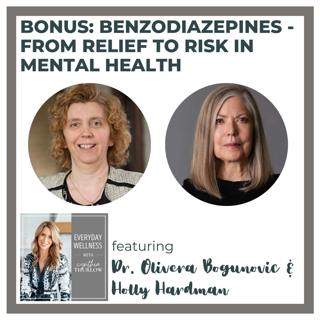
BONUS: Benzodiazepines - From Relief to Risk in Mental Health with Dr. Olivera Bogunovic and Holly Hardman

BONUS: Benzodiazepines - From Relief to Risk in Mental Health with Dr. Olivera Bogunovic and Holly Hardman

I am thrilled to have Dr. Olivera Bogunovic and Holly Hardman with me on the show today. Dr. Bogunovic is an assistant professor of psychiatry at Harvard Medical School and the medical director of the alcohol, drug, and addiction outpatient program at McLean Hospital. and Holly directed the documentary As Prescribed. In today’s discussion, we dive into the ongoing benzodiazepine crisis in the United States, with over 92 million prescriptions written each year for medications like Ativan, Valium, Xanax, and Klonopin. We discuss the origin of those drugs in the 1970s as treatments for anxiety and how they lead to tremendous physical dependency. Holly shares her experience with the neurological effects she suffered after long-term use of Klonopin, and we examine challenges in psychiatric care, the need for informed consent, and the impact of social media. We also cover the role of lifestyle, the need for psychotherapy and psychosocial support, and the significance of hope. This conversation is truly invaluable! Given how frequently benzodiazepines get prescribed, everyone must understand their associated risks and considerations. IN THIS EPISODE YOU WILL LEARN: How prescribing practices have evolved over the last two decades The significant consequences older adults face when they suddenly stop using benzodiazepines Holly shares how doctors misinformed her when she began taking Klonopin. Holly describes the benzodiazepine-induced symptoms and cognitive issues she experienced Why people must get informed about the long-term effects of benzodiazepines when consenting to take them How benzodiazepines work in the body and impact the brain Why benzodiazepines are ineffective when used long-term for insomnia The challenges certain people face when accessing psychiatric care What is BIND, and what are its symptoms? The significance of diet and holistic approaches for managing mental health, and why community support is essential in the recovery process Why As Prescribed is an educational documentary for everyone Connect with Cynthia Thurlow Follow on X ⁠Instagram⁠ ⁠LinkedIn⁠ Check out Cynthia’s ⁠website⁠ Submit your questions to ⁠support@cynthiathurlow.com⁠ Connect with Dr. Olivera Bogunovic ⁠The McLean Hospital⁠ The documentary, As Prescribed, is available in the United States and Canada on Prime Video, Apple, Kanopy, Tubi, and Google.

Avsnitt(614)

BONUS: Muscle Strength in Menopause: Key Tests & Lifestyle Measures with Dr. Vonda Wright

BONUS: Muscle Strength in Menopause: Key Tests & Lifestyle Measures with Dr. Vonda Wright

I am thrilled today to have the opportunity to speak with Dr. Vonda Wright, a practicing double-boarded orthopedic sports surgeon who has positioned herself at the intersection of longevity, women's health, and performance.  Dr. Wright is a great advocate for women's health, well-known and highly regarded for her frequent media appearances and thought leadership. In our discussion, we cover the importance of menopausal literacy and the impact of musculoskeletal syndrome in menopause, focusing on the critical decade, bone health, risk factors, and how to assess muscle strength. Dr. Wright shares her formula for strength training, and we explore the benefits of Zone 2 sprint training, examining the importance of V02-Max testing, particularly for frail individuals. We also address common musculoskeletal issues and essential lifestyle practices for maintaining orthopedic health.  This insightful conversation with Dr. Vonda Wright is one of my top picks on the podcast. I know you will love it! IN THIS EPISODE YOU WILL LEARN: What menopausal literacy means The symptoms of musculoskeletal syndrome during menopause The roles estrogen and testosterone play in the musculoskeletal system Why it is essential to focus on your health and notice any hormonal changes in the critical decade between the ages of 35 and 45  How the loss of loss of muscle mass and strength can lead to frailty and a risk of falling in middle-aged patients Why women must base their decisions regarding estrogen on facts The benefits of making smart nutrition, exercise, and sleep your priorities The exercise Dr. Wright recommends for improving cardiovascular fitness How weightlifting and trampoline rebounding in midlife supports bone health  How to use how to use V02 Max data to track your fitness level Some essential nutritional factors for supporting midlife health  Bio: Dr. Wright is a practicing double-boarded Orthopaedic Sports Surgeon, Author, Speaker, Researcher, and Innovator whose work stands at the intersection of Longevity / Women’s Health / Performance. Widely recognized for her thought leadership, Dr Wright is a frequent media and conference expert. Her innovative science-based approach is changing the lives of millions in mid-life. Dr Wright practices in Lake Nona, Florida, and is the founder and CEO of Precision Longevity. Connect with Cynthia Thurlow   Follow on X ⁠Instagram⁠ ⁠LinkedIn⁠ Check out Cynthia’s ⁠website⁠ Submit your questions to ⁠support@cynthiathurlow.com⁠ Connect with Dr. Vonda Wright On her⁠ website⁠ On⁠ Facebook⁠ ⁠Instagram⁠ ⁠X.com⁠ ⁠LinkedIn⁠ Leave a message on VIP Phone Number (407)-232-2334

1 Dec 1h 1min

Ep. 524 The Truth About Creatine Monohydrate – How to Boost Strength, Bones & Longevity with Mike Mutzel

Ep. 524 The Truth About Creatine Monohydrate – How to Boost Strength, Bones & Longevity with Mike Mutzel

Today, I am delighted to be joined by a friend and colleague, Mike Mutzel.  Mike has a master's in Clinical Nutrition from the University of Bridgeport. He is a graduate of the IFM, applies functional medicine in clinical practice, and is a consultant lecturer who teaches leading-edge science in a concise format for progressive clinicians to prevent chronic diseases.  In our discussion, Mike and I unpack the benefits of creatine monohydrate, highlighting the importance of ensuring the products we use are free of impurities. We explain how creatine monohydrate gets created, answer many listener questions, and describe current research specific to creatine monohydrate, discussing ways to support bone health, navigate dosing, and how to troubleshoot.  This conversation with Mike Mutzel is truly invaluable, and I look forward to having him back on the podcast to dive a little deeper into the science.  IN THIS EPISODE, YOU WILL LEARN: How creatine supports energy production across muscles, the brain, and other organ systems Why vegetarians and vegans should take creatine What to consider when choosing high-quality creatine supplements Dosing strategies based on diet, exercise, sleep, and individual needs How taking creatine with electrolytes while exercising can improve absorption Benefits of supplementing with amino acids alongside creatine for illness, recovery, or when protein intake is low Adjusting your creatine dosage for sleep, travel, or exercise demands How creatine supports bone and muscle health  The value of creatine for the eyes and ears Connect with Cynthia Thurlow   Follow on X, Instagram & LinkedIn Check out Cynthia’s website Submit your questions to support@cynthiathurlow.com Connect with Mike Mutzel On his website YouTube Instagram High Intensity Health Podcast Creatine Research: Creatine in Women's Health: Bridging the Gap From Menstruation Through Pregnancy to Menopause Effects of Creatine and Resistance Training on Bone Health in Postmenopausal Women Creatine Supplementation (3 g/d) and Bone Health in Older Women: A 2-Year, Randomized, Placebo-Controlled Trial Creatine Supplementation in Depression: A Review of Mechanisms, Efficacy, Clinical Outcomes, and Future Directions The Effects of 8-Week Creatine Hydrochloride and Creatine Ethyl Ester Supplementation on Cognition, Clinical Outcomes, and Brain Creatine Levels in Perimenopausal and Menopausal Women (CONCRET-MENOPA): A Randomized Controlled Trial

29 Nov 39min

Ep. 523 This Is Why Your Cholesterol Shifts in Midlife – The Best Strategies to Reduce Risk & Improve Vascular Health with Dr. Thomas Dayspring

Ep. 523 This Is Why Your Cholesterol Shifts in Midlife – The Best Strategies to Reduce Risk & Improve Vascular Health with Dr. Thomas Dayspring

I am excited to reconnect with Dr. Tom Dayspring today. He joined me before for an extremely popular seven-part podcast series where we tackled topics related to lipids and the physiological shifts that occur as we transition from perimenopause into menopause. Dr. Dayspring graciously agreed to return today for an Ask Me Anything episode, where we explore how lipids change as we navigate the perimenopause-to-menopause transition and discuss the significance of bioindividuality, inflammation, vascular health, and endothelial function in the context of changing estrogen levels. Dr. Dayspring also clarifies how visceral fat affects lipid levels, and we discuss testing for cardiovascular disease, the relevance of particle size, LPIR scores, and physical markers of insulin resistance.  Stay tuned for today’s valuable and fascinating conversation. I will share the second AMA with Dr. Dayspring later this fall. IN THIS EPISODE, YOU WILL LEARN: How estrogen loss impacts lipid metabolism in midlife Shifts in vascular health that occur during the menopause transition What makes endothelial function central to long-term health? Why triglycerides matter more than you think How variations in LDL particle size influence cardiovascular risk What standard cholesterol tests could miss about your cardiovascular health How inflammation can alter your lipid profile How your genes and lifestyle shape your lipid profile Markers women need to track over and above standard cholesterol tests How menopause reshapes women’s cardiovascular risk profile Connect with Cynthia Thurlow   Follow on X, Instagram & LinkedIn Check out Cynthia’s website Submit your questions to support@cynthiathurlow.com Connect with Dr. Thomas Dayspring On X (@DrLipid) On LinkedIn

26 Nov 1h 11min

BONUS: Stop Wasting Hours on CE! – The New High-Impact Method Every Healthcare Provider Needs with Karen DiMarco & Wendy Harrold

BONUS: Stop Wasting Hours on CE! – The New High-Impact Method Every Healthcare Provider Needs with Karen DiMarco & Wendy Harrold

Karen DiMarco and Wendy Harrold join me today for another episode in the podcast series featuring carefully curated professional companies I want to introduce to my community.  Karen is a nurse with over 30 years of experience. She is on a mission to transform healthcare through innovative business ventures. She has assisted in revolutionizing traditional continuing education by aligning with research on how nurses learn and retain knowledge most effectively, ultimately to improve patient outcomes. Wendy has over two decades of experience in the wellness and healthcare continuing education industry. She has a strong passion for holistic health and is committed to advancing education. She has played a pivotal role in developing innovative and impactful programs to bridge the gap between traditional medical practices and emerging wellness trends. In our conversation, we explore the evolution of continuing professional education, now referred to as continuing professional development. We examine why triggering our learning response truly matters, why self-directed learning is the future, and the current challenges with continuing education regarding delivery and time constraints. We also dive into deprogramming from past training methodologies and discuss the current ANCC guidelines, various types of learning, and the benefits of sapiency for supporting continuing education and reflective practice through artificial intelligence.  This discussion is relevant for medical providers and all interprofessionals, including clergy, attorneys, and other healthcare professionals. It is definitely one you will want to revisit. IN THIS EPISODE, YOU WILL LEARN: How reflective practice is transforming continuing education for healthcare professionals The value of self-directed learning over traditional, prescriptive CE methods How AI-guided reflection personalizes knowledge acquisition and retention The role of interprofessional conversations in accelerating practical learning How clinicians can earn CE credits by exploring topics relevant to their practice The benefits of panel discussions and expert debates for integrating new research How freedom in learning encourages critical thinking and intellectual curiosity The impact of moral injury and cognitive dissonance on clinical decision-making How structured programs support clinicians transitioning to self-directed learning The benefits of reflective practice for bringing research evidence into daily patient care Connect with Cynthia Thurlow   Follow on X, Instagram & LinkedIn Check out Cynthia’s website Submit your questions to support@cynthiathurlow.com Connect with Karen DiMarco and Wendy Harrold Sapience Email: hello@sapiencepro.co    https://sapience-affiliate.peachs.co/a/cynthia-thurlow

24 Nov 57min

Ep. 522  Menopause Is Wrecking Your Gut – The Best Nutrition Fixes for Midlife Women with Dr. Sarah Berry

Ep. 522 Menopause Is Wrecking Your Gut – The Best Nutrition Fixes for Midlife Women with Dr. Sarah Berry

I am delighted to connect with Dr. Sarah Berry today. She is a professor at King's College London and the Chief Scientist at the science and nutrition company, Zoe. As an academic leader in nutrition science, Sarah has conducted over 35 human nutritional studies, and she currently leads the world's largest in-depth nutrition research project, the ZOE Predict Study. Her research is at the forefront of personalized nutrition, deepening our understanding of fats and the structure of food. Her recent studies explore menopause, snacking, cardiometabolic health, and more.  In our conversation today, we explore the general tendency of social and other media to misrepresent nutrition and discuss the importance of the food landscape, the food matrix, and fiber in addition to bioindividuality and personalized nutrition. Dr. Berry explains why bowel cancer rates in young adults are increasing and the potential drivers of that, and we dive into the impact of the exposome, the influence of menopause on our microbiome, and cardiometabolic risk factors. We examine the importance of polyphenols and other bioactive compounds, the demonization of fats and cholesterol, and we tackle the misinformation surrounding seed oils, clarifying why we should remain open-minded. We also share some simple swaps that women in perimenopause and menopause can apply.  This conversation with Dr. Sarah Berry is rich and thought-provoking, so you will likely want to listen to it more than once. IN THIS EPISODE, YOU WILL LEARN: How food labelling is so often misleading Why you should be cautious about taking nutritional advice from medical influencers The importance of considering the underlying factors that determine how healthy a particular food is   Why fiber is essential for a healthy microbiome How to avoid discomfort by spreading your fiber intake throughout the day The importance of personalized nutrition Potential drivers of early-onset colorectal cancer How the microbiome composition changes after menopause The value of polyphenols and dietary fat  Dr. Berry debunks common misconceptions about seed oils versus butter Some simple swaps to help women in perimenopause and menopause get enough fiber into their diets Bio:  Professor Sarah Berry Sarah is a Professor at King’s College London and Chief Scientist at ZOE, the science and nutrition company. As an academic leader in Nutrition Science, Sarah has conducted over 35 human nutrition studies and currently leads the world's largest in-depth nutrition research program, the ZOE PREDICT study. Her research is at the forefront of personalised nutrition, our understanding of fats, and the food structure. Sarah’s recent studies explore topics such as menopause, snacking, and cardiometabolic health. She’s often featured as an expert on ZOE's own podcast, ZOE Science and Nutrition, and regularly appears on television and radio to translate complex science into useful advice. Connect with Cynthia Thurlow   Follow on X, Instagram & LinkedIn Check out Cynthia’s website Submit your questions to support@cynthiathurlow.com Connect with Dr. Sarah Berry On Instagram The Zoe Science and Nutrition Podcast

22 Nov 1h 4min

Ep. 521 Metabolism Masterclass: Weight Loss Resistance Explained with Cynthia Thurlow, NP

Ep. 521 Metabolism Masterclass: Weight Loss Resistance Explained with Cynthia Thurlow, NP

Today, we have the first episode in a two-part mashup series focused on metabolism and weight loss resistance.  I am delighted to be joined today by Dr. William Li, Michelle Shapiro, and Lara Adler. Dr. Li and I explore how our metabolism shifts throughout our lifetime, the role of excess body fat, the influence of lifestyle choices, and the distinction between different types of fat. Michelle and I discuss the complex relationship between weight, shame, and self-perception, including how internal dialogue, orthorexia, and adverse childhood events shape our health journey. Lara and I examine how metabolic health and insulin resistance are affected by the endocrine-disrupting chemicals found in everyday products, food, and the environment.  You will love this invaluable compilation, packed with insights and practical knowledge from our expert guests. IN THIS EPISODE, YOU WILL LEARN: How metabolism changes as we age The difference between brown (biologically active) and white fat  Excess body fat drives inflammation and hormonal changes. How our internal dialogue influences our lifestyle choices  Impact of adverse childhood experiences on long-term health and stress responses Dietary strategies can fail when driven by fear or perfectionism. Endocrine-disrupting chemicals block or mimic hormones  Early-life chemical exposures set the stage for lifelong metabolic challenges Reducing toxic exposure can support weight management and metabolic resilience.  How reducing your exposure to endocrine-disrupting chemicals present in everyday products can support your metabolic health and help you manage your weight  Connect with Cynthia Thurlow   Follow on X, Instagram & LinkedIn Check out Cynthia’s website Submit your questions to support@cynthiathurlow.com Connect with Dr. William Li On social media: @Dr William Li On his website Sign up for Dr. Li’s free newsletter  Ep. 354 Metabolism Myths Debunked: Weight Gain Insights with Dr. William Li Connect with Michelle Shapiro On her website Quiet the Diet Podcast Ep. 390 Understanding Shame, Food Behaviors & Weight Loss with Michelle Shapiro Connect with Lara Adler On her website On Facebook and Instagram Ep. 159 Lara Adler Explains The Link Between Chemical Exposure And Weight Gain & Other Health Issues

19 Nov 1h 4min

Ep. 520 We Got Healthcare Wrong – The Biggest Flaws in Modern Medicine & How To Fix Them with Dr. Aaron Hartman

Ep. 520 We Got Healthcare Wrong – The Biggest Flaws in Modern Medicine & How To Fix Them with Dr. Aaron Hartman

Today, I am thrilled to reconnect with Dr. Aaron Hartman, a triple-board-certified physician who recently wrote the book "Uncurable."  In today’s expansive conversation, we delve deeply into the structural flaws of traditional allopathic medicine. Dr. Hartman shares how his own clinical approach has evolved and recounts Anna’s story, explaining how her experience became a turning point in his professional growth. We highlight the importance of lifelong learning, patient advocacy, and the benefits of removing restrictions to allow providers to deliver patient-centered care. We examine the legacy of the Flexner Report, the rigidity it introduced to modern medicine, and the broad potential of GLP-1s beyond weight loss. We discuss the hidden factors that shape medical errors, the effects of insurance reimbursement, the challenges of existing in the current medical system, and how fear of liability influences clinical decisions. We also explore the triangle of health and the effects of unresolved trauma. This episode is packed with valuable insights, so you will likely want to revisit it more than once. IN THIS EPISODE, YOU WILL LEARN: How traditional allopathic medicine is structurally rigid and limits patient-centered care Dr. Hartman shares how patient advocacy and curiosity-driven learning fueled his clinical evolution. How the Flexner Report created a hierarchy that discourages innovation and integrity The therapeutic potential of GLP-1s beyond weight loss  Why being open-minded as a clinician does not mean being reckless How insurance reimbursement models reward overdiagnosis and procedural volume instead of outcomes What the fear of litigation leads to, regarding defensive medicine and unnecessary testing How clinical decisions, overtesting, and overdiagnosis can inadvertently contribute to serious medical errors and harm patients What the triangle of health is, and how it underpins overall wellbeing Why unresolved trauma can cause physical illnesses Connect with Cynthia Thurlow   Follow on X, Instagram & LinkedIn Check out Cynthia’s website Submit your questions to support@cynthiathurlow.com Connect with Dr. Aaron Hartman On his website Purchase a copy of Uncurable

17 Nov 59min

Ep. 519 We’re Failing Women’s Bones – The Shocking Truth About Early Bone Loss with Dr. Doug Lucas

Ep. 519 We’re Failing Women’s Bones – The Shocking Truth About Early Bone Loss with Dr. Doug Lucas

Today, I’m thrilled to welcome Dr. Doug Lucas for the first episode of a two-part masterclass on bone health. Dr. Lucas is double board-certified as both an orthopedic surgeon and an osteoporosis specialist. He is on a mission to show the world that osteoporosis is both preventable and reversible.   In our discussion today, we take a deep dive into existing guidelines and their limitations and examine how Depo-Provera and oral contraceptives affect women’s bone physiology, particularly in younger women. We clarify why no ovulation means no bone balance, how breastfeeding affects bone health, and the importance of peak bone density. We explore the importance of early interventions and screenings, risk factors for poor bone health, the concept of relative energy deficiency, and the limitations of DEXA scans compared to REMS technology. Dr. Lucas also discusses bone health markers and the effects of frailty, falls, and sarcopenia, and shares the foundational pillars of health and longevity. Stay tuned for part two of our masterclass on bone health. IN THIS EPISODE, YOU WILL LEARN: How existing osteoporosis guidelines tend to overlook the key nuances of prevention and care The importance of early bone-health screening  How Depo-Provera and the contraceptive pill disrupt bone physiology in younger women How bone balance becomes disrupted with suppressed ovulation  Why peak bone density is a critical target in early adulthood How breastfeeding affects bone density  Where DEXA scans fall short and how REMS technology offers a clearer picture of bone health How relative energy deficiency impacts bone health in active women Why muscle mass is essential for protecting bone health and preventing frailty  The lifestyle pillars for long-term bone health and longevity Connect with Cynthia Thurlow   Follow on X, Instagram & LinkedIn Check out Cynthia’s website Submit your questions to support@cynthiathurlow.com Connect with Dr. Doug Lucas The OsteoCollective Community The Dr. Doug Show

15 Nov 59min

Populärt inom Vetenskap

p3-dystopia
dumma-manniskor
svd-nyhetsartiklar
allt-du-velat-veta
kapitalet-en-podd-om-ekonomi
ufo-sverige
det-morka-psyket
sexet
rss-vetenskapsradion
bildningspodden
rss-vetenskapsradion-2
rss-vetenskapspodden
naturmorgon
medicinvetarna
dumforklarat
rss-i-hjarnan-pa-louise-epstein
rss-arkeologi-historia-podden-som-graver-i-vart-kulturlandskap
barnpsykologerna
rss-broccolipodden-en-podcast-som-inte-handlar-om-broccoli
halsorevolutionen