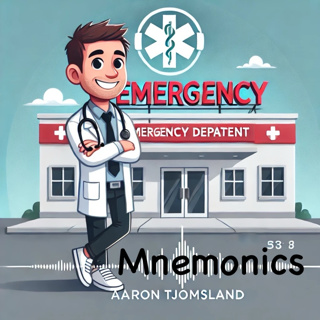
H’s and T’s mnemonic: OKTV, THROW TEN TOXIC TAMPONS

H’s and T’s mnemonic: OKTV, THROW TEN TOXIC TAMPONS

The “H’s and T’s” refer to a mnemonic used in medicine to help healthcare professionals quickly recall the most common causes of cardiac arrest during a code (a medical emergency requiring CPR). Memorizing these is crucial because identifying and addressing these causes rapidly can improve the chances of saving a patient’s life.

Here’s a breakdown:


The H’s: OK TV


Hypoxia - Lack of oxygen to tissues can lead to a heart stopping, so ensuring proper oxygenation is key.


Hypo-/Hyperkalemia - Abnormal potassium levels affect the heart’s electrical activity, potentially causing it to stop.


Hypothermia - Low body temperature can slow heart function and lead to cardiac arrest.


Hypovolemia - Loss of blood or fluids can lead to insufficient circulation and cardiac arrest.


Hydrogen ion (acidosis) - A build-up of acid in the blood (often due to respiratory failure or shock) can disrupt heart function.


The T’s: THROW TEN TOXIC TAMPONS


Thrombosis (pulmonary or coronary) - Blood clots in the lungs (pulmonary embolism) or heart (myocardial infarction) can obstruct blood flow, leading to cardiac arrest.


Tension Pneumothorax - Air trapped in the chest cavity compresses the heart and lungs, affecting circulation.


Toxins - Certain substances (medications, drugs, poisons) can disrupt heart rhythms.


Tamponade (cardiac) - Accumulation of fluid around the heart prevents it from pumping effectively.


Importance of Memorizing the H’s and T’s:


These causes cover many reversible conditions that may lead to cardiac arrest. During a code, time is critical, so having these potential causes at the top of your mind helps quickly assess and treat the patient. Remembering the “H’s and T’s” mnemonic ensures that a healthcare provider methodically works through possible causes and provides the best chance of resuscitation.

Avsnitt(63)

Hyperkalemia: STABILIZE, SHIFT, SEND-IT (I C BIG K DROP)

Hyperkalemia: STABILIZE, SHIFT, SEND-IT (I C BIG K DROP)

The 3-Step Approach to Acute Hyperkalemia 1. Stabilize: the Heart (If ECG changes) → Calcium 2. Shift: K+ Into Cells → Insulin + Glucose, Albuterol, Bicarb (if acidotic) 3. Send-it: Remove K+ From Bod...

11 Mars 202527min

USED CARS non-anion gap metabolic acidosis: high chloride low bicarbonate

USED CARS non-anion gap metabolic acidosis: high chloride low bicarbonate

USED CARS mnemonic for non-anion gap metabolic acidosis (NAGMA):Why “USED CARS”? • Ureterosigmoidostomy • Saline & Chloride infusion (excessive).. chloride offsets AG • Endocrine disorders (Addison’s ...

6 Mars 202548min

GOLD MARK (better than MUDPILES): Anion Gap Metabolic Acidosis Mnemonic (7,440.12 MRRM)

GOLD MARK (better than MUDPILES): Anion Gap Metabolic Acidosis Mnemonic (7,440.12 MRRM)

The GOLD MARK causes are divided into three major pathophysiologic groups based on the source of the acid production:​ Alcohols (Toxic Ingestions) → Emergency Toxins​ Glycols → Ethylene glycol (antifr...

5 Mars 20251h 2min

7,440 MR RM: Blood Gas ABG interpretation

7,440 MR RM: Blood Gas ABG interpretation

Mister Ronald McDonald (MR RM) is a helpful flowchart for interpreting acid-base disorders, specifically for determining whether a patient’s condition is due to a metabolic (M) or respiratory (R) caus...

13 Feb 202533min

Glasgow-Blatchford Score (Glass Cow Black Ford): Upper GI Bleed indications for hospital admission

Glasgow-Blatchford Score (Glass Cow Black Ford): Upper GI Bleed indications for hospital admission

To determine if the patient requires admission or can be discharged, the Glasgow-Blatchford Score (GBS) is used. Here’s the ABCDEF mnemonic and why these factors increase the risk of an upper GI bleed...

29 Okt 202417min

CENTOR criteria Fever PAIN: Strep Throat mnemonic

CENTOR criteria Fever PAIN: Strep Throat mnemonic

CENTOR criteria Fever PAIN: Strep Throat mnemonic

24 Okt 202416min

Adventitious Lung Sounds: Everyone Can Always take in STRIDE, Fine CCHAP with fire crackers

Adventitious Lung Sounds: Everyone Can Always take in STRIDE, Fine CCHAP with fire crackers

These are the adventitious lung sounds Mneumonics.Strider:Everyone can take in stride.Crackles:A fine chap with firecrackers.Wheezing:Just ask any whale: Can you HAC the wheeze? Rhonchi:I BOPped the w...

3 Okt 202424min

Populärt inom Hälsa

somna-med-henrik
rss-bara-en-till-om-missbruk-medberoende-2
rss-jossan-nina
inga-beiga-morsor
alska-oss
not-fanny-anymore
rss-vuxna-pa-latsas
sexnoveller-deluxe
brottarbroder
johannes-hansen-podcast
angestpodden
rss-viktmedicinpodden
sova-med-dan-horning
sa-in-i-sjalen
rss-the-house-podcast-3
vinterpasset
tyngre-radio
rss-sjalsligt-avkladd
smartare-fitness-podden
sex-pa-riktigt-med-marika-smith