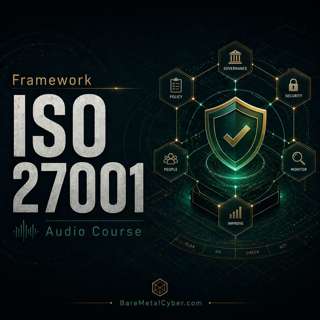
Framework - ISO 27001 (Cyber)

Framework - ISO 27001 (Cyber)

The ISO/IEC 27001 Framework is the internationally recognized standard for establishing, implementing, maintaining, and continually improving an Information Security Management System (ISMS). It provides a systematic approach to managing sensitive information through risk management, governance, and control implementation. At its core, ISO 27001 helps organizations protect the confidentiality, integrity, and availability of data—whether stored, processed, or transmitted—by aligning security practices with business objectives and regulatory requirements. The framework is built around a risk-based process, requiring organizations to identify potential threats, assess their likelihood and impact, and implement appropriate controls from the companion standard ISO/IEC 27002. These controls cover a wide range of areas including asset management, access control, cryptography, operations security, and supplier relationships. By tailoring these controls to organizational needs, ISO 27001 supports both flexibility and accountability—ensuring that security measures are not just technical but also strategic and operational. Beyond compliance, ISO 27001 fosters a culture of continuous improvement through regular audits, performance monitoring, and leadership involvement. Certification to the standard demonstrates to customers, partners, and regulators that an organization follows internationally accepted best practices for managing information security risk. More than a checklist, ISO 27001 functions as an ongoing management framework that integrates security into every level of organizational decision-making, helping build trust, resilience, and long-term operational stability.

Den här podcasten är hämtad från ett öppet RSS-flöde och publiceras inte av Podme. Den kan innehålla reklam.

Avsnitt(71)

Episode 39 — A.5.33–5.34 — Protection of records; Privacy & PII protection

Episode 39 — A.5.33–5.34 — Protection of records; Privacy & PII protection

A.5.33 mandates that records—authoritative evidence of activities performed—are protected so they remain authentic, reliable, and usable for as long as needed. For the exam, note the required controls...

14 Okt 202514min

Episode 38 — A.5.31–5.32 — Legal/regulatory/contractual; Intellectual property rights

Episode 38 — A.5.31–5.32 — Legal/regulatory/contractual; Intellectual property rights

A.5.31 requires organizations to identify and comply with all applicable legal, regulatory, and contractual requirements related to information security. For the exam, emphasize traceability: you need...

14 Okt 202514min

Episode 37 — A.5.29–5.30 — Security during disruption; ICT readiness for BC

Episode 37 — A.5.29–5.30 — Security during disruption; ICT readiness for BC

A.5.29 focuses on maintaining information security when normal operations are disrupted, such as during disasters, severe outages, or crisis events. For the exam, remember that protection objectives d...

14 Okt 202513min

Episode 36 — A.5.27–5.28 — Learning from incidents; Collection of evidence

Episode 36 — A.5.27–5.28 — Learning from incidents; Collection of evidence

A.5.27 requires organizations to institutionalize learning from incidents, transforming individual events into durable improvements. For the exam, emphasize that “learning” goes beyond a retrospective...

14 Okt 202513min

Episode 35 — A.5.25–5.26 — Event assessment/decision; Incident response

Episode 35 — A.5.25–5.26 — Event assessment/decision; Incident response

A.5.25 establishes a disciplined mechanism to assess events and decide whether they constitute information security incidents, preventing alert fatigue and ensuring consistent prioritization. For exam...

14 Okt 202515min

Episode 34 — A.5.23–5.24 — Use of cloud services; Incident mgmt planning & prep

Episode 34 — A.5.23–5.24 — Use of cloud services; Incident mgmt planning & prep

A.5.23 focuses on governing the use of cloud services so that risk treatment is consistent with enterprise policy and legal obligations. For the exam, explain that governance spans service selection, ...

14 Okt 202514min

Episode 33 — A.5.21–5.22 — ICT supply chain; Monitoring/review of supplier services

Episode 33 — A.5.21–5.22 — ICT supply chain; Monitoring/review of supplier services

A.5.21 extends supplier governance to the broader ICT supply chain, recognizing that products and services depend on multiple tiers of vendors, firmware, open-source components, and logistics. For exa...

14 Okt 202516min

Episode 32 — A.5.19–5.20 — Supplier relationships; Supplier agreements

Episode 32 — A.5.19–5.20 — Supplier relationships; Supplier agreements

A.5.19 establishes that supplier relationships must be governed to protect the organization’s information and services. For the exam, focus on risk-based segmentation of suppliers—by data sensitivity,...

14 Okt 202514min

Populärt inom Utbildning

rss-bara-en-till-om-missbruk-medberoende-2
historiepodden-se
det-skaver
nu-blir-det-historia
harrisons-dramatiska-historia
sektledare
not-fanny-anymore
rss-viktmedicinpodden
allt-du-velat-veta
johannes-hansen-podcast
roda-vita-rosen
rikatillsammans-om-privatekonomi-rikedom-i-livet
rss-ar-det-rimligt
sa-in-i-sjalen
rss-max-tant-med-max-villman
rss-basta-livet
sex-pa-riktigt-med-marika-smith
rss-foraldramotet-bring-lagercrantz
rss-mina-andetag
rss-traningsklubben