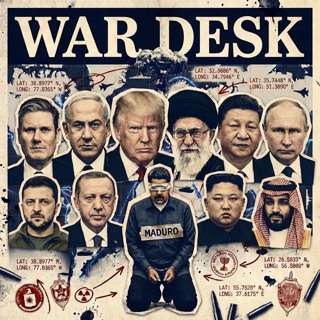
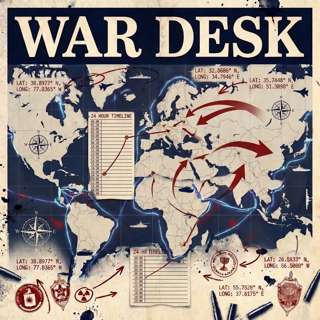
War Desk

War Desk is an AI-native investigative series built to track the real risk of global war. With thousands of military reports, declassified government testimony, intelligence assessments, and verified conflict data now publicly available, the volume of information exceeds what any traditional newsroom can process. AI can.

This series leverages artificial intelligence at every layer of production. From custom-built architecture that ingests and cross-references thousands of primary source documents, to AI-generated audio that delivers findings in a consistent, accessible format, War Desk represents a new model for geopolitical journalism. What would take a team of defense analysts months to compile, AI can process in days, surfacing patterns, contradictions, and connections across theaters that would otherwise remain buried across separate headlines.


Each episode draws directly from primary sources: Department of Defense force posture statements, IAEA safeguards reports, Congressional testimony, think tank assessments from CSIS, RAND, and ISW, declassified intelligence estimates, and verified conflict databases. The AI architecture identifies relevant findings, cross-references claims across sources, and synthesizes them into episodes that make this information accessible to the public.

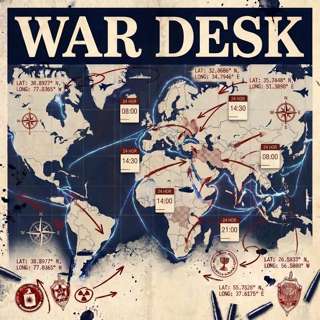
The series covers the five active flashpoints that could escalate to major war: the U.S.-Iran confrontation, the Russia-Ukraine war, the Taiwan Strait, the Korean Peninsula, and the global alliance structures that connect them. It examines the military deployments, the nuclear timelines, the economic consequences, and the decisions being made by specific people in specific rooms.


This is not sensationalized content. It is not political commentary. It is documented fact, processed at scale, and presented with journalistic rigor. The goal is simple: give the public the same quality of threat assessment that governments produce internally.

War Desk is politically neutral by design. Every side's claims are sourced and attributed. Adversarial media is labeled. No spin. No speculation. Every source for every episode is published at wardesk.fm so listeners can verify every claim themselves.

New episodes release daily, with AI enabling rapid analysis and production that keeps pace with a fast-moving geopolitical landscape. Journalistic standards guide the output. Every claim is tied to specific documents. The series clearly distinguishes between verified facts, official claims, and unresolved contradictions.


This is documented fact, processed at scale, presented for the public.

Den här podcasten är hämtad från ett öppet RSS-flöde och publiceras inte av Podme. Den kan innehålla reklam.

Avsnitt(167)

Day 63: 20,000 Sailors Trapped as Hormuz Blockade Holds

Day 63: 20,000 Sailors Trapped as Hormuz Blockade Holds

Over 20,000 civilian seafarers remain stranded on immobilized tankers in the Persian Gulf as prohibitive war risk insurance premiums render maritime transit economically impossible. While the US enfor...

1 Maj 25min
Day 62: IDF Says Lebanon Truce Limits Hezbollah Ops

Day 62: IDF Says Lebanon Truce Limits Hezbollah Ops

On April 29, 2026, IDF commanders said the Lebanon cease-fire is curbing their ability to counter Hezbollah. Iran's rial currency hit a record low as a shaky ceasefire with the US and Israel held. Six...

30 Apr 24min
Day 61: US Rejects Iran Offer to Reopen Hormuz Strait

Day 61: US Rejects Iran Offer to Reopen Hormuz Strait

Washington has officially rejected an Iranian proposal to reopen the Strait of Hormuz, citing Tehran's attempt to decouple maritime commerce from the ongoing nuclear disarmament negotiations. As the n...

29 Apr 23min
Day 60: Oil Hits $108 as Hormuz Traffic Plummets

Day 60: Oil Hits $108 as Hormuz Traffic Plummets

Global oil prices have surged to 108 dollars per barrel as the US-led tourniquet strategy restricts shipping through the Strait of Hormuz to just 5 percent capacity. This economic pressure coincides w...

28 Apr 29min
Day 59: US Rejects Iran Hormuz-for-Nukes Deal

Day 59: US Rejects Iran Hormuz-for-Nukes Deal

Diplomatic backchannels in Islamabad collapsed after the United States rejected Iran's proposal to open the Strait of Hormuz, citing a refusal to decouple maritime relief from nuclear compliance. This...

27 Apr 26min
Day 58: Sanctioned Vessels Bypass US Strait of Hormuz

Day 58: Sanctioned Vessels Bypass US Strait of Hormuz

Marine tracking data confirms that the Ocean Jet and Lumina Ocean successfully navigated the Strait of Hormuz on April 25, 2026, by hugging the Iranian coastline to evade detection. This breach highli...

26 Apr 36min
Day 57: Israel Kills 12 in Gaza, Lebanon Truce Cracks

Day 57: Israel Kills 12 in Gaza, Lebanon Truce Cracks

Despite a formal ceasefire extension, Israeli forces killed 12 Palestinians in Gaza and engaged in active surface-to-air missile combat with Hezbollah, rendering the diplomatic agreement tactically ir...

25 Apr 28min
Day 56: Iran Naval Raids Block Strait of Hormuz Oil

Day 56: Iran Naval Raids Block Strait of Hormuz Oil

Despite a formal ceasefire, Iranian asymmetrical naval tactics have effectively severed the flow of refined petroleum through the Strait of Hormuz, triggering a global energy crisis. This disruption h...

24 Apr 26min
Populärt inom Politik & nyheter

p3-krim
svenska-fall
aftonbladet-daily
aftonbladet-krim
flashback-forever
rss-krimreportrarna
tv4-nyheterna-story
rss-vad-fan-hande
rss-krimstad
motiv
politiken
rss-sanning-konsekvens
de-fyras-gang
mannen-utan-spar
rss-flodet
svd-ledarredaktionen
spar
rss-aftonbladet-krim
rss-frandfors-horna
olyckan-inifran