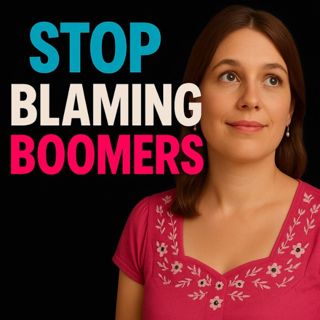

E170: Boomers Didn’t Steal Your Future. This Did - Dr. Jennie Bristow
El Podcast3 Joulu 2025

E170: Boomers Didn’t Steal Your Future. This Did - Dr. Jennie Bristow

Sociologist Dr. Jennie Bristow joins Jesse to dismantle “generation wars” rhetoric—especially Boomer-blaming—and re-center the real story: stalled economies, broken higher ed, housing dysfunction, and a culture that’s leaving young people anxious and unmoored.

Guest bio:
Dr. Jennie Bristow is a professor of sociology at Canterbury Christ Church University in the UK and a leading researcher on intergenerational conflict, social policy, and cultural change. She is the author of Stop Mugging Grandma: The Generation Wars and Why Boomer Blaming Won’t Solve Anything and the forthcoming Growing Up in the Culture Wars, which examines how Gen Z is coming of age amid identity politics, pandemic fallout, and collapsing institutional confidence.

Topics discussed:

  • How “intergenerational equity” became a fashionable idea among policymakers and millennial commentators after the 2008 financial crisis
  • Why blaming Baby Boomers for housing, student debt, and climate change hides deeper structural problems
  • The role of journalism, English majors, and the broken media business model in manufacturing generational conflict
  • Higher education as a quasi–Ponzi scheme: massification, student loans, and the weak graduate premium
  • Housing, delayed family formation, and why homeownership is a bad proxy for measuring generational “success”
  • Millennials vs. Gen Z: growing up with 9/11 and the financial crisis vs. growing up with COVID-19 and AI
  • AI, “zombie economies,” and why societies still need real work, real knowledge, and real skills
  • Social Security, ageing, low fertility, and what’s actually at stake in pension debates
  • Identity politics, culture wars, and how an obsession with personal identity fragments common life
  • Media polarization, rage clicks, and how subscription-driven, foundation-funded journalism blurs into activism

Main points & takeaways:

  • Generation wars are a distraction. The Boomer-vs-Millennial narrative was heavily driven by media and policy elites after the 2008 crisis. It channels anger away from structural issues—stagnant productivity, weak labor markets, housing policy failure, and a dysfunctional higher-ed and welfare state.
  • Boomers didn’t “steal the future” — policy did. Baby Boomers are just a large cohort who happened to be born into a period of postwar economic expansion. Treating them as a moral category (“greedy,” “sociopaths”) obscures the role of monetary, housing, education, and labor-market policy choices.
  • Class beats cohort. Within every “generation” there are huge differences: inheritance vs no inheritance, elite degrees vs low-quality credentials, secure jobs vs precarity. Talk of “Boomers” and “Millennials” flattens these class divides into fake demographic morality plays.
  • Housing is a symbol, not the root cause. The rising age of first-time buyers and insane rents are real problems—but they’re manifestations of policy and market failures, not proof that Boomers hoarded all the houses. Using homeownership as the key generational metric gets the story backwards.
  • Higher education is oversold. Mass university attendance, especially in non-vocational fields, has left many millennials and Zoomers with heavy student debt and weak job prospects. Degrees became a costly entry ticket to the labor market without guaranteeing meaningful work or higher wages.
  • AI is a wake-up call, not pure doom. AI will automate a lot of white-collar tasks (journalism, marketing, some finance), but it also exposes how shallow “skills” education has become. Bristow argues students need real knowledge and disciplinary depth so humans can meaningfully supervise and direct AI systems.
  • Ageing and pensions are solvable political questions, not excuses to scapegoat the old. Longer life expectancy and rising dependency ratios do require institutional redesign—but that should mean rethinking work, welfare, and economic dynamism, not treating older people as fiscal burdens to be phased out.
  • Gen Z is growing up in a culture of fractured identity. Instead of being socialized into a shared civic culture, young people are pushed into micro-identities and online culture-war camps. That emphasis on personal identity over common purpose undermines their ability to form stable adult roles.
  • Media business models amplify rage and generational framing. As ad revenue collapsed and subscriptions and philanthropy took over, many outlets shifted toward more partisan, activist-style content. Generational blame is a cheap, emotionally potent frame that fits this economic logic.

Top 3 quotes:

On the myth of Boomer villainy

“Baby Boomers are not a generation of sociopaths who set out to rob the young of their future; they’re just people born at a particular time in history. Turning them into moral scapegoats lets us avoid talking about policy failures.”

On universities and the millennial bait-and-switch

“We raised millennials to believe they were special, told them to follow their dreams, pushed them into university and debt—and then discovered the jobs and opportunities they’d been promised weren’t actually there.”

On why generational labels mislead more than they explain

“These categories are cultural inventions, not scientific facts. People don’t live as ‘a millennial’ or ‘a Boomer’—they live as parents, workers, citizens. When we talk about generations instead of class, policy, and history, we end up fighting the wrong battles.”

🎙 The Pod is hosted by Jesse Wright
💬 For guest suggestions, questions, or media inquiries, reach out at https://elpodcast.media/
📬 Never miss an episode – subscribe and follow wherever you get your podcasts.
⭐️ If you enjoyed this episode, please rate and review the show. It helps others find us.

Thanks for listening!

Jaksot(186)

E98: The Corruption of America's Food Industry: Austin Frerick Explains

E98: The Corruption of America's Food Industry: Austin Frerick Explains

Austin Frerick exposes the monopolistic grip on America’s food system and the consequences for quality, health, labor, and democracy in his new book Barons.Guest bio: Austin Frerick is a Yale Universi...

20 Syys 202458min
E97: Aging Populations & Their Global Consequences: Interview w/ Charles Goodhart

E97: Aging Populations & Their Global Consequences: Interview w/ Charles Goodhart

Renowned economist Charles Goodhart joins the podcast to explore how aging populations, falling birthrates, and shifting global labor dynamics are reshaping the future of economies, politics, and soci...

18 Syys 202454min
E96: Kamala's Rise to Power, Trump v Harris Debate, Media Bias w/ Caleb Maupin

E96: Kamala's Rise to Power, Trump v Harris Debate, Media Bias w/ Caleb Maupin

Journalist and political analyst Caleb Maupin discusses his controversial book Kamala Harris and the Future of America, censorship, and the political forces shaping the 2024 U.S. presidential election...

14 Syys 20241h 12min

E95: Breaking Judge Explains Raygun’s Olympic Performance - w/ Kev "DJ Renegade' Gopie

E95: Breaking Judge Explains Raygun’s Olympic Performance - w/ Kev "DJ Renegade' Gopie

DJ Renegade, co-creator of the Olympic breaking judging system, explains how breakdancing entered the 2024 Paris Olympics and addresses the controversy surrounding competitor B-Girl Ray Gun.Guest Bio:...

7 Syys 202440min

E94: LIES My Liberal Teachers Taught Me - w/ Wilfred Reilly

E94: LIES My Liberal Teachers Taught Me - w/ Wilfred Reilly

Dr. Wilfred Reilly joins the show to discuss his latest book Lies My Liberal Teacher Told Me, challenging dominant narratives in education, race, gender, and American history.Guest Bio: Dr. Wilfred Re...

5 Syys 20241h 10min
E93: Exploring Venture Capital & Surveillance Capitalism w/ Rob Lalka

E93: Exploring Venture Capital & Surveillance Capitalism w/ Rob Lalka

Rob Lalka, Tulane professor and author of The Venture Alchemist, explores how big tech used venture capital and surveillance to convert profits into political and societal power.Guest Bio: Rob Lalka i...

24 Elo 20241h 1min

E92: Inside the Invisible Cage: How Algorithms Control Workers w/ Hatim Rahman

E92: Inside the Invisible Cage: How Algorithms Control Workers w/ Hatim Rahman

Award-winning professor Hatim A. Rahman joins the podcast to discuss Inside the Invisible Cage, exploring how algorithms and AI shape modern work, from gig platforms to corporate offices.Guest Bio: Dr...

19 Elo 202459min

E91: Unpacking Google’s Monopoly Case w/ Harvard Professor Shane Greenstein

E91: Unpacking Google’s Monopoly Case w/ Harvard Professor Shane Greenstein

Harvard’s Shane Greenstein breaks down the Google antitrust ruling, the future of search, and why the biggest tech companies may be due for a reckoning.👤 Guest Bio: Shane Greenstein is the Martin Mar...

16 Elo 202442min

Suosittua kategoriassa Liike-elämä ja talous

sijotuskasti
mimmit-sijoittaa
psykopodiaa-podcast
rss-rahapodi
pomojen-suusta
rss-rahamania
ostan-asuntoja-podcast
juristipodi
rss-myyntikoulu
rss-seuraava-potilas
rss-draivi
sijoitusovi-podcast
rss-lahtijat
rss-startup-ministerio
herrasmieshakkerit
rahapuhetta
bakkari-tarinoita-tapahtumien-takahuoneista
lakicast
rss-h-asselmoilanen
rss-turha-edes-yrittaa