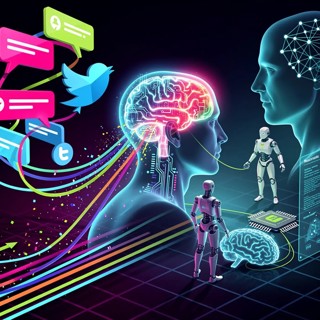

Episode #70: From Twitter to Threads: Escaping the Training Data Mines of Late Capitalism

Episode #70: From Twitter to Threads: Escaping the Training Data Mines of Late Capitalism

In this episode of the podcast, host Stewart Alsop III engages in a wide-ranging conversation with Stewart Alsop II about data training, social media competition between X and Threads, and the broader technological landscape from semiconductors to AI. The discussion covers everything from Taiwan's dominance in chip manufacturing through TSMC, the evolution of supercomputers from Seymour Cray's innovations to modern GPU clusters, and the challenges facing early-stage companies trying to scale specialized technologies like advanced materials for semiconductor manufacturing. The conversation also touches on the complexities of cryptocurrency adoption, the changing nature of work in an increasingly specialized economy, and the implications of AI data centers on power consumption and infrastructure.

Timestamps

00:00 The Rise of Threads and Competition with X

03:01 The Semiconductor Landscape: TSMC vs. Intel

06:03 The Role of Supercomputers in Modern Science

09:00 AI and the Future of Data Centers

11:46 The Evolution of Computing: From Mainframes to Clusters

14:54 The Impact of Moore's Law on Semiconductor Technology

17:52 Heat Management in High-Performance Computing

31:01 Power and Cooling Challenges in AI Data Centers

33:42 Battery Technology and Mass Production Issues

35:33 The Importance of Specialized Jobs in the Economy

38:54 The Evolution of ARM and Its Impact on Microprocessors

42:49 The Shift in Software Development with AI

46:50 Trust and Data Privacy in the Cloud

49:45 The Democratization of Investing and Its Challenges

53:52 The Regulatory Landscape of Cryptocurrency


Key Insights

1. TSMC's foundry dominance stems from strategic focus, not outsourcing. Taiwan Semiconductor Manufacturing Company became the global chip leader by specializing purely in manufacturing chips for other companies, while Intel failed because they couldn't effectively balance making their own chips with serving as a foundry for competitors. This wasn't about unions or cheap labor - it was about TSMC doing foundry work better than anyone else.
2. Scale economics have fundamentally transformed computing infrastructure. The shift from custom supercomputers like Seymour Cray's machines to clusters of networked mass-produced computers represents a broader principle: you can't compete against scale with handcrafted solutions. Today's "supercomputers" are essentially networks of standardized components communicating at extraordinary speeds through fiber optics.
3. AI infrastructure is creating massive resource bottlenecks. Sam Altman has cornered the market on DRAM memory essential for AI data centers, while power consumption and heat dissipation have become national security issues. The networking speed between processors, not the processors themselves, often becomes the limiting factor in these massive AI installations.
4. Trust is breaking down across institutions and platforms. From government competence to platform reliability, trust failures are driving major shifts. Companies like Carta are changing terms of service to use customer data for AI training, while social media platforms like Twitter/X are being used as training data farms, prompting migrations to alternatives like Threads.
5. Personal software development is becoming democratized while enterprise remains complex. Individuals can now build functional software for personal use through AI coding assistance, but scaling to commercial applications still requires traditional expertise in manufacturing, integration, and enterprise sales processes.
6. Cryptocurrency regulation is paradoxically centralizing a decentralized system. Trump's GENIUS Act forces stablecoin issuers to become banks subject to transaction censorship, while major Bitcoin holders like Michael Saylor introduce leverage risks that could trigger broader market instability.
7. User experience remains the critical barrier to technology adoption. Despite decades of development, cryptocurrency interfaces are still incomprehensible to normal users, requiring complex wallet addresses and multi-step processes that prevent mainstream adoption - highlighting how technical sophistication doesn't guarantee usability.

Tämä jakso on lisätty Podme-palveluun avoimen RSS-syötteen kautta eikä se ole Podmen omaa tuotantoa. Siksi jakso saattaa sisältää mainontaa.

Jaksot(110)

Episode #110: Trust, Debt, and Foundation Models: The New Global Competition

Episode #110: Trust, Debt, and Foundation Models: The New Global Competition

In this episode of the Stewart Squared podcast, host Stewart Alsop sits down with his father Stewart Alsop II to explore the rapidly evolving landscape of AI and foundation models, with a particular f...

8 Loka 51min

Episode #109: Are We Building the Dark Fiber of AI?

Episode #109: Are We Building the Dark Fiber of AI?

In this episode of the Stewart Squared podcast, host Stewart Alsop sits down with his son, Stewart Alsop II, to unpack Anthropic's anticipated IPO and the seismic shifts happening in AI right now. The...

1 Loka 1h 4min

Episode #108: Cybersecurity vs. Existential Risk: What Anthropic Won't Tell You in Their IPO

Episode #108: Cybersecurity vs. Existential Risk: What Anthropic Won't Tell You in Their IPO

In this episode of the Stewart Squared podcast, host Stewart Alsop and his father Stewart Alsop II tackle the pressing issue of cybersecurity in AI development, moving beyond what Stewart calls the "a...

24 Syys 1h 2min

Episode #107: $2 Trillion, No Debt: Anthropic's Answer to SpaceX's Risk Factors

Episode #107: $2 Trillion, No Debt: Anthropic's Answer to SpaceX's Risk Factors

In this episode of the Stewart Squared podcast, host Stewart Alsop and guest Stewart Alsop II dig into Anthropic's upcoming IPO and the rapidly shifting AI landscape following the recent releases of O...

17 Syys 1h 10min

Episode #106: The $30 Trillion Question: Inside Anthropic's Audacious IPO Play

Episode #106: The $30 Trillion Question: Inside Anthropic's Audacious IPO Play

In this episode of the Stewart Squared podcast, host Stewart Alsop and guest Stewart Alsop II tackle Anthropic's upcoming IPO and what it means for the broader tech landscape. They compare it to Space...

10 Syys 1h 5min

Episode #105: Beating OpenAI at Their Own Game: Our Case, and the Filing That Settles It

Episode #105: Beating OpenAI at Their Own Game: Our Case, and the Filing That Settles It

In this episode of the Stewart Squared podcast, host Stewart Alsop III and his father Stewart Alsop II dig into the unprecedented AI infrastructure buildout happening across big tech, with Google rais...

3 Syys 1h 1min

Episode #104: 36,000 Companies, One Metric: What DPI Did to Private Equity

Episode #104: 36,000 Companies, One Metric: What DPI Did to Private Equity

In this episode of the Stewart Squared podcast, host Stewart Alsop sits down with his father Stewart Alsop II to unpack how private equity, venture capital, and growth equity have evolved—and possibly...

27 Elo 1h 8min

Episode #103: Scarce to Itself: NVIDIA, Apple, a Driverless Zoox, and the Real Fight Over the Future of Cars

Episode #103: Scarce to Itself: NVIDIA, Apple, a Driverless Zoox, and the Real Fight Over the Future of Cars

In this episode of Stewart Squared, Stewart Alsop III and Stewart Alsop II dig into the fast-moving world of self-driving cars — from Cruise's rocky history and Waymo's expansion to Zoox's driverless ...

20 Elo 1h 1min

Suosittua kategoriassa Liike-elämä ja talous

sijotuskasti
vallattomat
mimmit-sijoittaa
psykopodiaa-podcast
rss-rahapodi
rss-oivalluksia-rahasta-elamasta
rss-rahamania
ostan-asuntoja-podcast
oppimisen-psykologia
rss-startup-ministerio
rss-hereilla
sijoituspodi
rss-karon-grilli
rss-paasipodi
rss-elama-jota-rakastat
rss-porssipodi
rss-kaupan-tila
rss-sopivasti-hyvan-arjen-reseptit
sijoitusovi-podcast
asuntoasiaa-paivakirjat