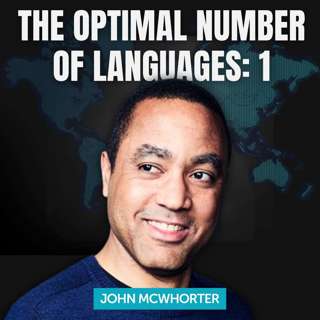

#142 Classic episode – John McWhorter on why the optimal number of languages might be one, and other provocative claims about language

#142 Classic episode – John McWhorter on why the optimal number of languages might be one, and other provocative claims about language

John McWhorter is a linguistics professor at Columbia University specialising in research on creole languages. He's also a content-producing machine, never afraid to give his frank opinion on anything and everything. On top of his academic work, he's written 22 books, produced five online university courses, hosts one and a half podcasts, and now writes a regular New York Times op-ed column.

Rebroadcast: this episode was originally released in December 2022.

YouTube video version: https://youtu.be/MEd7TT_nMJE

Links to learn more, video, and full transcript: https://80k.link/JM

We ask him what we think are the most important things everyone ought to know about linguistics, including:

  • Can you communicate faster in some languages than others, or is there some constraint that prevents that?
  • Does learning a second or third language make you smarter or not?
  • Can a language decay and get worse at communicating what people want to say?
  • If children aren't taught a language, how many generations does it take them to invent a fully fledged one of their own?
  • Did Shakespeare write in a foreign language, and if so, should we translate his plays?
  • How much does language really shape the way we think?
  • Are creoles the best languages in the world — languages that ideally we would all speak?
  • What would be the optimal number of languages globally?
  • Does trying to save dying languages do their speakers a favour, or is it more of an imposition?
  • Should we bother to teach foreign languages in UK and US schools?
  • Is it possible to save the important cultural aspects embedded in a dying language without saving the language itself?
  • Will AI models speak a language of their own in the future, one that humans can't understand but which better serves the tradeoffs AI models need to make?

We’ve also added John’s talk “Why the World Looks the Same in Any Language” to the end of this episode. So stick around after the credits!

Chapters:

  • Rob's intro (00:00:00)
  • Who's John McWhorter? (00:05:02)
  • Does learning another language make you smarter? (00:05:54)
  • Updating Shakespeare (00:07:52)
  • Should we bother teaching foreign languages in school? (00:12:09)
  • Language loss (00:16:05)
  • The optimal number of languages for humanity (00:27:57)
  • Do we reason about the world using language and words? (00:31:22)
  • Can we communicate meaningful information more quickly in some languages? (00:35:04)
  • Creole languages (00:38:48)
  • AI and the future of language (00:50:45)
  • Should we keep ums and ahs in The 80,000 Hours Podcast? (00:59:10)
  • Why the World Looks the Same in Any Language (01:02:07)

Producer: Keiran Harris
Audio mastering: Ben Cordell and Simon Monsour
Video editing: Ryan Kessler and Simon Monsour
Transcriptions: Katy Moore

Jaksot(325)

#20 - Bruce Friedrich on inventing outstanding meat substitutes to end speciesism & factory farming

#20 - Bruce Friedrich on inventing outstanding meat substitutes to end speciesism & factory farming

Before the US Civil War, it was easier for the North to morally oppose slavery. Why? Because unlike the South they weren’t profiting much from its existence. The fight for abolition was partly won bec...

19 Helmi 20181h 18min

#19 - Samantha Pitts-Kiefer on working next to the White House trying to prevent nuclear war

#19 - Samantha Pitts-Kiefer on working next to the White House trying to prevent nuclear war

Rogue elements within a state’s security forces enrich dozens of kilograms of uranium. It’s then assembled into a crude nuclear bomb. The bomb is transported on a civilian aircraft to Washington D.C, ...

14 Helmi 20181h 4min

#18 - Ofir Reich on using data science to end poverty & the spurious action-inaction distinction

#18 - Ofir Reich on using data science to end poverty & the spurious action-inaction distinction

Ofir Reich started out doing math in the military, before spending 8 years in tech startups - but then made a sharp turn to become a data scientist focussed on helping the global poor. At UC Berkeley...

31 Tammi 20181h 18min

#17 - Will MacAskill on moral uncertainty, utilitarianism & how to avoid being a moral monster

#17 - Will MacAskill on moral uncertainty, utilitarianism & how to avoid being a moral monster

Immanuel Kant is a profoundly influential figure in modern philosophy, and was one of the earliest proponents for universal democracy and international cooperation. He also thought that women have no ...

19 Tammi 20181h 52min

#16 - Michelle Hutchinson on global priorities research & shaping the ideas of intellectuals

#16 - Michelle Hutchinson on global priorities research & shaping the ideas of intellectuals

In the 40s and 50s neoliberalism was a fringe movement within economics. But by the 80s it had become a dominant school of thought in public policy, and achieved major policy changes across the Englis...

22 Joulu 201755min

#15 - Phil Tetlock on how chimps beat Berkeley undergrads and when it’s wise to defer to the wise

#15 - Phil Tetlock on how chimps beat Berkeley undergrads and when it’s wise to defer to the wise

Prof Philip Tetlock is a social science legend. Over forty years he has researched whose predictions we can trust, whose we can’t and why - and developed methods that allow all of us to be better at p...

20 Marras 20171h 24min
#14 - Sharon Nunez & Jose Valle on going undercover to expose animal abuse

#14 - Sharon Nunez & Jose Valle on going undercover to expose animal abuse

What if you knew that ducks were being killed with pitchforks? Rabbits dumped alive into containers? Or pigs being strangled with forklifts? Would you be willing to go undercover to expose the crime? ...

13 Marras 20171h 25min

#13 - Claire Walsh on testing which policies work & how to get governments to listen to the results

#13 - Claire Walsh on testing which policies work & how to get governments to listen to the results

In both rich and poor countries, government policy is often based on no evidence at all and many programs don’t work. This has particularly harsh effects on the global poor - in some countries governm...

31 Loka 201752min

Suosittua kategoriassa Koulutus

rss-murhan-anatomia
voi-hyvin-meditaatiot-2
rss-narsisti
adhd-podi
psykopodiaa-podcast
rss-uskonto-on-tylsaa
rss-rahamania
rss-valo-minussa-2
rss-duodecim-lehti
rss-niinku-asia-on
mielipaivakirja
rahapuhetta
aamukahvilla
rss-liian-kuuma-peruna
rss-vapaudu-voimaasi
aloita-meditaatio
kesken
dear-ladies
rss-eron-alkemiaa
rss-arkea-ja-aurinkoa-podcast-espanjasta