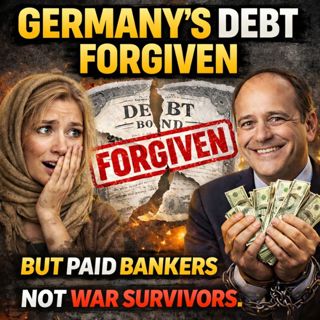

E177: Why Bankers Got Paid and Europe Recovered: The London Debt Agreement Explained
El Podcast9 Tammi

E177: Why Bankers Got Paid and Europe Recovered: The London Debt Agreement Explained

Economic historian Tobias Straumann breaks down how Germany’s debt meltdown in 1931 crashed the global economy—and how a surprisingly generous 1953 debt deal helped spark the German economic miracle by putting growth ahead of punishment.

GUEST BIO: Tobias Straumann (Switzerland) is Professor of Modern & Economic History at the University of Zurich; author of Out of Hitler’s Shadow and 1931: Debt, Crisis, and the Rise of Hitler.

TOPICS DISCUSSED:

  • 1931 as the real inflection point of the Great Depression
  • Treaty of Versailles + reparations politics (why it’s not a straight-line story)
  • Germany’s “double surplus” debt trap (budget + trade surplus) and default dynamics
  • Gold standard breakdown and global contagion
  • London Debt Agreement (1953): what it did and why it mattered
  • WWII reparations vs interwar debts vs private creditors (who got paid)
  • Cold War incentives vs the older “German problem” (balance of power since 1871)
  • 1990 reunification, the 2+4 treaty, and why reparations weren’t reopened
  • Later compensation: Israel/Claims Conference, forced labor, voluntary gestures
  • Poland/Greece reparations claims in modern politics
  • Comparisons: Japan/Italy reparations and postwar strategy
  • Modern debt parallels (domestic vs foreign-currency debt; political will)

MAIN POINTS:

  • 1931 turned a severe recession into a worldwide depression via Germany-centered financial contagion.
  • Versailles mattered, but Allied policy adjustments and domestic politics shaped outcomes more than a simple “Versailles caused WWII” line.
  • Germany’s foreign-currency debt made austerity + transfer demands self-defeating, ending in default and system collapse.
  • The 1953 London Debt Agreement was pivotal: it reduced and restructured interwar debts and made repayment compatible with recovery.
  • West Germany paid little-to-no WWII reparations (effectively deferred), while interwar private creditors recovered significant shares—morally messy but stabilizing.
  • Cold War pressures helped, but Europe’s long-running challenge was integrating a too-strong Germany into a stable order.
  • In 1990, the 2+4 framework avoided reopening WWII reparations to keep reunification politically and economically manageable.
  • Later payments (Israel, Holocaust victims, forced laborers) partially addressed moral claims outside classic state-to-state reparations.

TOP 3 QUOTES:

  • “We think that the year 1931 was the turning point… it turned into a worldwide depression.”
  • “It’s probably the biggest and most important debt settlement of the 20th century.”
  • “It’s morally hard to swallow… but it had the advantage of stabilizing Western Europe economically and politically.”

🎙 The Pod is hosted by Jesse Wright
💬 For guest suggestions, questions, or media inquiries, reach out at https://elpodcast.media/
📬 Never miss an episode – subscribe and follow wherever you get your podcasts.
⭐️ If you enjoyed this episode, please rate and review the show. It helps others find us.

Thanks for listening!

Jaksot(186)

E106: FDR, Joe Kennedy, & Birth of the SEC: Crypto Risks & Election Insights w/ Diana B. Henrique

E106: FDR, Joe Kennedy, & Birth of the SEC: Crypto Risks & Election Insights w/ Diana B. Henrique

Veteran financial journalist and bestselling author Diana B. Henriques joins to discuss the historical parallels between the unregulated crypto markets of today and the chaotic Wall Street of the 1920...

14 Marras 20241h 31min

E105: Recovering After Disaster: The Realities of Homeowners Insurance - w/ Professor Ken Klein

E105: Recovering After Disaster: The Realities of Homeowners Insurance - w/ Professor Ken Klein

Law professor Ken Klein explains why so many Americans are unprotected against natural disasters—and what happens when your home is gone and insurance falls short.Guest Bio: Ken Klein is a law profess...

8 Marras 20241h

E104: Four Best-Selling Authors Favorite Books

E104: Four Best-Selling Authors Favorite Books

Four acclaimed authors join us to share the books that shaped their lives—and the stories they believe everyone should read.📚 Guest Bios:Diana Henriques – Award-winning journalist and author of The W...

3 Marras 20241h 5min

E103: Why We Need Big Families in a Shrinking World: w/ Dr. Catherine Pakaluk

E103: Why We Need Big Families in a Shrinking World: w/ Dr. Catherine Pakaluk

Dr. Catherine Pakaluk, economist and author of Hannah’s Children, discusses why some American women still choose large families, what it means for the future of society, and the deeper meaning of pare...

26 Loka 20241h 4min

E102: Crypto Criminals: The New Age of Money Laundering - w/ Geoff White

E102: Crypto Criminals: The New Age of Money Laundering - w/ Geoff White

Investigative journalist Geoff White explains how modern technology—from crypto to the dark web—has revolutionized money laundering for the world’s most dangerous criminals.Guest bio: Geoff White is a...

19 Loka 202433min

E101: Goodbye Eastern Europe: A Conversation w/ Author Jacob Mikanowski

E101: Goodbye Eastern Europe: A Conversation w/ Author Jacob Mikanowski

Historian and journalist Jacob Mikanowski explores the legacy of communism, post-Soviet transitions, surveillance states, and the uncertain future of Europe.Guest Bio: Jacob Mikanowski is a historian,...

12 Loka 20241h 1min

E100: How the FBI Built a Secret Tech Startup to Snare Criminals: w/ Joseph Co

E100: How the FBI Built a Secret Tech Startup to Snare Criminals: w/ Joseph Co

Investigative journalist Joseph Cox joins to discuss Dark Wire, his explosive new book revealing how the FBI secretly ran a global encrypted phone company to spy on the criminal underworld.Guest Bio: ...

5 Loka 202455min

E99: Tech-Savvy or Tech-Slave? The Extinction of Experience: Author Christine Rosen

E99: Tech-Savvy or Tech-Slave? The Extinction of Experience: Author Christine Rosen

Christine Rosen discusses her book The Extinction of Experience, warning against the societal costs of technological overreach, constant surveillance, and the erosion of human judgment and private lif...

28 Syys 20241h

Suosittua kategoriassa Liike-elämä ja talous

sijotuskasti
mimmit-sijoittaa
psykopodiaa-podcast
rss-rahapodi
rss-rahamania
pomojen-suusta
ostan-asuntoja-podcast
juristipodi
rss-myyntikoulu
rss-seuraava-potilas
rss-lahtijat
rss-draivi
leadcast
sijoitusovi-podcast
asuntoasiaa-paivakirjat
rss-startup-ministerio
rss-sami-miettinen-neuvottelija
rahapuhetta
rss-h-asselmoilanen
rss-turha-edes-yrittaa