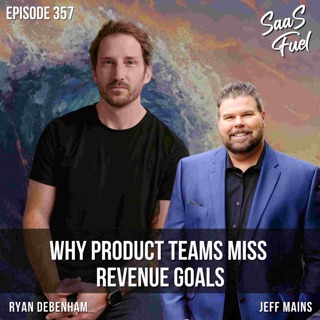
Why Product Teams Miss Revenue Goals | Ryan Debenham | 357
SaaS Fuel27 Tammi

Why Product Teams Miss Revenue Goals | Ryan Debenham | 357

Ryan Debenham, CEO of Grin, shares his unconventional journey from software engineer to leading a nearly billion-dollar creator management platform. In this candid conversation, Ryan reveals how he "accidentally" became a CEO by following challenges rather than titles, and why that mindset shift transformed how he builds products and companies.

He discusses the critical disconnect between engineering and go-to-market teams, the revolutionary potential of AI agents in influencer marketing, and why democratizing influence could unlock a massive untapped market. Ryan also shares insights from his time at Qualtrics (acquired by SAP for $8B) and Route, offering practical wisdom on connecting product teams to revenue outcomes and building AI that feels "alive."

Key Takeaways

[4:30] - The Accidental CEO Path: Ryan explains how becoming a CEO was never his plan—he loved building products but never built companies around them. His career evolved by chasing challenges rather than titles or money.

[10:30] - The Product-to-Company Graveyard: Ryan candidly shares how his early product ideas (including a ride-sharing concept 20 years ago and a photo categorization tool) died because he focused only on building, not on solving the hard business problems.

[12:15] - The Mindset Shift: The biggest change from engineering to CEO? When revenue numbers became Ryan's responsibility, he finally understood what customers truly needed—not just what they said they wanted.

[14:30] - Breaking Down Silos: Ryan discusses why the tension between product, engineering, marketing, and sales "will kill the business" and how he's connecting these departments at the hip.

[19:30] - The Qualtrics Lesson: A powerful story about spending six months building the wrong text analytics product at Qualtrics, despite sitting next to customers repeatedly. The lesson: understanding business needs requires deeper connection than just listening to feature requests.

[26:00] - AI as Electricity: Ryan's compelling analogy comparing LLMs to the development of electricity and CPUs—powerful building blocks that are worthless alone but transformational when paired with the right infrastructure.

[28:30] - Mandatory AI Adoption: Ryan required all engineers at Grin to use AI coding tools. One engineer quit over the pressure but came back, realizing it was a mistake. His prediction: in a few years, you won't get hired as an engineer if you don't know AI tools.

[32:00] - Building Software That's "Alive": Ryan describes Gia, Grin's AI agent that journals daily, runs standups with other agents, creates action items, and can discuss what she's learning and what features should be built next.

[35:00] - The Influencer Marketing Problem: Why Grin's growth stalled—aspirational customers bought the software but failed at influencer marketing because the operational complexity was too high, leading to churn.

[38:30] - The Two-Sided Platform Gap: Most influencer platforms built for merchants and forgot creators. Ryan explains why supporting creators is the most important part of the solution.

[44:30] - Democratizing Influence: Ryan's vision that "everybody is an influencer"—the real opportunity is capturing and rewarding the micro-influence that happens in everyday conversations between millions of people.

[49:00] - The Collision Course: Why affiliate marketing and influencer marketing are merging into something new—it's all about capturing word-of-mouth at different scales.

Tweetable Quotes"Becoming a CEO was not part of my plan. I've always loved building product. What would typically happen is I would build a product and then never build a company for that product." - Ryan Debenham"Don't pick your job based on the title, don't pick your job purely based on the money. Just follow the opportunities that challenge you and ultimately you will wind up in the best place." - Ryan Debenham"Until that dollar—the retention amount or the new dollar—is your responsibility, you will never feel the same urgency to build something correctly that ultimately serves the customer's need." - Ryan Debenham"The tension between product management, marketing, and customer success will kill the business. That tension exists because people responsible for outcomes feel like the team they rely on is not seeing the picture." - Ryan Debenham"I believe we're building a product that's alive. These agents journal every day, run standups, review observations, collaborate, produce plans, and create action items. I can sit down with Gia and ask what she's learning." - Ryan Debenham"LLMs are like electricity or the CPU—by itself worthless, but when provided with the appropriate surrounding infrastructure, it becomes a unit of intelligence that can create highly intelligent software." - Ryan DebenhamSaaS Leadership Lessons1. Chase Challenges, Not Titles

Ryan's career trajectory wasn't planned—he followed opportunities that made him uncomfortable and challenged him to grow. This approach led him from engineering to CEO, gaining diverse experience across product, operations, and go-to-market. The lesson: Career growth comes from embracing discomfort and expanding your skillset, not from chasing specific roles.

2. Revenue Responsibility Changes Everything

The biggest mindset shift from engineering to CEO was owning revenue numbers. When retention and new revenue became Ryan's responsibility, he developed a fundamentally different understanding of customer needs. Lesson: Connect your product and engineering teams to revenue outcomes—even partially—to align their work with business success.

3. Break Down Departmental Silos Aggressively

Ryan requires engineers to attend customer meetings, sit with product marketing, and discuss go-to-market strategy. At Grin, marketing and engineering are "connected at the hip." The lesson: Organizational silos create tension and misalignment. The more your teams understand the complete customer journey and business needs, the better they'll build.

4. Build for Business Outcomes, Not Feature Requests

Ryan's six-month mistake at Qualtrics taught him that listening to customers isn't enough—you must dig deeper to understand what will drive business results. The lesson: Product teams should understand not just what customers ask for, but whether building it will drive the ultimate business outcome you need.

5. AI Adoption Should Be Non-Negotiable

Ryan made AI coding tools mandatory at Grin, comparing it to the shift from assembly language to modern programming languages. His prediction: engineers who don't use AI will become unemployable. The lesson: Treat AI as a foundational skill shift, not an optional enhancement. Leaders should require adoption and provide support for the transition.

6. Solve the Hard Problem, Not Just the Interesting One

Ryan's early products failed because he focused on what was interesting to build rather than solving the complete business problem (like Uber had to solve regulatory and operational challenges, not just build an app). At Grin, the hard problem isn't software—it's making influencer marketing operationally viable for average brands. The lesson: Identify the complete problem space, including the unsexy operational challenges, and solve those to build a sustainable business.

Guest Resources

ryan.debenham@grin.co

grin.ai

https://www.linkedin.com/in/ryandebenham

Episode Sponsor

The Captain's Keys

Small Fish, Big Pond – https://smallfishbigpond.com/ Use the promo code ‘SaaSFuel’

Champion Leadership Group – https://championleadership.com/

SaaS Fuel Resources

Website - https://championleadership.com/

Jeff Mains on LinkedIn - https://www.linkedin.com/in/jeffkmains/

Twitter - https://twitter.com/jeffkmains

Facebook - https://www.facebook.com/thesaasguy/

Instagram - https://instagram.com/jeffkmains

Jaksot(385)

Overcoming Fear in Sales and Entrepreneurship: How to Build Confidence and Take Action | Jim Effner | 384

Overcoming Fear in Sales and Entrepreneurship: How to Build Confidence and Take Action | Jim Effner | 384

Jeff Mains sits down with Jim Effner, founder of P2P Group and a 36-year veteran of Northwestern Mutual, where he grew a firm from 63 to 127 financial advisors and nearly 400 total staff before sellin...

30 Huhti 44min

The Future of Legacy: How AI Can Preserve Your Story Forever | Brian Will | 383

The Future of Legacy: How AI Can Preserve Your Story Forever | Brian Will | 383

Brian Will — Wall Street Journal bestselling author, serial entrepreneur, and founder/CEO of Living Forever AI — joins host Jeff Mains for a wide-ranging conversation on entrepreneurship, scaling, sal...

28 Huhti 43min

How to Use AI Effectively: Smarter Ways to Work and Scale Your Business | Steve Wunker | 382

How to Use AI Effectively: Smarter Ways to Work and Scale Your Business | Steve Wunker | 382

What if AI isn't just a tool to plug into your business — but a reason to redesign the entire thing? In this episode, Jeff Mains sits down with Steven Wunker, managing director of New Markets Advisors...

23 Huhti 48min

New Competitive Moats in AI: Why Trust and Relationships Matter More Than Ever | Nikki Barua | 381

New Competitive Moats in AI: Why Trust and Relationships Matter More Than Ever | Nikki Barua | 381

Nikki Barua — immigrant, serial entrepreneur, and CEO of Flip Work — joins Jeff Mains for a conversation on what it truly takes to build something outsized in the AI age. Drawing on two decades of exp...

21 Huhti 45min

Ship, Learn, Repeat: The Real Growth Strategy for Startup Founders | Mike Collins | 380

Ship, Learn, Repeat: The Real Growth Strategy for Startup Founders | Mike Collins | 380

Mike Collins is a serial entrepreneur turned venture capitalist who has spent his career at the intersection of technology, innovation, and investing. Starting at a VC firm right out of college in 198...

16 Huhti 52min

How to Turn Customers into Brand Advocates and Drive Word-of-Mouth Growth | Ken Rapp | 379

How to Turn Customers into Brand Advocates and Drive Word-of-Mouth Growth | Ken Rapp | 379

Most SaaS founders obsess over acquisition — but what happens after the sale is where loyalty is either built or silently lost. In this episode, Jeff Mains sits down with Ken Rapp, CEO and co-founder ...

14 Huhti 46min

How Tech Professionals Can Avoid Concentration Risk and Build Financial Freedom | Stanley Leong | 378

How Tech Professionals Can Avoid Concentration Risk and Build Financial Freedom | Stanley Leong | 378

In this episode, Jeff Mains sits down with Stanley Leong — former IBM/Agilent engineer turned bestselling author and private wealth advisor — to explore what it truly means to engineer your finances. ...

9 Huhti 45min

AI and Emotional Intelligence: Finding the Balance in Modern Research | James Warren | 377

AI and Emotional Intelligence: Finding the Balance in Modern Research | James Warren | 377

What if the most valuable data in your company isn't in a dashboard — it's buried in stories no one is asking for?In this episode, Jeff Mains sits down with James Warren, founder and CEO of Share More...

7 Huhti 52min

Suosittua kategoriassa Liike-elämä ja talous

sijotuskasti
mimmit-sijoittaa
rss-rahapodi
psykopodiaa-podcast
hyva-paha-johtaminen
rss-oivalluksia-rahasta-elamasta
rss-rahamania
inderespodi
rss-lahtijat
ostan-asuntoja-podcast
rahapuhetta
oppimisen-psykologia
lakicast
rss-bisnesta-bebeja
rss-sisalto-kuntoon
rss-inderes
leadcast
mihin-sita-saastais
rss-rikasta-elamaa
rss-40-ajatusta-aanesta