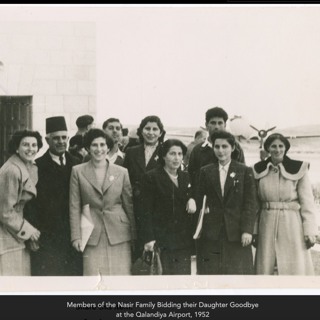
Nakba #56 - Samia Nasir Khury
Överlevarna1 Helmi

Nakba #56 - Samia Nasir Khury

“My father worked as a governor for the British government, and the rest of the family followed him. He was later transferred to Safad. There we had good relations with our Jewish neighbors. That was normal. Women exchanged baked goods with one another during different holidays and celebrations. In 1946 it finally became clear to him what the British were doing—that they were preparing the way for the Jews to take over. His job became impossible, and he decided to resign. He went to the King David Hotel to submit his letter of resignation. As he stepped over the threshold of the hotel, he looked at his watch and realized he was early. He decided to visit a friend in Mamilla in the meantime. Shortly after he left the hotel, it was blown to pieces. The man my father was going to visit was not as lucky. He had gone to the hotel and was killed by the bomb. This was in 1946. Irgun was responsible for the attack, but the various Zionist organizations constantly blamed one another. This was only the beginning. Then came the bombing of the Semiramis Hotel and the massacre in Dayr Yasin. That was when people began to feel real fear. After my father resigned, he began teaching physics. We remained in al-Quds. I was a happy teenager. I went to parties, and my aunts and cousins lived there. It was a wonderful time. We used to go to the YMCA, where we were members. They had leadership courses, tennis courts, a gym, and a swimming pool. It was a fantastic place. In 1948, the family moved to Birzeit, where my father taught and where I attended a boarding school—it felt like my second home. Suddenly, rumors spread that something was wrong. People began pouring in from al-Ramla and Lydda. They were fleeing and had been walking for two or three days. I will never forget that sight. Everything was so sad; people were utterly exhausted. Someone told us they had lost a son. One man was confused and rambling; he did not understand what was happening. I especially remember a woman who had lost all her belongings. Despite that, she was grateful to have survived. She said: “Furniture can be replaced, but not people.” My aunt told my cousins and me to cook food for the refugees. We boiled eggs and potatoes, sliced tomatoes and cucumbers—everything we could get hold of. My aunt also helped prepare a school building where some of the refugees could find shelter. My aunts and cousins had come to Birzeit to escape the unrest in al-Quds. Everyone believed this would be over in a few weeks, and that we would be able to return. But in October, we began to understand that this was no picnic. After the war in 1967, East al-Quds was annexed by Jordan. It then became possible again for my mother and me to visit our house. The house had become a daycare center, so it was easy to enter. My mother began explaining to a woman sitting in the office that it had once been her bedroom. It was painful to see our house again. I had hoped, for as long as possible, that we would be allowed to return. We never went back again. The Nakba is still ongoing; the displacement is still ongoing. Everything here is so hard to predict under the Israeli occupation. When you get up in the morning and put your right foot down, you do not know whether your left foot will follow. In 1993, during the first intifada, my son produced a song and made cassette copies of it. He was arrested by the police and taken for interrogation at Moscobiyeh in al-Quds. He was accused of spreading music that glorified the intifada. He was imprisoned for six months. First he was held in Ayalon prison in al-Ramla. He went through hell there. We were allowed to visit him, but I was not allowed to touch him. He sat behind a net. Later he was transferred to Prison Six, outside Atlit. The time in prison made my son more enthusiastic and determined than before. He continues to make music.

Tämä jakso on lisätty Podme-palveluun avoimen RSS-syötteen kautta eikä se ole Podmen omaa tuotantoa. Siksi jakso saattaa sisältää mainontaa.

Jaksot(323)

Överlevarna #35: Egon Brill

Överlevarna #35: Egon Brill

Du som inte tror på gud, vad tror du på? - Jag försöker tro på andra människor, trots allt, säger Egon Brill. Foto: Cato Lein. Inspelat den 13 nov 2017.

18 Touko 20181h 51min

Överlevarna #34: Adèle Schreiber

Överlevarna #34: Adèle Schreiber

- I juni 1944 blev vi deporterade från gettot i Satu Mare till Auschwitz. Jag skildes från mina föräldrar och blev inkastad i en vagn. Mitt enda sällskap var min älsklingsbok, Alice i Underlandet, säg...

12 Touko 20181h 10min

Överlevarna #33: Alexander Rothman

Överlevarna #33: Alexander Rothman

- Hur vill du uttala ditt efternamn, Rothman, med ”o” eller ”å”? - Rothman med ”o”, eftersom vi befinner oss i Sverige. - Inte tyskt uttal? - Jag avskyr ”Råtman”, för att det har en tysk anstrykning. ...

4 Touko 20181h 7min

Överlevarna #32: Walter Frankenstein

Överlevarna #32: Walter Frankenstein

- 1942 jobbade vi åt Gestapo, men våra löner betalades av judiska församlingen. Jag blev kommenderad att laga putsen i Adolf Eichmanns kontor på Kurfuerstenstrasse i Berlin. Eichmann satt bakom sitt s...

27 Huhti 20182h 25min

Överlevarna #31: Dora Bodlander

Överlevarna #31: Dora Bodlander

- När jag lämnade baracken sa en flicka: "Dora håll min hand. Jag känner att jag ska dö" Jag blev rädd och drog tillbaka min hand. När jag kom tillbaka in i baracken var hon död. Och än i dag har jag ...

21 Huhti 201855min

Överlevarna #30: Lili Jodelsohn

Överlevarna #30: Lili Jodelsohn

- Min mamma, två av mina systrar, min bror, mormor och moster åkte till gasen med samma. Det sista jag hörde min nioåriga bror Jakob säga var: "Jag vill inte dö." Foto: Cato Lein Inspelat den 25 okt...

13 Huhti 20181h 22min

Överlevarna #29: Zsuzsanna Reisch

Överlevarna #29: Zsuzsanna Reisch

- Min moster kom tillbaka från Bergen-Belsen. Hon hade överlevt, men hon var ganska förstörd och hennes huvud var också förstört. Hon fick ett svårt liv, hon blev en labil person i hela sitt liv, säge...

6 Huhti 20181h 16min

Överlevarna #28: Cyla Trus

Överlevarna #28: Cyla Trus

- Hur har du burit dig åt för att behålla din livsglädje, trots dina svåra erfarenheter? - Vad kan man göra? Man kan väl inte ta livet av sig? säger Cyla Trus Foto: Cato Lein

30 Maalis 201836min

Suosittua kategoriassa Koulutus

rss-murhan-anatomia
psykopodiaa-podcast
voi-hyvin-meditaatiot-2
adhd-podi
rss-rahamania
rss-liian-kuuma-peruna
rahapuhetta
kesken
rss-valo-minussa-2
rss-narsisti
rss-luonnollinen-synnytys-podcast
rss-tietoinen-yhteys-podcast-2
rss-vapaudu-voimaasi
rss-niinku-asia-on
filocast-filosofian-perusteet
psykologia
ihminen-tavattavissa-tommy-hellsten-instituutti
rss-duodecim-lehti
aamukahvilla
rss-elamankoulu