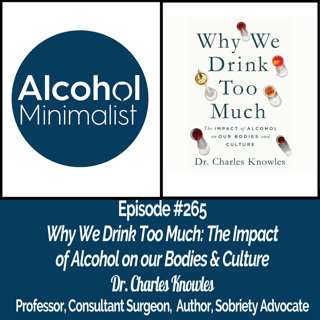
Why We Drink Too Much: The Impact  of Alcohol on our Bodies & Culture with Dr. Charles Knowles

Why We Drink Too Much: The Impact of Alcohol on our Bodies & Culture with Dr. Charles Knowles

In this episode of the Alcohol Minimalist Podcast, Molly sits down with Dr. Charles Knowles, professor of surgery at Queen Mary University of London and author of Why We Drink Too Much.

This is a deep, science-forward conversation about why humans drink alcohol, why some people lose control while others don’t, and how culture, biology, psychology, and learning all intersect in our relationship with alcohol.

Dr. Knowles shares his personal journey through alcohol dependence, recovery, and ultimately peace—alongside the neuroscience, history, and behavioral science that explain why alcohol can quietly shift from pleasure to reliance.

If you’ve ever wondered “Why me?”, questioned your own drinking without fitting neatly into a label, or felt stuck in the gray area between “fine” and “not fine,” this conversation offers clarity, compassion, and perspective.

What You’ll Learn in This Episode

  • Why problematic drinking is not a moral failure or lack of willpower
  • The difference between reward drinking and relief drinking—and why that shift matters
  • Why consumption alone is a poor measure of alcohol’s impact
  • The Three C’s of Drinking: Consumption, Consequences, and Control
  • What “alcohol reliance” means—and why so many people live in this gray area
  • Why sobriety, abstinence, and neutrality are not the same thing
  • How emotional sobriety and peace are built after (or alongside) behavior change
  • Why understanding the brain can help some people change—and why action still matters
  • The role of culture, normalization, and storytelling in how we relate to alcohol
  • Why a period of alcohol-free time can be valuable, regardless of long-term goals

Key Concepts Discussed

  • Alcohol as a learned behavior, not a character flaw
  • Psychological dependence vs. physical dependence
  • Cognitive dissonance in gray-area drinking
  • Neuroplasticity and habit reinforcement
  • Emotional sobriety as a state of mind, not a rule set
  • Identity, agency, and discovering who you are without alcohol driving the story

Notable Quote

“Peace is an incredibly important thing—and it’s not until you find it that you realize you never had it.”

About the Guest

Dr. Charles Knowles is a professor of surgery at Queen Mary University of London, a consultant colorectal surgeon, and the author of over 300 peer-reviewed scientific publications. Why We Drink Too Much is his first popular science book, combining rigorous research with lived experience to challenge how we think about alcohol, addiction, and recovery.


Recommended Resource

Final Takeaway

Changing your relationship with alcohol isn’t about labels, perfection, or deprivation. It’s about understanding what’s driving your behavior, questioning old narratives, and creating enough space to build peace—mentally, emotionally, and physically.

This episode is an invitation to look at alcohol with curiosity instead of judgment—and to remember that meaningful change is always possible.

Low risk drinking guidelines from the NIAAA:

Healthy men under 65:

No more than 4 drinks in one day and no more than 14 drinks per week.

Healthy women (all ages) and healthy men 65 and older:
No more than 3 drinks in one day and no more than 7 drinks per week.

One drink is defined as 12 ounces of beer, 5 ounces of wine, or 1.5 ounces of 80-proof liquor. So remember that a mixed drink or full glass of wine are probably more than one drink.

Abstinence from alcohol
Abstinence from alcohol is the best choice for people who take medication(s) that interact with alcohol, have health conditions that could be exacerbated by alcohol (e.g. liver disease), are pregnant or may become pregnant or have had a problem with alcohol or another substance in the past.

Benefits of “low-risk” drinking
Following these guidelines reduces the risk of health problems such as cancer, liver disease, reduced immunity, ulcers, sleep problems, complications of existing conditions, and more. It also reduces the risk of depression, social problems, and difficulties at school or work.


★ Support this podcast ★

Tämä jakso on lisätty Podme-palveluun avoimen RSS-syötteen kautta eikä se ole Podmen omaa tuotantoa. Siksi jakso saattaa sisältää mainontaa.

Jaksot(400)

Think Thursday: Why We Defend Decisions No Longer Fit

Think Thursday: Why We Defend Decisions No Longer Fit

Why can it be so hard to change your mind—even when new information suggests an old decision no longer works?In this Think Thursday episode, Molly explores cognitive dissonance and choice-supportive b...

13 Elo 12min

Summer's Greatest Hits:Your Relationship with Alcohol-Awareness & Challenges: Society & Industry

Summer's Greatest Hits:Your Relationship with Alcohol-Awareness & Challenges: Society & Industry

This week on the Alcohol Minimalist Podcast, Molly continues the Summer’s Greatest Hits series by revisiting one of the earliest episodes of the show.Last week focused on the science behind alcohol an...

10 Elo 20min

Think Thursday: The Effort Paradox

Think Thursday: The Effort Paradox

When does persistence help us grow—and when does it keep us stuck?In this Think Thursday episode, Molly explores the effort paradox, effort justification, and the sunk-cost effect. We often value some...

6 Elo 13min

Summer's Greatest Hits: Your Relationship with Alcohol-Awareness & Challenges: Science

Summer's Greatest Hits: Your Relationship with Alcohol-Awareness & Challenges: Science

For the Alcohol Minimalist Summer’s Greatest Hits series, Molly revisits the most downloaded episode in the podcast’s catalog.In this episode, she explores one of the biggest challenges to changing yo...

3 Elo 31min

Think Thursday: Why Endings Matter More Than We Realize

Think Thursday: Why Endings Matter More Than We Realize

Why can the final moments of an experience shape how we remember the whole thing?In this Think Thursday episode, Molly explores the peak-end rule—the brain’s tendency to remember an experience largely...

30 Heinä 12min

Your Evening Brain: Work With It - Not Against It

Your Evening Brain: Work With It - Not Against It

Why does the commitment you make over your morning coffee sometimes feel so much harder to keep after dinner?In this episode, Molly explores the neuroscience behind what she calls your Evening Brain—t...

27 Heinä 14min

Think Thursday: A Love Letter to Your Beautiful Brilliant Human Brain for World Brain Day

Think Thursday: A Love Letter to Your Beautiful Brilliant Human Brain for World Brain Day

In honor of World Brain Day on July 22, this Think Thursday episode celebrates the extraordinary organ behind every thought, memory, feeling, and behavior.Molly explores how the brain functions as:A p...

23 Heinä 14min

Revisiting: Drinking Alone & Drinking Secrecy-Why It's Important to Change

Revisiting: Drinking Alone & Drinking Secrecy-Why It's Important to Change

This week, Molly is revisiting an important episode about drinking alone, drinking secrecy, and what these behaviors may reveal about your relationship with alcohol.Drinking alone does not automatical...

20 Heinä 25min

Suosittua kategoriassa Koulutus

rss-murhan-anatomia
psykopodiaa-podcast
voi-hyvin-meditaatiot-2
rss-vapaudu-voimaasi
kesken
rss-arkea-ja-aurinkoa-podcast-espanjasta
rss-niinku-asia-on
adhd-podi
rahapuhetta
rss-liian-kuuma-peruna
rss-suomen-aa-podcast
jari-sarasvuo-podcast
ilona-rauhala
rss-luonnollinen-synnytys-podcast
aamukahvilla
ihminen-tavattavissa-tommy-hellsten-instituutti
rss-naistalk
rss-nyt-puhutaan-ulosotosta
solu-ja-molekyylibiologian-perusteet
psykologia