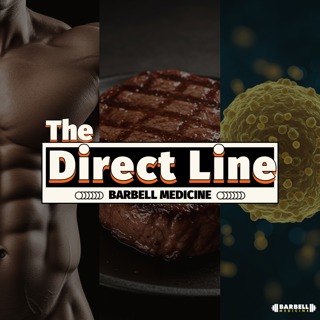
Episode #388: Muscle Imbalances, Red Meat Risk, and the Science of Body Fat Set Points

Episode #388: Muscle Imbalances, Red Meat Risk, and the Science of Body Fat Set Points

In this special preview of the Barbell Medicine Plus Direct Line, Dr. Jordan Feigenbaum and Dr. Austin Baraki move past the fitness basics to tackle high-level technical nuances. We dive into the persistent myth of "muscle imbalances" and why your asymmetry might actually be a functional feature of your training.

We also address the "meat" of the cardiovascular debate: is red meat and saturated fat consumption still risky if you are highly active and have a high-fiber diet? Finally, we explore the Dual Intervention Point Model to explain why the body defends its energy stores and how our environment has shifted the biological "set point" for body fat.

Timestamps
  • 00:00 – Barbell Medicine Plus: Special Annual Membership Promotion
  • 01:03 – Muscle Imbalances: A Reliable Predictor of Pain?
  • 03:59 – Acuted vs. Gradually Acquired Asymmetries
  • 08:55 – How Coaches Should Manage "Alignment" Beliefs
  • 11:54 – Is Red Meat Necessary to Limit if You Are Otherwise Healthy?
  • 15:36 – The Role of Substitution: Plant vs. Animal Protein
  • 19:50 – Analyzing the Lean Mass Hyper-Responder (LMHR) Phenotype
  • 26:20 – The Dual Intervention Point Model of Body Fatness
  • 30:26 – Lipostat, Gravistat, and the Regulation of Energy Stores


Next Steps


Key Takeaways
  • Asymmetry as a Feature: Human bodies are not naturally symmetrical. In many athletes—such as tennis players, pitchers, or rowers—asymmetry is a functional adaptation to the sport's demands.
  • The Pathological vs. The Normal: Acutely acquired asymmetries (post-surgery or trauma) require specific clinical attention. Long-standing or gradually acquired asymmetries are rarely the primary driver of pain.
  • Saturated Fat & The Healthy User Bias: While fit individuals have a lower overall risk profile, elevated LDL and ApoB particles represent a "time-volume" exposure risk that should not be ignored based solely on lifestyle.
  • The Lean Mass Hyper-Responder (LMHR): We analyze the bold claims surrounding the LMHR phenotype and discuss why mechanistic hypothesizing currently lacks the "hard human outcome receipts" to prove long-term safety.
  • Body Fat Regulation: The Dual Intervention Point Model suggests the body defends a lower boundary (starvation) and an upper boundary (predation). In the modern environment, the "predation pressure" has vanished, leading to a genetic drift upward in body fat set points.


Our Sponsors:
* Check out FIGS and use my code FIGSRX for a great deal: https://wearfigs.com
* Check out Factor: https://factormeals.com/bbm50off
* Check out Quince: https://quince.com/BBM


Support this podcast at — https://redcircle.com/barbell-medicine-podcast/donations

Advertising Inquiries: https://redcircle.com/brands

Privacy & Opt-Out: https://redcircle.com/privacy

Jaksot(421)

Suosittua kategoriassa Terveys ja hyvinvointi

unicast
rss-hanna-tikander
tiedenaiset-podcast
rss-pitaisko-erota
psykopodiaa-podcast
voi-hyvin-meditaatiot-2
puhu-muru
rss-narsisti
vakeva-elama-viisaampi-mieli-vahvempi-keho
meditaatiot-suomeksi
rss-pt-paahtio
rss-en-saa-unta
junnut-pelissa
rss-vapaudu-voimaasi
rss-kyykkya-ja-kuoharia
katilon-kahvitunti
terapiassa
docemilia
rss-uplevel-by-sonja-hannus
rss-kuumilla-aalloilla