
What Happens in the Brain When We Improvise

What Happens in the Brain When We Improvise

Explore the neuroscience behind musical improvisation—and what it reveals about our natural capacity for creativity.

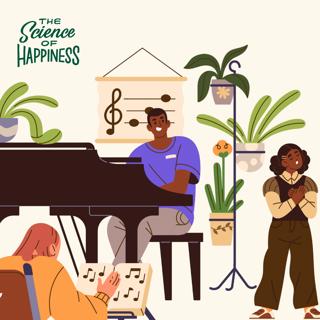
Summary: Creativity may be more natural than we think. Research on musicians and children improvising at the piano suggests that improvisation can quiet the brain’s inner critic while engaging networks linked to exploration, play, and reward. In this episode of The Science of Happiness, we look at the neuroscience of improvisation—and what a “beginner’s mind” can teach us about opening up creativity in everyday life.

How To Do This Practice:

  1. Choose a simple starting point: Begin with something familiar—a simple melody, rhythm, phrase, movement, or creative prompt. It could be notes on a keyboard, a beat you tap on the table, a few lines of writing, or even a movement with your body.
  2. Change one small thing: Experiment by altering a single element, like the speed, mood, rhythm, or key. Small changes help spark creativity without feeling overwhelming.
  3. Let go of judgment: Remind yourself there are no mistakes in improvisation, only possibilities. If something sounds unexpected, treat it as part of the exploration rather than something to fix.
  4. Follow your curiosity: Notice what sounds, patterns, or ideas interest you and build on them. Let each moment guide the next instead of planning too far ahead.
  5. Treat it like play: Approach improvisation with a playful mindset, the way kids experiment and explore. The goal isn’t perfection—it’s discovery and enjoyment.
  6. Reflect on how it felt: Afterward, take a moment to notice how the experience affected your mood or mindset. Many people find that improvising helps them feel more relaxed, creative, and open.

Scroll down for a transcription of this episode.

Today’s Guests:

DR. KAREN CHAN BARRETT is an Assistant Professor with a joint appointment in the Institute for Health & Aging at the UCSF School of Nursing.

Learn more about Dr. Karen Chan Barrett here: https://karenchanbarrett.com/

Related The Science of Happiness episodes:

The Science of Singing Along: https://tinyurl.com/4nbb3v76

The Science of Humming: https://tinyurl.com/4esyy6nd

How Music Can Hold and Heal Us: https://tinyurl.com/49svzn4v

Related Happiness Breaks:

Music to Inspire Kindness in Kids: https://tinyurl.com/yjk344rd

A Humming Technique to Calm Your Nerves: https://tinyurl.com/mr42rzad

A Walking Meditation: https://tinyurl.com/mwbsen7a

Tell us about your experience with this practice. Email us at happinesspod@berkeley.edu or follow on Instagram @HappinessPod.

Help us share The Science of Happiness! Leave us a 5-star review on Apple Podcasts and share this link with someone who might like the show: https://tinyurl.com/2p9h5aap

Transcription: https://tinyurl.com/hux7v5ma

Tämä jakso on lisätty Podme-palveluun avoimen RSS-syötteen kautta eikä se ole Podmen omaa tuotantoa. Siksi jakso saattaa sisältää mainontaa.

Jaksot(348)

Where To Look For Joy

Where To Look For Joy

How can we feel more moments of joy? Explore how joy is rooted in connection, gratitude, and paying attention to the people and moments that bring meaning to our lives.Summary: Did you know that joy i...

13 Elo 15min

Happiness Break: A Body Scan for Calm and Ease

Happiness Break: A Body Scan for Calm and Ease

Meditation teacher Spring Washam guides us in a practice of embodied awareness, helping us use the body as an anchor during stressful or overwhelming moments.How To Do This Practice: Find a comfortab...

6 Elo 10min

Ear Hustle Podcast: Corny-Ass Episode

Ear Hustle Podcast: Corny-Ass Episode

Scroll down for a transcription of this episode.Nigel says no matter where you are, everyone has a story to tell about a hug: good, bad, or awkward. Earlonne isn’t buying it. Ear Hustle is a proud mem...

5 Elo 43min

Why You Can’t Do It Alone

Why You Can’t Do It Alone

Can anyone truly succeed alone? We explore how role models, mentors, and strong social support make upward mobility far more possible than grit alone.Summary: What role do the people around us play in...

30 Heinä 20min

Happiness Break: Holding Truth With Compassion

Happiness Break: Holding Truth With Compassion

Take a moment to connect with your body and make space for difficult emotions with compassion and care. This embodiment practice is guided by Lyla June Johnston, a Diné musician, scholar of Indigenous...

23 Heinä 10min

Why Revenge Feels So Good—and Why It Hurts Us

Why Revenge Feels So Good—and Why It Hurts Us

Neuroscience reveals revenge can become a powerful habit—and that forgiveness may be one of the most effective ways to break the cycle.Summary: After years of bullying led him to almost committing an ...

16 Heinä 23min

Happiness Break: A Meditation to Move Through Anger

Happiness Break: A Meditation to Move Through Anger

Try a practice in accepting difficult feelings like anger or irritation to help keep your cool, feel better overall, and find calm with contemplative social scientist Eve Ekman. How To Do This Practic...

9 Heinä 7min

How Joy Helps Save the Planet

How Joy Helps Save the Planet

Choosing joy over guilt and shame can make climate-friendly habits easier to sustain while improving your own well-being along the way.Summary: Fear may grab our attention, but research suggests joy i...

2 Heinä 22min

Suosittua kategoriassa Tiede

rss-poliisin-mieli
tiedekulma-podcast
rss-mita-tulisi-tietaa
rss-tiedetta-vai-tarinaa
utelias-mieli
rss-tervetta-skeptisyytta
rss-ammamafia
rss-duodecim-lehti
rss-ylistys-elaimille
rss-kasvikutsut
rss-radplus
rss-luontopodi-samuel-glassar-tutkii-luonnon-ihmeita
rss-ranskaa-raakana
hippokrateen-vastaanotolla
mielipaivakirja
rss-bios-podcast
filocast-filosofian-perusteet
rss-astetta-parempi-elama-podcast