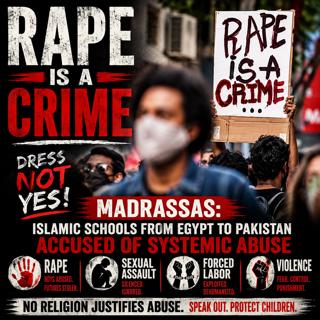

Madrassas: Islamic schools from Egypt to Pakistan accused of systemic abuse -rape, sexual assault, forced labor, and violence against boys.

Madrassas: Islamic schools from Egypt to Pakistan accused of systemic abuse -rape, sexual assault, forced labor, and violence against boys.

"They call it discipline. They call it education. But when children are trapped in closed systems without oversight, and abuse is repeated, hidden, and unpunished—what you're looking at isn't failure. It's a system that learned how to protect itself, not the boys inside it."

Clips:: What Is A Madrasa In Islamic Education? - Islamic Knowledge Network

Global Journalist: Islamic schools grapple with abuse scandals

Melania: The Ultimate First Lady

The Royal Scam - YouTube

Demonic Doorways and Signs or Symptoms of Demonization/Demonic Oppression – Jesus Truth Deliverance

Hinduism Is Of The Devil

Why are we silent about the sexual abuse at madrassas?

Rapes in madrasas: Breaking the silence

2,960 children sexually abused in 2020: report

Obscenity leads to rapes | PM Imran Khan | Pakistan

AP: Sexual abuse rampant at Pakistan's Islamic schools - CBS News

Madrassa Sex Abuse Case Shocks Pakistan – The Diplomat

Madrassas allegedly 'infested' with sexual abuse of minors

Do you have a psychopath in your life? The best way to find out is read my book. BOOK *FREE* Download – Psychopath In Your Life4

Support is Appreciated: Support the Show – Psychopath In Your Life

Tune in: Podcast Links – Psychopath In Your Life

My old discussion forum with last 10 years of victim stories, is back online. Psychopath Victim Support Community | Forums powered by UBB.threads™

Google Maps My HOME Address: 309 E. Klug Avenue, Norfolk, NE 68701 SMART Meters & Timelines – Psychopath In Your Life

Afghanistan paedophile ring may be responsible for abuse of over 500 boys

Social workers claim teachers and local officials are implicated, and believe thousands more children may have been targeted

A paedophile ring involved in the abuse of at least 546 boys from six schools has been discovered in Afghanistan's Logar province.

Some of the victims of the abuse have since been murdered according to the campaigners who first discovered videos of abuse posted to a Facebook page.

Five families killed their sons after their faces were seen on videos posted to social media. Two other boys – a 13 and 15 year old – were killed last week, although the perpetrators are unknown.

Civil society organisation, The Logar Youth, Social and Civil Institution, which has been working in the region for 16 years, revealed the extent of the abuse after discovering more than 100 videos on the social media site.

The institution is investigating other high schools in the region, believing thousands more children may have been abused.

Mohammed Mussa, a lead social worker at the institution, alleges that teachers, headteachers and local authority officials are implicated in the abuse ring.

"The boys we have spoken to are between the ages of 14 to 20 and the cases were reported in relatively secure areas. That's one of the reasons why we think that the numbers could peak significantly," he said. "Perpetrators might coordinate because they understand that if legal action is taken against them, they work as a group rather than an isolated incident."

One school boy, Tamim*, 17, from Logar province, said that he recorded his headteacher's demands on his phone last year.

"He told me that he loved me and wanted to have sex with me," Tamim said. His parents hadn't believed him until they heard the recording.

Students said the headteacher had built a private room in the school's library, where he molested male students after school and on weekends.

Tamim said the headteacher has been fired from his post, but is understood to now hold a position in the Ministry of Education.

A Ministry of Education spokesperson Nooria Nazhat said: "If there is a complaint about our staff, the judicial authorities are responsible to investigate it. If a teacher behaves inappropriately, the teacher is punished according to the law … Detecting crime and investigating it is not the task of the Ministry of Education. We have 220,000 teachers – we can't check on all of their lives."

Another student, Daud*, 18, who used to attend a different high school, said one of his teachers would fail him in class and then demand sexual services in return for a passing grade.

So far, 66 cases of abuse have been identified at his school.

"My teacher said, 'you don't need to study, I will pass you anyway'," Daud told the Guardian. "Often, students from poor families were singled out because they were vulnerable," he said.

According to Mussa, some of the teachers were reported to the police but were released shortly after and have not been charged.

"The rapists are teachers, older students, authority figures and even extended family members," he said. He and his team have received death threats since exposing the abuse.

He added that many of the abused boys have also been threatened. "Many of the victims are blackmailed. They are forced to sell drugs or engage in illegal activities in exchange for their rape videos to not be released," Mussa said.

"Impunity, toxic gender norms and poverty of victims play a big role in the silencing of these crimes. These boys come from the most marginalised sections of society, they don't have a voice and very few speak up on their behalf," said Charu Hogg, executive director of the All Survivors Project, an organisation working with male victims of sexual violence in Afghanistan where, she said, sexual abuse was massively underreported.

Patricia Gossman, associate Asia director at Human Rights Watch, added: "There is impunity for child rape because very often the perpetrators are powerful men in the military, police, or other official institutions. Even though the practice has been criminalised, the law too often goes unenforced."

Children often fear speaking out about sexual abuse for fear of ruining their family's 'honour'. Photograph: Stefanie Glinski

Male sexual abuse is widespread in Afghanistan. Psychologist Lyla Schwartz, who runs mental health initiative Peace of Mind Afghanistan, said victims rarely report what happens as any attention or subsequent trial can ruin the family's "honour".

"Oftentimes, families blame the receivers of sexual violence instead of the perpetrators, not believing that respected authority figures would engage in such behaviour. That's part of the reason there has been not a single prosecution for male rape this year – and few, if any even – in previous ones."

Schwartz has now started counselling several of the boys.

"If the children aren't being helped to deal with the traumatic experience, it can exasperate into violence, mental health disorders, PTSD or even perpetration of sexual abuse. The students are so vulnerable and they will put the blame on themselves and feel shame, even though they didn't do anything wrong," she explained, admitting that since the cases were so rampant and on such high levels, there isn't capacity to help everyone.

Afghanistan's 37-million-strong population continues to lack widespread psychological support and more than 18 years of war have left much of the country devastated, with the both the Taliban and Islamic State continuing to gain territory.

Male rape and sexual torture in the Syrian war: 'It is everywhere' Read more

Much of Logar – home to less than half a million people – is controlled by the Taliban, who have killed several of the sex abusers, according to the Logar Youth, Social and Civil Institution.

A further 25 families of raped boys have relocated to different provinces.

"Hundreds of others don't have the means to do that," explained Mussa, who has since asked the US Embassy in Kabul to help to support the boys.

Sexual violence causes deep and long-lasting psychological harm to victims, said Hogg, warning of limited numbers of staff to respond to the needs of sexual violence survivors of all genders in Afghanistan. "Stigma causes a significant barrier to seeking support," she added.

It's hard to say just how many boys have been abused in Afghanistan. "The practise is frowned upon, but it's still practised widespread," said Schwartz.

"Every class we talked to had students report forceful sexual abuse," explained Mussa. "It happens in every province. Children's rights are completely neglected."

* Names have been changed.

Source: Afghanistan paedophile ring may be responsible for abuse of over 500 boys | Global development | The Guardian

Medieval Islamic Empires: Madrasa + State Power Were Intertwined

From roughly the 10th–16th centuries, rulers actively founded, funded, and controlled madrasas.

Key mechanism: Waqf (endowments)

Rulers, elites, and royal families endowed madrasas through charitable trusts (waqf)

These paid for:

  • Teachers' salaries
  • Student housing and food
  • Buildings and maintenance

This made madrasas:

  • Free for students
  • Financially tied to ruling power

Why rulers invested in madrasas

This wasn't just religious charity—it was governance.

Legitimacy

Rulers needed religious credibility

  • Supporting Islamic scholarship signaled: "We rule in accordance with religion"
  • Scholars trained in madrasas often validated rulers publicly

Legal infrastructure

Madrasas trained:

  • Judges (qadis)
  • Legal scholars (ulama)

These people ran:

  • Courts
  • Religious law systems

So madrasas were effectively state training institutions

Social control and cohesion

  • Standardized teaching of Islamic law and doctrine
  • Helped unify large empires with diverse populations
Concrete historical examples

Seljuk Empire (11th century)

Vizier Nizam al-Mulk established the Nizamiyya madrasas

These were among the first large, state-backed education networks

Purpose: train Sunni scholars and stabilize the empire

Mamluk and Fatimid Egypt

  • Massive investment in Cairo institutions like Al-Azhar
  • Scholars were often tied to court patronage

Ottoman Empire

  • Built a state-integrated madrasa system

Clear pipeline:

  • Madrasa → scholar → judge → state official
  • Some positions were effectively part of the imperial bureaucracy
Were they "controlled" by rulers?

Not fully—but influenced heavily.

There was a dual structure:

  • Formal independence (through waqf funding)
  • Practical dependence (rulers appointed, funded, or favored scholars)

So:

  • Madrasas were not exactly "state schools"
  • But they were deeply embedded in the political system

How this compares to later systems (your angle)

Structurally, this resembles:

Medieval European universities funded by kings/church

Later systems like:

  • State churches
  • Crown-backed education systems
  • Even some modern religious schooling tied to state funding

The pattern is consistent:

Education system + moral authority + state funding = long-term influence over society

Bottom line

Royals and ruling elites historically worked closely with madrasa systems.

  • They funded them (waqf)
  • Relied on them to produce legal and religious authorities
  • And used them to stabilize and legitimize power

They were not fringe institutions—they were part of the core machinery of governance in many Islamic empires.

Medieval Europe: Church and Crown were fused power centers

From roughly 800–1600, the Church was not just religious—it was:
  • A political authority
  • A legal system
  • A landowner
  • A gatekeeper of legitimacy

Core reality:

A king without Church approval was often seen as illegitimate.

The key exchange: legitimacy for protection

What rulers got:

Divine legitimacy

  • "King by the grace of God"
  • Public endorsement from clergy
  • Control over population through shared belief systems

What the Church got:

  • Land, wealth, and tax privileges
  • Legal authority (church courts)
  • Protection and enforcement power

This was a mutual dependency system, not a one-way relationship.

Direct royal control over church structure

In many cases, rulers didn't just support the Church—they controlled it.

Appointment power (critical)

Kings often appointed:

  • Bishops
  • Abbots

These positions controlled:

  • Land
  • Wealth
  • Legal authority

This created a pipeline:

Church office = political office

The Investiture Conflict (11th–12th century)
  • Major clash between popes and kings over who appoints bishops
  • Shows how high the stakes were

Outcome:

  • Church gained more formal independence
  • But in practice, rulers still retained influence

Churches as state infrastructure

Churches handled core functions of society:

Education

  • Monasteries and cathedral schools educated elites
  • Later universities grew out of church systems

Law

Church courts handled:

  • Marriage
  • Morality
  • In some cases, inheritance

Records

  • Baptism, marriage, death records
    → Early identity system for populations

Social control

Sermons shaped:

  • Gender roles
  • Authority obedience
  • Moral behavior

Extreme case: full state control (England)

Church of England

  • King Henry VIII breaks from Rome (1530s)
  • Creates a national church under royal authority

Result:

  • Monarch becomes head of the Church
  • Complete fusion of religious and political power

Comparison to madrasa systems (clean distinction)

Madrasas:

  • Funded by rulers (waqf)
  • Influenced by state
  • But often not fully controlled centrally

Churches in Europe:

  • Direct political actors
  • Often run by or tightly controlled by rulers
  • In some cases, indistinguishable from the state

Structural pattern

Across both systems, the pattern is consistent:

Control education + control moral authority + control institutions = control population

But the church model went further:

  • It penetrated every life stage
  • It maintained records, law, and belief systems
  • It often had enforcement backing (state power)

Bottom line

Royals didn't just "work with" churches—they were often intertwined with them at a structural level.

  • Kings relied on churches for legitimacy and social control
  • Churches relied on kings for power, protection, and expansion
  • In some cases (like England), they became one unified system

Religious Institutions (Boys as primary victims in specific contexts) Catholic Church (global)

Pattern

  • Altar boys and boarding school students heavily represented
  • Abuse often occurred in parishes, seminaries, and church-run schools
  • Internal handling: reassignment rather than removal

Key cases

  • Boston Globe Spotlight investigation (U.S., 2002)
  • Irish Industrial Schools (decades-long abuse of boys)
  • German and French church reports (thousands of victims, many male)

Mechanics

  • Authority + moral framing
  • Confession secrecy
  • Institutional reputation prioritized

Islamic Quranic boarding systems (beyond madrassas label)

(especially West Africa—distinct from South Asian madrassas)

Talibé system (Senegal and region)

Pattern

  • Boys sent to Quranic teachers (marabouts)
  • Forced begging quotas
  • Physical punishment, neglect, and in some cases sexual abuse

Documented by

  • Human Rights Watch
  • UNICEF

Residential Schools / Boarding Institutions

Indigenous Residential Schools (Canada, U.S., Australia)

Pattern

  • Boys separated from families
  • Strict discipline + cultural suppression
  • Physical and sexual abuse documented

Key processes

  • Truth and Reconciliation Commission of Canada findings
  • Large numbers of male victims in dormitory settings

British Boarding Schools (UK elite & state systems)

Pattern

  • "Fagging" systems (older boys controlling younger boys)
  • Abuse in dormitories and sports culture

Cases

  • Multiple prosecutions across UK independent schools
  • Cultural normalization delayed exposure

Youth Organizations (Non-religious)

Boy Scouts of America (baseline comparison)

Already covered, but structurally important as the template:

  • Overnight activities
  • Adult male leadership
  • Internal files ("perversion files")

Other Scouting / Youth Groups (global)
  • UK Scouts, Australian Scouts (smaller but similar cases)
  • Cadet programs (varies by country)

Detention / Correctional Systems (boys & young men)

Juvenile Detention Centers (U.S. & globally)

Pattern

  • Staff-on-youth abuse (often higher than peer-on-peer)
  • Retaliation for reporting
  • Isolation cells used as control

Framework

  • Prison Rape Elimination Act
  • DOJ investigations repeatedly find violations

Adult prisons (young male inmates)
  • High rates of sexual victimization
  • Power hierarchy replaces formal authority

Sports Academies & Training Systems

Elite youth sports (gymnastics, football academies, wrestling)

Pattern

  • Coach authority + career dependency
  • Travel + overnight camps
  • Silence due to future opportunities

Cases

  • UK football abuse scandal (multiple coaches convicted)
  • Cases across Olympic development systems

Orphanages & Child Welfare Systems

Institutional orphanages (global)

Pattern

  • Boys warehoused in dormitory settings
  • Minimal oversight
  • Abuse by staff and older children

Historical links

  • Orphan trains (U.S.)
  • Eastern European orphanages (post-WWII and later)

Military Cadet & Training Schools

Cadet academies / military prep schools

Pattern

  • Hierarchical command structures
  • Hazing rituals
  • Abuse framed as "discipline"

Examples

  • U.S., UK, Russia, and others have documented cases
  • Often underreported due to institutional protection

Core Pattern (Across ALL systems)

This is the through-line you're tracking:

Intake at young age

  • Families transfer authority (often for opportunity or survival)

Closed environment

  • Limited outside visibility
  • Controlled communication

Hierarchy

  • Adult authority or senior-youth dominance

Dependency

  • Food, education, status, or release controlled internally

Reputation shield

  • Religious, national, or moral branding

Delayed exposure

  • Decades later (Boston, BSA, residential schools)

The Boy Scouts and madrassas are not isolated anomalies—they are one version of a recurring institutional model:

When boys are placed in closed, hierarchical systems with high trust and low oversight, abuse risk increases—regardless of religion, country, or mission.

The most concrete, documented case sets 🇸🇳 Senegal (one of the best-documented systems)

This is the strongest, most detailed dataset globally.

Human Rights Watch (2017–2018 field investigation)

  • Covered 8 of 14 regions
  • Based on 150+ interviews

Documented cases:

  • 61 cases of physical abuse (beatings)
  • 15 cases of rape or sexual abuse
  • 14 cases of children chained/imprisoned

Multiple deaths from:

  • beatings
  • neglect
  • fires
  • traffic accidents during forced begging

Scale finding:

  • ~100,000+ boys (talibés) forced into daily begging

This is not isolated—this is a system-level pattern with quantified incidents.

🇸🇩 Sudan (khalwa schools – undercover documentation)

BBC / investigative reporting

Children:

  • chained or shackled
  • beaten routinely
  • denied food/water

Some children reported:

  • rape and sexual abuse

One investigation described:

  • "children… severely beaten, routinely shackled… imprisoned"

Estimated scale:

  • ~30,000 khalwa schools nationwide

🇧🇩 Bangladesh (tracked incident counts)

~30 sexual abuse incidents reported in 2021

~25 incidents reported in just two months (2020)

Typically involve teacher authority abuse

Important: these are only reported cases, not total prevalence.

🇵🇰 Pakistan (fragmented but persistent reporting)

Not one dataset—but consistent patterns across:

  • police reports
  • NGO reporting
  • media investigations

Repeatedly documented:

  • sexual abuse by clerics
  • intimidation of families
  • low conviction rates

Key point:

No central list, but decades of recurring cases

🇬🇧 United Kingdom (diaspora madrassas)

Hundreds of allegations reported to authorities (BBC investigations)

Includes:

  • physical abuse
  • sexual abuse
  • excessive punishment

This is one of the few places where law enforcement data exists, but still incomplete.

🇹🇳 Tunisia (single high-profile institutional case)

2019:

42 boys removed

  • sexual abuse + forced labor confirmed

Government intervention shut down facility

This is a clear, documented institutional case, not anecdotal.

🇹🇷 Turkey

Multiple scandals involving:

  • Quran course instructors
  • religious hostels

Pattern:

  • Individual cases → public scandal → legal action

What ties all these "instances" together

Across all regions, the same abuse configurations show up:

Sexual abuse

  • Teacher → student (authority-driven)
  • Often underreported

Physical abuse

Beatings for:

  • failing memorization
  • not meeting quotas
  • discipline enforcement

Confinement

  • Chaining
  • Locking children in rooms
  • Imprisonment inside school compounds

Forced labor / economic exploitation

  • Begging quotas (Senegal most documented)
  • Domestic labor

Neglect deaths

  • Illness untreated
  • Fires
  • Malnutrition
  • Street exposure

Example:

  • Senegal cases include deaths from beatings, illness, and accidents while begging

What you're NOT going to find (and why)

There is no equivalent of:

  • Boy Scouts "perversion files"
  • Catholic Church diocesan records dump
  • Central compensation database

Child abuse in elementary Quranic schools, known in some regions as madrassas or khalwa, is a concerning issue that has been reported in various regions. Several cases of violent corporal punishment, child labour, child sexual abuse and physical abuse have been documented of children attending madrassas. Activists and organisations have worked to expose cases of child abuse and call for action against the perpetrators.[1][2] The United Nations Children's Fund (UNICEF) has engaged religious and traditional leaders, as well as government and civil society, in efforts to protect children from various forms of abuse, including child marriage, violent corporal punishment, domestic abuse, and child labour.[3]

Overview

Definition

This section is an excerpt from Child abuse in football § Definition.[edit]

Child abuse refers to the physical, sexual, and/ or psychological maltreatment or neglect of a child or children, particularly by a parent or caregiver. It may include any act or failure to act by a caregiver or parent that results in harm, actual or potential, to a child and can occur in a child's home, organisations, schools, or community.[4] Child abuse can take various forms, including physical abuse, sexual abuse, emotional abuse, and neglect.[5][6]

Different professionals, social and cultural groups, and even different time periods have varying definitions of what constitutes child abuse.[7][8] Abuse and maltreatment are often used interchangeably, and child maltreatment can be an umbrella term that covers all forms of child abuse and neglect.[9][10]: 11  The definition of child maltreatment depends on cultural values related to children, child development, and parenting.[11] Definitions of child maltreatment can vary among different sectors of society that deal with the issue, such as child protection agencies, legal and medical communities, public health officials, researchers, practitioners, and child advocates.[12]

Abuse usually refers to deliberate acts of commission, while neglect refers to acts of omission.[13] Child maltreatment includes both acts of commission and acts of omission by parents or caregivers that cause actual or threatened harm to a child. Some health professionals and authors consider neglect as part of the definition of abuse, while others do not.[14] Delayed effects of child abuse and neglect, especially emotional neglect, and the diversity of acts that qualify as child abuse are also factors.[15]

Prevalence

Research indicates that child maltreatment, including physical, emotional, and sexual abuse, is a significant concern across various educational environments, including madrasas. For instance, studies have shown that children in religious educational settings may face unique vulnerabilities due to the authoritative nature of these institutions and the potential for abuse of power by educators or caregivers.[16] The lack of oversight and accountability in some madrasas can exacerbate the risk of maltreatment, as children may be less likely to report abuse due to fear of repercussions or a lack of understanding of their rights.[16]

Moreover, the prevalence of child abuse in madrasas can be influenced by broader societal factors, such as poverty, parental education levels, and community norms. For example, research has demonstrated that children from low-income families or those with less educated parents are at a higher risk of experiencing maltreatment.[17][18] This correlation suggests that socio-economic status plays a crucial role in the prevalence of child abuse, including within madrasas, where financial constraints may limit the resources available for child protection and welfare.[19]

Additionally, the cultural context surrounding child-rearing practices in certain communities may contribute to the normalization of abusive behaviours. In some cases, physical punishment is viewed as an acceptable form of discipline, which can lead to higher rates of physical abuse in educational settings, including madrasas.[20] This cultural acceptance of harsh disciplinary measures can create an environment where abuse is overlooked or justified, further complicating efforts to address maltreatment in these institutions.[20]

By country

Bangladesh

Qawmi madrasas operate independently of the Bangladesh Madrasah Education Board, leading to challenges in monitoring and regulating these institutions. This autonomy can result in inadequate supervision and accountability, potentially contributing to abuse. Reports indicate that corporal punishment is prevalent in some Qawmi madrasas. A survey by the Bangladesh Bureau of Statistics and UNICEF found that over 80% of children aged 1–14 experienced violent punishment, with madrasa students particularly affected.[21]

In 2021, approximately 30 incidents of sexual violence in Qawmi madrasas were reported in the media. In 2020, 25 such incidents were reported in November and December alone. These cases often involve teachers exploiting their authority over students.[22]

Benin

Some Quranic teachers exploit children by forcing them into begging, a practice that constitutes a form of child trafficking.[23] The Committee on the Rights of the Child reviewed Benin's combined third to fifth periodic report on implementing the Convention on the Rights of the Child. Benin highlighted progress in health and education, and measures to combat domestic violence, child labor, and exploitation. However, concerns were raised about the lack of implementation of policies, ritual killings, harmful practices against girls, and insufficient resources for child protection. The Committee emphasized the need for better enforcement of laws and increased awareness of children's rights.

A UN expert, Najat Maalla M'jid, highlighted the alarming levels of child abuse, violence, and exploitation in Benin. During her visit, she found that many children suffer from various forms of abuse, including infanticide, female genital mutilation, forced marriages, and sexual exploitation. The abuse is often justified by traditions and customs, and perpetrators frequently enjoy impunity. Despite having a legal framework for child protection, Benin struggles with implementation due to corruption and lack of resources. The expert urged the government to prioritize child protection and called for a comprehensive strategy to address these issues.

Brunei

Brunei's Education (School Discipline) Regulations 2004 permit corporal punishment in schools. The Syariah Penal Code 2013 includes provisions that allow acts "done in good faith for the benefit of a person who is not baligh [attained puberty] by guardians or others having lawful charge of the child". This has raised concerns about the potential for justifying corporal punishment under the guise of discipline.[26]

Egypt

Reports indicate that child abuse, including corporal punishment, occurs in various educational settings in Egypt, including Quranic schools. A 2010 article highlighted that student beating is endemic across Egypt's educational system, with instances of severe punishment leading to serious injuries and even fatalities. For example, a student in Alexandria was fatally punched for not completing homework, and another had his arm broken by a teacher for failing to solve an equation.[27]

France

In Marseille, a Quranic school faced allegations of child abuse when several students reported instances of physical punishment and neglect. Investigations revealed that the institution lacked proper oversight, allowing such abuses to occur unchecked. In 2018, a Quranic teacher in Aubervilliers, a suburb of Paris, was arrested for physically abusing students. The teacher was accused of administering severe corporal punishment under the guise of discipline, leading to significant physical and psychological harm to the children involved.[citation needed]

Indonesia

In November 2024, the headmaster of Pondok Pesantren Sri Muslim Mardhatillah in Jambi city was arrested for allegedly sexually abusing at least 12 students over two years. Investigations revealed that the school lacked proper licensing to operate as a religious educational institution.[28]

Iran

In 2016, a Quran teacher, Saeed Tousi, accused of molesting and raping children, even within the home of Supreme Leader Ali Khamenei. Additionally, a former Iranian Football Federation official revealed that at least 10 young players were raped by a club president. These incidents have sparked widespread condemnation and highlighted the lack of sufficient legal measures to deter such crimes.[29]

Kuwait

An Egyptian Islamic education teacher in Kuwait was arrested for allegedly sexually assaulting six children, causing widespread outrage on social media. The arrest followed a complaint by a Pakistani father about his 8-year-old son being assaulted. The teacher, who has been in Kuwait for nine years, was charged with sexual assault by threatening children in the Farwaniya and Khaitan areas. All victims were expatriates, aged between 7 and 12. The teacher confessed to luring and assaulting children.[30][31]

Malaysia

In September 2024, Malaysian authorities arrested Nasiruddin Mohd Ali, CEO of Global Ikhwan Services and Business (GISB) Holdings, along with other senior managers, amid allegations of operating charity homes where children were sexually abused. Early morning raids across Kuala Lumpur led to the detention of 18 individuals, with five others apprehended at the Thai border. The case involves over 400 children rescued from GISB-run shelters, many showing signs of abuse and neglect. Additionally, three men were charged with sexually assaulting boys in a religious school. GISB, associated with the banned Al-Arqam sect, is also under investigation for money laundering and religious offenses.[32]

In a related incident, the imam of a surau (Muslim prayer hall) in Bukit Beruntung, Malaysia, expressed shock upon learning about the abuse allegations linked to GISB. The imam emphasized the need for vigilance to prevent such incidents within religious institutions.[33]

Mauritania

Talibé children often live in harsh conditions, relying on begging to provide money and food for their marabout. They typically do not receive meals or clothing from the marabout and sleep in basic accommodations. About 50.9% of the surveyed children reported being physically abused by their marabout, often due to not bringing in enough money from begging or failing to learn their lessons properly.[34]

New Zealand

A recent Royal Commission of Inquiry revealed that approximately 200,000 children, young people, and vulnerable adults experienced abuse in state and faith-based care between 1950 and 2019. This abuse occurred across various institutions, including religious schools and care facilities.[35]

Nigeria

This section is an excerpt from Almajiranci § Criticism.[edit]

Almajirai on a labour work

Almajirai collecting food in a street in Katsina, Katsina State, Nigeria

The almajiri system has been highly controversial in Nigeria. Some believe that the almajiri system was originally good, but has since deteriorated.[36] Critics say that the almajiri system promotes poverty and neglects, abuses, and exploits young boys, who wear tattered clothing, beg for food on the streets, and work for free.[37] In one study of almajirai in the Kaduna state, 38% of boys surveyed said they were tired all the time, and 62% reported feeling hungry.[38] In the same study, 88% of almajirai said they spend most of their time begging.[39] Some Muslims criticize this practice, as begging is generally discouraged in Islam.[39] Moreover, the conditions that almajirai live in are often unhygienic and not conducive to their health.[36]

The almajiri system is often attacked for promoting youth delinquency and violence and for providing street gangs and Boko Haram with an ample supply of vulnerable young recruits.[40][41][42] People believe that the almajiri system fuels Boko Haram because 1) the children are radically indoctrinated and manipulated by their Quranic teachers and 2) the children are economically disadvantaged and live without their parents, which makes them easy targets for recruitment.[43][41][37] Some say that Boko Haram would not exist with almajirai, while others say there's no evidence that Boko Haram recruits from almajirai systematically more than they recruit from any other vulnerable youth demographic in Nigeria.[42][43] A recent study involving interviews with scholars whose works have associated the Almajirai with terrorism found no evidence supporting the extremism discourse other than hypothetical worst-case scenarios based on an economic deprivation thesis, which contributes to securitisation of the Almajirai.[44]

Additionally, since the almajirai do not receive a secular education (math, science, English, etc.), they are often unequipped for professional jobs.[41][45]

Because almajirai beg on the streets and are seen by some as unproductive to society, the children face widespread stigmatization: some consider them to be "the butchers of Nigeria," "urchins" and "nuisances."[40][41][43]

Pakistan

A 2017 Associated Press investigation found that sexual abuse is a widespread problem in Pakistan's Islamic schools, with thousands of incidents reported.[46] In 2021, a high-profile case in Lahore highlighted ongoing issues, where a madrassa student accused a prominent religious leader of sexual abuse.[47][48] Investigations and police reports have uncovered allegations of sexual harassment, rape, and physical abuse by Islamic clerics teaching at madrassas.[49] There have been calls for reform and action against the perpetration of abuse.[50][51]

Saudi Arabia

A systematic literature review identified 15 studies conducted between 1998 and 2016, revealing that physical abuse of children is more widespread and severe in the Kingdom than previously acknowledged.[52]

Senegal

This section is an excerpt from Talibe § Nature of the abuse.[edit]

A begging talibé

Begging used to be characterised by the talibé asking for food to supplement the daara's supplies when it could not sustain its own demands from the harvests provided by the marabout's fields.[53] The increasing number of daaras in urban settings has stemmed the traditional forms of support that sustained daaras. The prevalence of almsgiving in Senegalese society has made child begging profitable in cities.[54] In the 1970s, some urban daaras ran seasonally, allowing for marabouts to return to their villages for the harvest. However, it became more economically viable for urban daaras to remain open all year round:

Over time, the marabouts started to stay in the cities…Why return to the village, where they had to work the land for long hours, when [in the city] a child comes daily with money, sugar, and rice?[55]

Perry warns that the above view can imply that only urban daaras exploit talibés. She contends that urban and rural daaras "are the same. There is just one difference: the urban talibe's 'farm' is the urban street, and [the] 'crop' he harvests is cash, and not peanuts."[56]

The practice of marabouts taking on talibés is seldom subject to state regulation, making it easier for abuse of this relationship to occur.[57] The Senegalese government has recently created state-regulated daaras in order to reduce abuses. However, urban daaras with resident talibés form the most common form of Quranic schools.[58]

Some marabouts, instead of teaching their talibés about the Quran, exploit them for labour, typically through forced begging on the streets. The nature of this exploitation exposes such talibés to disease, injury, death, physical abuse and sexual abuse.

A 2007 UNICEF study of child begging in Dakar, the capital of Senegal, found that "the large majority of child beggars (90%) are talibés".[59] UNICEF has estimated there to be between 50,000 and 100,000 begging talibés in Senegal.[60] A 2010 report suggests that the number of talibés is on the rise.[61] Other researchers, however, warn that "estimates on the numbers of street children rest upon largely elastic and nebulous definitions."[62] Indeed, there are no official statistics to substantiate these claims. Others respond that the rise of Arabic-maderas is causing the number of talibés to decline.[63]

Human Rights Watch (HRW) has warned that the social status enjoyed by marabouts has emboldened "those responsible for the proliferation of forced child begging and other abuses committed by the marabouts against talibé children."[64] Perry cautiously agrees that "reverence of marabouts and respect for the talibé institution may be a dominant ideology, but it is not now, nor ever was, totalising or uncontested".[65]

Platform for the Promotion and Protection of Human Rights (PPDH) along with HRW, reported in December 2019 the overlooked abuse, exploitation and neglect of thousands of talibé children at traditional Quranic schools. The Senegalese government was accused of neglecting and not doing enough to tackle the widespread and chronic abuse faced by children at the religious schools.[66]

The United Nations' Convention on the Rights of the Child (CRC) creates rights to adequate living standards for children, with regard to the means of the primary caregivers, as well as the means of the state to support the primary caregivers.[67] HRW argues that states, parents and marabouts are in breach of CRC in failing to oversee the adequate housing, care and nourishment of talibés.

HRW also cites the following as other abuses of talibés which breach CRC.

  • Forced begging;[68] HRW argues that this exposes talibés to considerable dangers. HRW documented cases of talibés dying in car accidents while trying to beg on the streets. The exposure to dangerous work, HRW argues, not only threatens the physical and mental security of talibés, but their lives.[69]
  • Corporal punishment; physical punishments in schools has been described by the UN Committee on the Rights of the Child, as a type of violence which CRC seeks to stop.[70]
  • Education; HRW argues that, where a child's education is almost entirely neglected due to copious hours of begging, this may amount to a breach of CRC.[71]
  • Sexual abuse; CRC requires states to take steps to protect children from sexual abuse.[72]
  • Leisure; where a marabout denies talibés leisure time, this may breach the child's right "to rest and leisure."[73]

Sudan

This section is an excerpt from Khalwa (school) § Child abuse allegations.[edit]

In 2015, the director of the Safe Child organisation, Siddiqa Kubaida, alleged that two children were raped in two khalawi in Khartoum North and Shambat, by two sheikhs. The organisation drew attention to the death of one child after the incident, and the suffering of the other.[74]

In 2016, in an interview with Al-Araby Al-Jadeed, Sheikh Fadlallah Muhammad Zain, one of the graduates of the khalwa system, acknowledged that flogging is the most widespread punishment for kids who do not memorise their daily course from the Qur'an.[75] When he was asked about chaining students, Zain said "In our khalwa, I witnessed this kind of punishment once, but the irony is that the one who took the responsibility of tying the child with iron chains was not the sheikh, but the father of the child, and he did that of his own free will, desiring that his child complete memorising the Holy Qur'an".[75]

In 2020, a BBC report about khalawi, shocked many, inside or outside Sudan, due to the painful scenes of violence and ill-treatment of students.[76][77] The BBC Arabic investigation, revealed that children, under the age of five, were subjected to systematic abuse, including being chained, whipped, shackled, forced to sleep naked on extremely hot iron surfaces, and confinement in dark rooms, with deprivation of food and drink, and sexual assault.[78] BBC Arabic conducted this investigative report in partnership with the "Arab Reporters for Investigative Journalism" network. It included secret filming inside 23 khalawi, over 18 months in Sudan.[79] By December 2020, the film had led to a major public reaction in Sudan, with legislative changes and governmental promises of prosecutions. However, a follow-up report by the BBC in December 2020 found the government had been slow to respond, and there had been little real change.[80]

In 2022, 15 new rape cases were reported in a khalwa in North Darfur. The cases came to light after an investigation of a different case that involved more than 20 children. The journalistic investigation indicated that families of victims are generally afraid to report incidents of sexual and physical abuse, as most sheikhs are well respected and feared in the community.[81] In the same year, the rape of 10 children by a sheikh in a khalwa in western Sudan was reported by Al-Arabia.[82] The sheikh was sentenced to 15 years for sexual harassment and harm, and not rape or pedophilia, which was criticised by lawyers and children's rights experts.[82][83]

Yasser Moussa, a mental health specialist and expert in the field of children's rights, believes that Al-Khalawi in its current form perpetuates a vicious cycle of child abuse, because most of the students depend on sheikhs who are also a khalwa graduate that may have gone through similar physical or sexual abuse, which make them have more ability to apply the same practices they were exposed to during their childhood.[82] Another psychiatric consultant indicated that what is revealed of sexual abuse does not equal one percent of the crimes committed.[83] Political analyst Huthaifa Al-Jallad said: "Through my direct and personal observations of one of the khalawi near my house; I noticed that the sheikh sends his children to modern schools, while he exploits his students in work inside the khalwa, perform various household chores inside the sheikh house, and bringing alms. This sheikh (like many) is a charlatan that is often visited by women and some men seeking sorcery".[84]

The living conditions at the khalwa were assessed, and the findings indicate that infectious diseases are common among khalwa students, and their living environment facilitates the transmission of these diseases. Stool examination results showed that a percentage of students had worms, ova, and red blood cells in their stools, along with splenomegaly, hepatomegaly, infectious conjunctivitis, trachoma, anaemia and malaria.[85][86]

Tunisia

In January 2019, Tunisian authorities raided an unlicensed Quranic school in Regueb, central Tunisia, uncovering severe child abuse and exploitation. The school housed 42 boys aged 10 to 17, who were subjected to forced labour, physical abuse, and indoctrination into extremist ideologies. Investigations revealed that nine students had been sexually abused, and the school operated without official oversight, raising concerns about child protection and the proliferation of unregulated religious institutions in Tunisia.[87]

This incident highlighted the broader issue of child abuse within educational settings in Tunisia. In March 2019, authorities investigated the sexual abuse of 20 children by a teacher in a public school, underscoring systemic challenges in safeguarding children from abuse.[87]

Despite legal reforms aimed at protecting children, such as Tunisia becoming the first non-member state to sign the Council of Europe's convention against child sexual abuse in October 2019, these cases indicate ongoing challenges in effectively implementing child protection measures.[87]

Turkey

In 2016, in Karaman, a 54-year-old teacher was accused of sexually abusing 10 children in guesthouses allegedly run illegally by two Islamic foundations, including the Ensar Foundation, which has close ties to the Turkish government.[88]

In 2018, a religious official from the Diyanet (Turkey's Directorate of Religious Affairs) was accused of abusing two girls attending a Quran course.[89]

In 2020, Sheik Fatih Nurullah, leader of the Uşşaki Islamic cult, was arrested for sexually abusing a 12-year-old girl.[89]

United Kingdom

A BBC investigation uncovered over 400 allegations of physical abuse in madrassas over a three-year period, suggesting that these cases may represent just a fraction of the actual incidents,[90] which can be in thousands.[91]

Local authorities have been asked to provide information on the number of cases, indicating a rise in reported incidents.[92] Efforts have been made to address the issue, with calls for reform and improved safeguards within madrassas.[93]

Uzbekistan

In August 2018, illegal religious schools were shut down following accusation of child abuse.[94]

Yemen

Instances of child abuse in Quranic schools in Yemen have been documented, particularly concerning physical and emotional maltreatment. A cross-sectional study conducted in Aden governorate revealed that physical abuse is prevalent in basic-education schools, including Quranic institutions. The study highlighted that students often experience harsh corporal punishment, which can have long-term detrimental effects on their well-being and academic performance.[95]

Resource Section Foundational Systems: How Madrassas Were Built to Operate
  • Makdisi, George. The Rise of Colleges: Institutions of Learning in Islam and the West.
    Establishes madrassas as formal institutions with defined hierarchy, funding streams, and long-term structural continuity.
  • Tibawi, A. L. Islamic Education: Its Traditions and Modernization into the Arab National Systems.
    Documents how religious education systems became embedded in state and national identity structures.
  • Rosenthal, Franz. Knowledge Triumphant.
    Shows how control of knowledge functioned as a form of authority within Islamic institutions.
Control Mechanisms: Funding, Authority, and Closed Systems
  • EBSCO Research Starters. "Rise of Madrasas."
    Identifies waqf endowments as the financial engine—independent funding that reduces outside oversight.
  • Ahmed, Munir-ud-Din. Muslim Education and the Scholars' Social Status.
    Details how ulama (religious authorities) maintain internal control over curriculum and discipline.
  • Chamberlain, Michael. Knowledge and Social Practice in Medieval Damascus.
    Demonstrates how education institutions operate inside elite networks, reinforcing internal loyalty over external accountability.
Transformation Under Pressure: Narrowing of Curriculum and Isolation
  • Riaz, Ali. "Madrassah Education in Pre-colonial and Colonial South Asia."
    Shows how madrassas shifted from broad education centers to more restricted religious training systems under colonial disruption.
  • Husain, S. Madrassas: Evolution (or Devolution?).
    Raises the central question: whether modern madrassas represent institutional decline and narrowing, not expansion.
Socioeconomic Pipeline: Intake of Vulnerable Populations
  • Mumtaz, Zahid. From Education to Welfare (ANU, 2021).
    Identifies madrassas as welfare substitutes—providing food, housing, and schooling primarily to poor families.
  • Alam, Md. Badre. "Contribution of Madrassa Education to Society."
    Confirms the dual role: education system and poverty absorption mechanism.
Structural Characteristics That Limit External Oversight
  • Baiza, Yahia. Handbook of Islamic Education.
    Places madrassas within decentralized systems where governance varies widely and oversight is inconsistent.
  • Hassim, M. E. F. "Madrassa (Madrasah)." International Encyclopedia of Civil Society.
    Notes global variation—ranging from integrated schools to isolated, boarding-style institutions with minimal regulation.

Jaksot(561)

The Nuclear Scare SCAM. Russia Did NOT Develop Their Own Nuclear Atomic Weapon: FDR Sent Them USA Plans.  Was Chernobyl Chemical or Nuclear?

The Nuclear Scare SCAM. Russia Did NOT Develop Their Own Nuclear Atomic Weapon: FDR Sent Them USA Plans. Was Chernobyl Chemical or Nuclear?

Chernobyl Wasn't Just an Explosion—People Stayed, Ate Contaminated Food, and Kept Working While the Danger Spread, and Many Questions Still Aren't Fully Answered   Clip:  Galen Winsor - What stopped p...

26 Huhti 2h 40min

My Story: Is It Sulfur or Uranium in My Home MURDERING Me?  Alzheimer's: Uranium And Sulfur Gases -Can Produce the EXACT Same Symptoms.

My Story: Is It Sulfur or Uranium in My Home MURDERING Me? Alzheimer's: Uranium And Sulfur Gases -Can Produce the EXACT Same Symptoms.

"The warning signs are real—the silence around them is the cover." What's Causing the Damage? Gas Odors, Toxic Exposure, and Non-Healing Wounds—How Real Symptoms Get Dismissed, Reframed, and Blamed on...

19 Huhti 2h 47min

Elites and Rape: From Paris to Bacha Bazi -Who Built the System That Protects It?  Are powerful men who rape boys GAY or pedophiles?

Elites and Rape: From Paris to Bacha Bazi -Who Built the System That Protects It? Are powerful men who rape boys GAY or pedophiles?

"When power is immune and children are powerless, abuse doesn't hide in the shadows—it gets renamed as culture, art, or tradition, and sold back to the public as civilization."   Clips:  The Dark Hist...

12 Huhti 1h 50min

Monarch Butterfly: Named for Kings, Born Without Mothers.  -CIA Project MK7 -WHY does Satan Hate Women?

Monarch Butterfly: Named for Kings, Born Without Mothers. -CIA Project MK7 -WHY does Satan Hate Women?

"Monarchy isn't family—it's a closed breeding system for power, where elites replicate control while the rest live with the consequences." From monarchy and inherited rule to institutional systems tha...

29 Maalis 2h 16min

Male Rape Scandal: The Boy Scouts of America-backed by churches and royalty-taught boys to trust their leaders while secretly keeping "perversion files". Hundreds of thousands of boys abused.

Male Rape Scandal: The Boy Scouts of America-backed by churches and royalty-taught boys to trust their leaders while secretly keeping "perversion files". Hundreds of thousands of boys abused.

"When an institution knows who the predators are and moves them instead of stopping them, the cover-up becomes part of the crime." The Boy Scouts of America Abuse Scandal: A Century of Hidden Files, ...

22 Maalis 3h 26min

Male Rape:  Laws have excluded male victims, leaving men and boys abused in churches, prisons, schools and institutions without legal recognition or protection under the law.  Is Jesus Christ really SATAN?

Male Rape: Laws have excluded male victims, leaving men and boys abused in churches, prisons, schools and institutions without legal recognition or protection under the law. Is Jesus Christ really SATAN?

"For decades the law didn't fail male victims. It erased them."   This episode investigates the history of male rape laws and sexual assault legislation, revealing how legal definitions for decades f...

8 Maalis 2h 52min

Follow the Incest and Money - Consanguineous Marriage - The highest rates of cousin marriage in the world exceeding 40-60% across Saudi Arabia and Qatar. Is the Black Stone of Mecca SATANIC?

Follow the Incest and Money - Consanguineous Marriage - The highest rates of cousin marriage in the world exceeding 40-60% across Saudi Arabia and Qatar. Is the Black Stone of Mecca SATANIC?

"When power keeps marrying itself, corruption isn't a flaw — it's the design. Follow the incest and the money, and you don't find culture or tradition. You find a system terrified of accountability." ...

22 Helmi 3h 6min

Suosittua kategoriassa Koulutus

rss-murhan-anatomia
psykopodiaa-podcast
voi-hyvin-meditaatiot-2
adhd-podi
rss-niinku-asia-on
rss-liian-kuuma-peruna
rss-rahamania
jari-sarasvuo-podcast
psykologia
rss-valo-minussa-2
rss-tietoinen-yhteys-podcast-2
kesken
rss-arkea-ja-aurinkoa-podcast-espanjasta
rss-narsisti
rss-vapaudu-voimaasi
rahapuhetta
filocast-filosofian-perusteet
ihminen-tavattavissa-tommy-hellsten-instituutti
kehossa
rss-psykalab