The Public Wealth Fund Conundrum

The Public Wealth Fund Conundrum

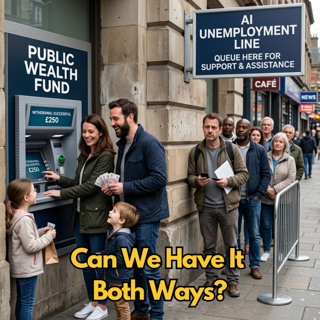
In its new paper, OpenAI floats a striking idea for the intelligence age: a Public Wealth Fund. The premise is simple. If advanced AI creates enormous economic gains, those gains should not flow only to founders, major firms, and investors. A public fund could give every citizen a direct stake in AI-driven growth, with returns distributed broadly rather than captured narrowly. Paper: At first glance, the idea feels like a serious answer to one of AI’s biggest political problems. If AI makes the economy more productive while also disrupting jobs, reshaping industries, and concentrating power, then a shared fund offers a new kind of social contract. If the country gets richer from AI, ordinary people should feel that wealth too. But the idea does more than spread money around. It changes the emotional and political relationship between the public and the system causing the disruption. Once your household, your retirement, or your community starts benefiting from AI-driven returns, automation no longer feels like something happening over there. It starts to feel like a system you are partly invested in.

That is where the deeper tension begins. A public dividend could make AI growth more legitimate and more broadly shared. But it could also make it harder to resist the damage AI causes, because the same system hollowing out a profession, reducing bargaining power, or thinning out a community is also sending value back to the public.


The Conundrum:

If AI wealth is widely shared through a public fund, society may finally solve one of the ugliest parts of technological change: a small group gets rich while everyone else is told to be patient. A shared dividend could make growth feel legitimate, reduce backlash, and give ordinary people a real stake in national prosperity.

But it could also weaken one of the few forces that still slows bad transitions down. If the public is paid from the upside of automation, then layoffs, institutional thinning, and regional decline become harder to oppose cleanly. The question is no longer just whether change is fair. It is whether people can still judge that change clearly once they are being compensated by it. If AI can make every citizen a shareholder in disruption, should we see that as long-overdue shared prosperity, or as a system that quietly buys away the pressure to challenge what automation is doing to public life?

Tämä jakso on lisätty Podme-palveluun avoimen RSS-syötteen kautta eikä se ole Podmen omaa tuotantoa. Siksi jakso saattaa sisältää mainontaa.

Jaksot(871)

Should We Rebuild Work Around AI?

Should We Rebuild Work Around AI?

The episode opened with a practical warning for people building AI systems: timestamps and time zones can quietly break databases, automations and search tools. That led into Slack Code, a new collabo...

21 Elo 1h 7min

Is Grok Bot the Best AI Work Assistant?

Is Grok Bot the Best AI Work Assistant?

The episode opened with a hands-on comparison of Grokbot, Codex and Claude. Gareth found Grokbot strong for delegation, organization and everyday work, but weaker on difficult problem solving. The dis...

20 Elo 1h 3min

Do We Need to Rethink What Work Is?

Do We Need to Rethink What Work Is?

The episode opened with Apple Vision Pro being used to map a house while running Ethernet cable, letting a worker see marked locations through floors and walls. That led to a wider discussion about di...

19 Elo 1h

Are Custom GPTs Reaching the End?

Are Custom GPTs Reaching the End?

The episode opened with a practical example of how quickly AI coding agents are moving beyond software. Someone used Claude to write a Mac driver for an old Windows-only HP printer, leading to a wider...

18 Elo 50min

Are AI Harnesses the New AI Wrappers?

Are AI Harnesses the New AI Wrappers?

The episode opened with the reported Stripe acquisition of OpenRouter at a $7 billion valuation and questions about how OpenRouter’s business model supports that price. The conversation expanded into ...

17 Elo 58min

The Pool of One Conundrum

The Pool of One Conundrum

Insurance has always worked by not knowing. You paid into a pool with people you would never meet, and nobody could say which of you would be the one who burned, crashed, or got sick. Everyone paid fo...

15 Elo 23min

Can AI Solve the Energy Problem It Is Creating?

Can AI Solve the Energy Problem It Is Creating?

The episode opened with the growing power demands behind AI. The hosts discussed Nvidia, Google and Microsoft’s work on 800-volt DC power for data centers, which could reduce energy lost converting el...

14 Elo 58min

Is Grok 4.6 Changing the Economics of AI Agents?

Is Grok 4.6 Changing the Economics of AI Agents?

The episode opened with Grok 4.6, which reportedly moved close to Claude Opus 5 and GPT-5.6 Sol on Artificial Analysis benchmarks while offering lower costs and stronger efficiency on long-running age...

14 Elo 1h 5min