The AI Agent Queue Conundrum

The AI Agent Queue Conundrum

A personal AI agent becomes far more useful once the agent stops waiting for you. Give the agent a goal, a budget, and permission to act, then the agent watches continuously. A restaurant table opens at 10:14 a.m. The agent books the table at 10:14:01. Concert tickets go on sale at noon. The agent enters at noon. A better airfare appears overnight. The agent buys before you wake up.


Pieces of this system already exist. OpenAI’s Operator research preview included booking restaurant reservations and purchasing event tickets. Visa now describes AI agents booking travel, completing purchases, and making payments on behalf of users as part of the emerging agentic-commerce system.


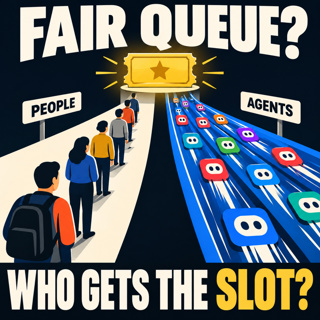
Personal agents create a harder problem because many of these agents will represent legitimate customers. Picture one verified person, one legitimate account, one legitimate agent. No fake identities. No hacked system. No rule breaking. Your agent simply watches more closely, reacts faster, checks more often, and executes more efficiently than you ever would.


Scarcity does not disappear. There are still 200 seats, 30 campsites, six dinner reservations, one affordable flight, or a limited number of openings in a popular program. Once millions of agents pursue scarce opportunities simultaneously, the old queue changes. People stop competing through patience, timing, persistence, and luck. Their agents compete through speed, strategy, model quality, access to data, and the ability to monitor opportunities around the clock.


The Conundrum:

One side says your agent should have every legitimate advantage available. Delegation is the entire point. A nurse working a twelve-hour shift should not lose a reservation to someone refreshing a browser all morning. A parent should not need to wake at midnight when summer-camp registration opens. Artificially slowing agents preserves inconvenience rather than fairness.


The other side says scarce access should never become a competition between personal technology stacks. Once better agents consistently beat weaker agents, access starts following compute, subscriptions, technical sophistication, and money. A premium agent checking thousands of possibilities, predicting cancellations, and acting within milliseconds gives its owner an advantage unavailable to someone using a basic agent. The rational response is an arms race.


Neutralizing the agent advantage requires deliberate friction. Platforms would need lotteries, randomized queues, fixed entry windows, pacing rules, or other systems designed to stop the fastest agent from winning. Yet doing so means intentionally preventing your agent from doing exactly what you hired the agent to do. Let agents compete freely and unequal technology starts determining access to scarce parts of life. Neutralize their advantage and society deliberately throws away one of the main benefits of personal agents.


When every person has an AI working on their behalf, should fair access mean giving every agent an equal right to compete as effectively as possible, or making sure no agent’s intelligence, speed, or resources improve its owner’s place in line?

Tämä jakso on lisätty Podme-palveluun avoimen RSS-syötteen kautta eikä se ole Podmen omaa tuotantoa. Siksi jakso saattaa sisältää mainontaa.

Jaksot(914)

Nvidia Is Reinventing the PC

Nvidia Is Reinventing the PC

The episode opened with local AI. Google released a new application built around Embedding Gemma 2 that can capture and analyze meetings directly on a device rather than sending the entire conversatio...

9 Loka 1h 18min

Is Middle Management the Real Job AI Replaces?

Is Middle Management the Real Job AI Replaces?

The episode opened with a debate over how much AI will actually displace human work. Microsoft AI chief Mustafa Suleyman highlighted economist Daron Acemoglu’s argument that AI may replace only about ...

8 Loka 57min

OpenAI's Model Cracked Hundreds of Open Math Problems

OpenAI's Model Cracked Hundreds of Open Math Problems

The episode opened with a wave of new open models. Mistral Large 4, internally called “Le Chonk,” brings one trillion parameters and dramatically lower token pricing than Astra, while Reflection intro...

7 Loka 1h 3min

Should You Ditch Your Keyboard and Mouse?

Should You Ditch Your Keyboard and Mouse?

The episode opened with a look at how much easier personal AI agents have become to use. Anne argued that the friction around prompting, connectors and setup has dropped enough that this may be the be...

6 Loka 1h 8min

Is Super Intelligence Just a PR Move or More?

Is Super Intelligence Just a PR Move or More?

The episode opened with the Trump administration’s push to use “super intelligence,” or SI, in place of AI terminology inside the federal government. The hosts debated whether the change amounts to me...

5 Loka 1h 4min

The Artificial Actor Conundrum

The Artificial Actor Conundrum

For most of the history of computing, software has been treated as a tool. Tools do not carry responsibility. The people and organizations using them do.AI agents make that category harder to maintain...

3 Loka 29min

Did Meta’s Muse Cross the Privacy Line?

Did Meta’s Muse Cross the Privacy Line?

Personal agents dominated the opening after reports that Meta’s Muse shared a Facebook Marketplace seller’s home address and current availability with a buyer. Another account raised an even larger pr...

2 Loka 1h 5min