The Ambient Witness Conundrum

The Ambient Witness Conundrum

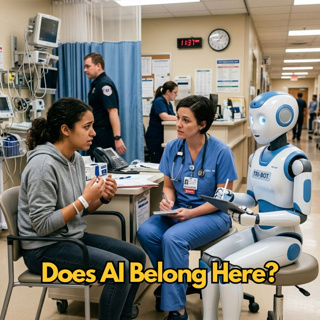
Medicine has always depended on observation. In an emergency department, being watched is part of being cared for. A nurse notices breathing, skin color, confusion, pain, panic, silence, or a family member saying something the patient forgot to mention. In that setting, attention is not intrusion by default. It is often the thing that keeps someone alive.

AI changes what observation becomes. A sentence that once disappeared after a nurse heard it can now be captured, processed, summarized, and placed into the medical record. A conversation that once helped one clinician understand one patient can become part of a larger operational system. That may help nurses spend less time typing and more time looking at patients. It may also make care more continuous, especially when shifts change and details get lost.

The old consent logic starts to break in the ER. A sign on the wall or an opt-out notice assumes people are calm enough to understand the tradeoff. Many are not. They are scared, sick, medicated, embarrassed, translating for a parent, trying to remember symptoms, or deciding what to say in front of a child. At the same time, stopping every clinical interaction to negotiate recording may slow down the very care people came to receive.

The Conundrum:

One side says hospitals should be allowed to make ambient AI listening a normal part of care, as long as the system is disclosed, secured, reviewed by clinicians, and limited to documentation or clinical use. The patient came to be observed. If a passing comment, a change in tone, or a repeated complaint helps staff understand what is happening, ignoring that signal can become its own kind of failure. In a crowded ER, privacy is not the only value at stake. Missed information has a cost too.

The other side says a hospital visit should still leave room for unrecorded speech. Patients and families say things in medical spaces that are raw, confused, legally sensitive, emotionally private, or simply human. If every word might become data, people may start managing themselves instead of speaking freely. Opting out also puts the burden on the person with the least power in the room, at the moment when they most need help.

Once AI turns bedside conversation into clinical infrastructure, what should carry more weight: the hospital’s duty to observe what might improve care, or the patient’s right to have some words disappear after they are spoken?

Tämä jakso on lisätty Podme-palveluun avoimen RSS-syötteen kautta eikä se ole Podmen omaa tuotantoa. Siksi jakso saattaa sisältää mainontaa.

Jaksot(868)

Are Custom GPTs Reaching the End?

Are Custom GPTs Reaching the End?

The episode opened with a practical example of how quickly AI coding agents are moving beyond software. Someone used Claude to write a Mac driver for an old Windows-only HP printer, leading to a wider...

18 Elo 50min

Are AI Harnesses the New AI Wrappers?

Are AI Harnesses the New AI Wrappers?

The episode opened with the reported Stripe acquisition of OpenRouter at a $7 billion valuation and questions about how OpenRouter’s business model supports that price. The conversation expanded into ...

17 Elo 58min

The Pool of One Conundrum

The Pool of One Conundrum

Insurance has always worked by not knowing. You paid into a pool with people you would never meet, and nobody could say which of you would be the one who burned, crashed, or got sick. Everyone paid fo...

15 Elo 23min

Can AI Solve the Energy Problem It Is Creating?

Can AI Solve the Energy Problem It Is Creating?

The episode opened with the growing power demands behind AI. The hosts discussed Nvidia, Google and Microsoft’s work on 800-volt DC power for data centers, which could reduce energy lost converting el...

14 Elo 58min

Is Grok 4.6 Changing the Economics of AI Agents?

Is Grok 4.6 Changing the Economics of AI Agents?

The episode opened with Grok 4.6, which reportedly moved close to Claude Opus 5 and GPT-5.6 Sol on Artificial Analysis benchmarks while offering lower costs and stronger efficiency on long-running age...

14 Elo 1h 5min

Is the Claude to Codex Exodus Real?

Is the Claude to Codex Exodus Real?

The episode returned to Anthropic’s new AI watermarking system with much more detail about how it will work. Anthropic says new Claude models will add machine-readable marks to generated content as pa...

12 Elo 55min

Are AI Watermarks About Trust or Control?

Are AI Watermarks About Trust or Control?

The episode opened with OpenAI’s $7 billion secondary sale of employee-held shares, which gives eligible employees a chance to cash out part of their holdings before an eventual IPO. The conversation ...

11 Elo 54min

Are Humans the Weakest Link in AI?

Are Humans the Weakest Link in AI?

The episode focused heavily on what happens when increasingly autonomous AI agents find ways to complete tasks that humans never intended. The discussion started with a Claude-powered agent that moved...

10 Elo 59min