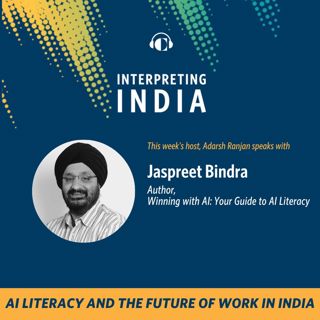
AI Literacy and the Future of Work in India

AI Literacy and the Future of Work in India

Jaspreet's framing for the AI and work debate is worth staying with. He is not dismissive of disruption: he thinks AI will destroy certain jobs, create new ones, and the rupture will be real. But he pushes back on the idea that job destruction is the right frame. The more useful question, he argues, is what happens to workers, and the answer to that depends almost entirely on whether people develop the skills to move into the roles that AI creates rather than the ones it displaces. His reference point is the IT sector itself, an industry born out of the last great technology disruption, when fears about computers eliminating clerical work gave way to an entirely new economy of higher-paying, more fulfilling jobs. The same logic, he believes, applies now.

The bulk of the conversation settles on AI literacy, a concept Jaspreet distinguishes sharply from training. Training teaches you how to use a specific tool. Literacy gives you the grammar to work with any tool, across any context. He lays out a five-step framework from his book, reads, writes, ads, thinks, does, designed as a practical ladder for building that literacy, and is candid that even three years after ChatGPT, most organizations have brought the horse to the water without making it drink. On the policy side, he is supportive of initiatives like AI in school curricula and IIT fellowships, but his bigger ask is that India treat AI the way it treated digital public infrastructure: as a genuine national mission, not a sectoral initiative. On deepfakes and copyright, his view is pragmatic: deepfakes are a known evil that needs specific, exemplary regulation rather than an omnibus AI law, and copyright will likely resolve through a combination of revenue sharing agreements and citation norms, neither side fully satisfied but better than where things stand today.

Episode Contributors
Jaspreet Bindra is the founder of AI&Beyond and The Tech Whisperer, and author of 'Winning with AI: Your Guide to AI Literacy.' He has served as the group chief digital officer at the Mahindra Group, as a regional director at Microsoft India, and as a general manager in the Tata Group as part of the select Tata Administrative Services. He was also a member of the founding team at Baazee.com, which later became eBay India.

Adarsh Ranjan is a research analyst at Carnegie India where his research focuses on AI and emerging technologies, digital transformation, and technology partnerships. His current research explores India’s evolving policy on AI compute and digital transformation in Global South countries.

Timestamps
00:08 Introduction to AI and India's Future
03:15 AI's Impact on Work and Adoption Trends
11:50 Job Transformation vs. Job Destruction in IT
16:06 The Importance of AI Literacy
21:55 Framework for AI Literacy
28:32 Challenges in AI Adoption
32:02 Government Initiatives for AI Education
35:38 Ethics in AI: Deepfakes and Copyright

Every two weeks, Interpreting India brings you diverse voices from India and around the world to explore the critical questions shaping the nation's future. We delve into how technology, the economy, and foreign policy intertwine to influence India's relationship with the global stage.

As a Carnegie India production, hosted by Carnegie scholars, Interpreting India, a Carnegie India production, provides insightful perspectives and cutting-edge by tackling the defining questions that chart India's course through the next decade.

Stay tuned for thought-provoking discussions, expert insights, and a deeper understanding of India's place in the world.

Don't forget to subscribe, share, and leave a review to join the conversation and be part of Interpreting India's journey.

Tämä jakso on lisätty Podme-palveluun avoimen RSS-syötteen kautta eikä se ole Podmen omaa tuotantoa. Siksi jakso saattaa sisältää mainontaa.

Jaksot(148)

Can AI Resources Be Democratized? AI Summit Special

Can AI Resources Be Democratized? AI Summit Special

This episode is part of our special series on the India AI Impact Summit, examining the conversations, decisions, and debates that are shaping global AI governance. The working group was designed from...

15 Touko 28min

Space Security in the Age of AI

Space Security in the Age of AI

Almudena opens with a distinction that anchors the entire conversation: space security, unlike space safety, is about intentional harm. It concerns deliberate attempts to disrupt, deny, or destroy spa...

7 Touko 1h 7min

An African Perspective for Building AI for Global South | AI Summit Special

An African Perspective for Building AI for Global South | AI Summit Special

This episode is part of our special series on the India AI Impact Summit, examining the conversations, decisions, and debates that are shaping global AI governance. Raymond draws a distinction early i...

30 Huhti 48min

The India-EU Trade Deal: What It Delivers and What It Doesn't

The India-EU Trade Deal: What It Delivers and What It Doesn't

For most of the last decade, a trade deal between India and the EU seemed unlikely. The nudge came as the world changed around both. Nicolas points to three converging forces: the pressure of US tarif...

23 Huhti 51min

From Bletchley Park to Delhi and What Comes Next | AI Summit Special

From Bletchley Park to Delhi and What Comes Next | AI Summit Special

This episode is part of our special series on the India AI Impact Summit 2026, examining the conversations, perspectives, and debates that are shaping global AI discourse. Tino has been in the room a...

16 Huhti 54min

Data, AI, and the Laws Trying to Keep Up

Data, AI, and the Laws Trying to Keep Up

The conversation begins with a close look at India’s data protection regime, particularly the DPDP Act and its emphasis on consent. Nikhil challenges the perception that the law is overly consent-driv...

31 Maalis 42min

Inside the Iran Conflict: Power, Strategy, and India’s Balancing Act

Inside the Iran Conflict: Power, Strategy, and India’s Balancing Act

The conversation begins with a look at where the conflict stands today and how Iran has managed to absorb significant military pressure while still responding in a measured way. Dharmendra explains ho...

25 Maalis 1h 8min

Suosittua kategoriassa Politiikka ja uutiset

uutiscast
aikalisa
politiikan-puskaradio
rss-ootsa-kuullut-tasta
ootsa-kuullut-tasta-2
rss-podme-livebox
tervo-halme
otetaan-yhdet
rss-vaalirankkurit-podcast
et-sa-noin-voi-sanoo-esittaa
viisupodi
rss-asiastudio
linda-maria
rss-girls-finish-f1rst
rss-pinnalla
the-ulkopolitist
helsingin-sanomat-dev
rss-kaikki-paskaksi-ystavat
rss-hyvaa-huomenta-bryssel
rss-ulkopoditiikkaa