India's AI Ambitions and the Road to Viksit Bharat | AI Summit Special

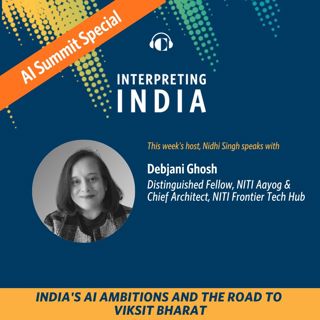
India's AI Ambitions and the Road to Viksit Bharat | AI Summit Special

This is the final episode of our special series on the India AI Impact Summit, examining the conversations, decisions, and debates that are shaping global AI governance.

This episode explores:

  • India has a clear North Star in Viksit Bharat 2047, but what will it actually take to get there and what role does AI play?
  • Should India focus on diffusing AI or building its own frontier research capability, and is that even the right way to frame the question?
  • What did the working group on AI for Economic Growth and Social Good set out to do, and what is the Global AI Impact Commons designed to deliver?
  • From skilling to last mile delivery, what stands between a great AI solution built in Bangalore and the farmer or district hospital that could benefit from it?

Debjani pushes back early on one of the most debated questions in India's AI conversation. The framing of frontier research versus diffusion, she says, is simply the wrong debate. India needs to do both. Without the machinery to convert its own data into intelligence, India would be diffusing imported intelligence, with no guarantee that the channel will always remain open. Building that machinery, while simultaneously deploying AI at scale, is not a choice. It is a necessity.

On the working group, the most important conversation was not about technology at all. It was about the human being. Every country in the room was still trying to figure out how to unlock AI's impact at population scale, and the group's key insight was that the world does not yet have a common standard for what impact even means. The Global AI Impact Commons, launched at the summit with over 80 stories from more than 30 countries, is designed to change that, giving countries a shared repository of real world success stories to learn from and replicate.

Her advice for getting AI to the last mile draws directly from India's DPI experience. None of the platforms that reached population scale, not Aadhaar, not UPI, started with the technology. They started with the problem. The best AI, she says, is the AI that is invisible. People should not have to think about it. And that principle, starting grassroots up, keeping it simple, and keeping the human at the center, is what India's AI builders need to take forward.

Every two weeks, Interpreting India brings you diverse voices from India and around the world to explore the critical questions shaping the nation's future. We delve into how technology, the economy, and foreign policy intertwine to influence India's relationship with the global stage.

As a Carnegie India production, hosted by Carnegie scholars, Interpreting India, a Carnegie India production, provides insightful perspectives and cutting-edge by tackling the defining questions that chart India's course through the next decade.

Stay tuned for thought-provoking discussions, expert insights, and a deeper understanding of India's place in the world.

Don't forget to subscribe, share, and leave a review to join the conversation and be part of Interpreting India's journey.

Tämä jakso on lisätty Podme-palveluun avoimen RSS-syötteen kautta eikä se ole Podmen omaa tuotantoa. Siksi jakso saattaa sisältää mainontaa.

Jaksot(153)

India, Australia, and the Critical Minerals Opportunity

India, Australia, and the Critical Minerals Opportunity

The conversation opens with a useful baseline on both countries. Australia has world-class mining equipment, technology, and services capabilities, and its mining sector contributes roughly 10 to 15 p...

13 Elo 49min
Chokepoints, Economic Warfare and India's Strategic Options

Chokepoints, Economic Warfare and India's Strategic Options

Edward lays out three criteria for what makes something a genuine choke point: dominant market share, difficulty to substitute, and the ability to weaponize it with asymmetric impact, hurting the adve...

10 Heinä 33min
Did India's AI Summit Get Safety Right? AI Summit Special

Did India's AI Summit Get Safety Right? AI Summit Special

This episode is part of our special series on the India AI Impact Summit, examining the conversations, decisions, and debates that are shaping global AI governance. Professor Ravindran addresses early...

19 Kesä 40min
Subsea Cables, Trusted Networks, and India's Strategic Opportunity

Subsea Cables, Trusted Networks, and India's Strategic Opportunity

Pooja opens with a mismatch that frames the entire conversation. India consumes around 20% of global internet traffic but accounts for just 2% of global subsea cable infrastructure. Even with the expa...

4 Kesä 46min
AI Literacy and the Future of Work in India

AI Literacy and the Future of Work in India

Jaspreet's framing for the AI and work debate is worth staying with. He is not dismissive of disruption: he thinks AI will destroy certain jobs, create new ones, and the rupture will be real. But he p...

26 Touko 44min
Can AI Resources Be Democratized? AI Summit Special

Can AI Resources Be Democratized? AI Summit Special

This episode is part of our special series on the India AI Impact Summit, examining the conversations, decisions, and debates that are shaping global AI governance. The working group was designed from...

15 Touko 28min

Space Security in the Age of AI

Space Security in the Age of AI

Almudena opens with a distinction that anchors the entire conversation: space security, unlike space safety, is about intentional harm. It concerns deliberate attempts to disrupt, deny, or destroy spa...

7 Touko 1h 7min

Suosittua kategoriassa Politiikka ja uutiset

uutiscast
aikalisa
politiikan-puskaradio
ootsa-kuullut-tasta-2
rss-ootsa-kuullut-tasta
otetaan-yhdet
rss-seksicast
tervo-halme
rss-podme-livebox
et-sa-noin-voi-sanoo-esittaa
rss-asiastudio
rss-kaikki-uusiksi
rss-vaalirankkurit-podcast
rss-tyolinjalla-pekka-sauri
rss-raha-talous-ja-politiikka
linda-maria
rss-voi-venaja
eevan-politiikkapodi-totuuksia-suomesta
rss-diet-woke