
Ulysses S. Grant: The Curse of Loyal Friends

Ulysses S. Grant: The Curse of Loyal Friends

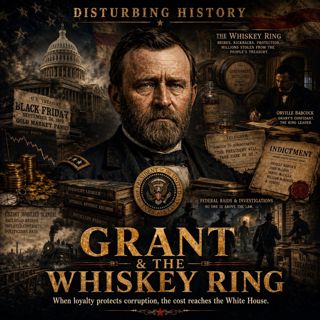
Ulysses S. Grant left the White House without a fortune, never took a bribe, and never sold an office, yet his administration produced more documented corruption than any presidency of the nineteenth century.

This episode of Disturbing History continues our series on the dark history of presidential politics by walking straight into the Gilded Age and the Whiskey Ring, the federal liquor-tax fraud that siphoned millions of dollars out of the United States Treasury while a depression squeezed ordinary Americans, and traces how the trail of stolen tax money ran all the way to the desk of Grant's private secretary, General Orville Babcock, in the office adjoining the president's own.

We open with the central question that runs through every scandal here. What happens when the honest man in the room is the reason the corruption survives? Drawing on sixteen years of law enforcement experience, your host lays out the pattern that connects Grant to crooked bosses and clean ones alike, the boss who stakes his spotless reputation on a guilty subordinate and makes that subordinate untouchable. Grant kept score on loyalty the way other men kept score on money, a habit forged during his years of failure before the Civil War, his binge drinking and resignation from the Army, the Hardscrabble farm, the firewood sold on St. Louis street corners, and the clerk's job in his brother's Galena leather store.

Once a man was inside the wall of Grant's trust, almost nothing could throw him out, and the con men of the era learned to exploit that vulnerability like published exploit code.The episode follows that pattern through the Black Friday gold panic of September eighteen sixty-nine, where Jay Gould and Jim Fisk attempted to corner the New York gold market by buying access to Grant through his own brother-in-law Abel Corbin, and the scheme collapsed only when Grant ordered the Treasury to sell.

From there we cover Credit Mobilier, the transcontinental railroad construction-company fraud that dragged Vice President Schuyler Colfax, future president James Garfield, and roughly two dozen members of Congress into the mud, the falling-out among thieves that exposed it, and the censure of Oakes Ames that closed the books while the rest of Washington walked. We set the political stage of the Panic of eighteen seventy-three, the spoils system, and the Salary Grab before turning to the main event.

The Whiskey Ring itself gets the full treatment. We explain the seventy-cents-a-gallon liquor tax, the economics of crooked whiskey, and how supervisor John McDonald built a parallel tax system across St. Louis, Milwaukee, Chicago, Cincinnati, and Peoria, with gaugers and storekeepers and collectors all lying in the same direction, campaign money flowing into Grant's eighteen seventy-two reelection effort, and cipher telegram warnings arriving from Washington signed with the alias Sylph. We follow Treasury Secretary Benjamin Bristow and his solicitor Bluford Wilson as they ran a covert investigation against their own department, counting grain in and barrels out at the railyards to build a shadow ledger, and we cover the May tenth, eighteen seventy-five raids, the two hundred thirty indictments, and the hundred and ten convictions.

Then we watch Grant's response to the indictment of Babcock, the order banning plea deals, the firing of special prosecutor John Henderson, and the sworn deposition the sitting president gave in defense of his private secretary, the only time in American history a president has been deposed as a witness in a criminal prosecution.The back half surveys the rest of the wreckage. The Belknap affair, where Secretary of War William Belknap raced to resign ninety minutes ahead of his unanimous impeachment over the Fort Sill post-tradership kickbacks, with George Custer's complaints riding off toward the Little Bighorn under Grant's anger.

The Interior Department under Columbus Delano, the Navy Department under George Robeson, Attorney General George Williams and the carriage, the New York Custom House and Roscoe Conkling, and the battalion of Grant relatives on the federal payroll. We close with Grant's final message to Congress and its famous line about errors of judgment rather than intent, the Grant and Ward Ponzi collapse that left the general with eighty dollars in his pocket, and the dying race to finish his Personal Memoirs that restored Julia to comfort and secured his place in American letters.

We also give Reconstruction its due, the Klan prosecutions and the Fifteenth Amendment, because the man who sent his deposition to defend Babcock and the man who sent the cavalry after the Klan were operating on the same code all the way down.

Have a forgotten historical mystery, disturbing event, unsolved crime, or hidden conspiracy you think deserves investigation?

Send your suggestions to brian@paranormalworldproductions.com.

Disturbing History is a dark history podcast exploring unsolved mysteries, secret societies, historical conspiracies, lost civilizations, and the shadowy stories buried beneath the surface of the past.

Follow the show and enable automatic downloads so you never miss a deep dive into history’s most unsettling secrets.

Because sometimes the truth is darker than fiction.

Tämä jakso on lisätty Podme-palveluun avoimen RSS-syötteen kautta eikä se ole Podmen omaa tuotantoa. Siksi jakso saattaa sisältää mainontaa.

Jaksot(123)

FDR: The Man Who Could Have Been King

FDR: The Man Who Could Have Been King

He was elected President of the United States 4 times, and a whole generation of Americans grew up unable to remember anyone else in the office. In this episode of Disturbing History, we pull apart th...

17 Heinä 1h 23min

The Fair Tax

The Fair Tax

Taxes don't sound like Disturbing History territory, until you learn the trail of blood and power behind them. This episode traces the entire violent history of taxation in America, from the Stamp Act...

15 Heinä 1h 15min

The Smithsonian's Strange Phenomena Files

The Smithsonian's Strange Phenomena Files

There's a building in Washington where, for the better part of a century, ordinary Americans mailed in the impossible. Flesh that fell from a clear sky onto a Kentucky farmwife making soap. A swarm of...

12 Heinä 1h 1min

Loving the Monster

Loving the Monster

Some nights the well runs dry, and I do what everybody does — I sink into the couch and let Netflix babysit me for a while. That's how I ended up watching The Worst Ex Ever, and that's how I ended up ...

10 Heinä 1h 1min

The Rise and Ruin of the FLDS Church

The Rise and Ruin of the FLDS Church

He was the mouthpiece of God to ten thousand followers. To the FBI, he was a face on the Ten Most Wanted list. And to a Nevada state trooper working a dark stretch of Interstate Fifteen, he was just a...

8 Heinä 1h 7min

Children Sent Through the Mail

Children Sent Through the Mail

In the winter of nineteen fourteen, a five-year-old girl named May Pierstorff stood on a train platform in Grangeville, Idaho, with fifty-three cents in postage stamps pinned to her coat. Her parents ...

5 Heinä 1h 1min

The Poison Bottles America Trusted

The Poison Bottles America Trusted

Before the Food and Drug Administration, before warning labels, before anyone had to prove a medicine was safe or even admit what was inside it, America ran on the bottle.This episode opens the cabine...

3 Heinä 59min

Nazi Propaganda & The American Mirror

Nazi Propaganda & The American Mirror

The word propaganda began as something holy. In sixteen twenty-two a committee of cardinals in Rome coined it to mean the spreading of the faith, and in this episode I follow that single word as it cu...

1 Heinä 1h 4min

Suosittua kategoriassa Yhteiskunta

olipa-kerran-otsikko
seitseman
siita-on-vaikea-puhua
i-dont-like-mondays
poks
antin-palautepalvelu
sita
hupiklubi
kaksi-aitia
gogin-ja-janin-maailmanhistoria
kolme-kaannekohtaa
mamma-mia
yopuolen-tarinoita-2
ihme-ja-kumma
loukussa
aikalisa
meidan-pitais-puhua
lahko
rss-haudattu
rss-palmujen-varjoissa