The Credit Card That Owns the Mint

The Credit Card That Owns the Mint

A US Treasury bond is the asset the whole financial system calls risk-free — the benchmark every other risk is measured against. This year, the most conservative institutions on earth started quietly treating it as a risk to hedge.

The strange part is what didn't happen. Federal debt crossed $39 trillion, annual interest passed $1 trillion — more than the entire defense budget — and the US lost its last triple-A rating, all to a collective shrug. Meanwhile, gold quietly overtook US Treasuries as the world's largest reserve asset. This episode is about the slow repricing of trust in "risk-free," why the cure is mathematically simple and politically brutal, and what a serious investor does about it.

In this episode:

The number nobody flinched at. Debt crossed $39 trillion (~123% of GDP), the deficit runs near $1.85 trillion (about $1.33 spent per $1 collected), and interest now tops $1 trillion a year — more than defense or Medicare. Moody's stripped the last triple-A in May 2025 — and the market hit records within days. A downgrade that moves no prices isn't a benign problem; it's a slow one.

The credit card that owns the mint. Ray Dalio's Big Debt Cycle — 35 cases over the last century, running roughly a human lifetime. A government that borrows in its own currency rarely goes broke the way a family does; it owns the printing press, so it never has to miss a payment. It goes broke the way a currency does — the bill arrives as inflation, spread silently across everyone holding the money or the bonds.

Three levers, all jammed. Dalio's "3% solution" — cut spending, raise taxes, lower real rates — is near-consensus and stuck. Entitlements and defense are untouchable (the FY2027 defense request would raise military spending 40%+), the latest tax package cut revenue, and the long rate is market-set: the Fed cut three times in 2025 to 3.50–3.75%, yet the 10-year still sits near 4.5%, term premium at its highest since 2011.

The quiet repricing. Central banks bought ~850 tonnes of gold in 2025, after three straight years above 1,000. The ECB's June 2026 report shows gold at 27% of official reserves — overtaking US Treasuries at 22% — though much of that was gold's price surge, not Treasury-dumping (at 2023 prices, Treasuries still lead). The 2022 freeze of ~$300 billion of Russian reserves taught every central bank that a dollar reserve can be switched off; gold can't.

Two cases that bracket the US. Japan shows how far the printing-press path stretches — debt ~230% of GDP, yet its 10-year bond has touched 2.8% (highest since 1996) and it holds more than $1 trillion of US Treasuries. France shows the other path — ~117% of GDP, governments collapsing over budgets, no printing press inside the euro. The US sits between them, spared only by the dollar's reserve status — the very thing gold is chipping away at.

The strongest bear case — answered. Betting against US debt has been a 40-year graveyard, there's no real alternative to the dollar, and stablecoins are a fresh bid for Treasuries. All fair. But this is a repricing thesis, not a collapse call — and that stablecoin demand lands at the short end, not the 30-year, where the repricing actually lives.

What it means for you. "Risk-free" isn't a place to hide; it's a label carrying more risk than it used to. The move isn't to sell everything — it's to own things that don't fall on the same day, with a modest sleeve (gold, hard assets, inflation-linked bonds) as insurance bought while the sun is out. And the highest-returning asset you own isn't in your portfolio at all — it's your own adaptability.

Read the written version at quietvelocity1.substack.com, the companion Substack to Conviction Bet.

New episodes weekly. Subscribe on Apple Podcasts, Spotify, YouTube, or Amazon Music.

Conviction Bet is independent investment commentary. Nothing in this episode is investment advice.

Tämä jakso on lisätty Podme-palveluun avoimen RSS-syötteen kautta eikä se ole Podmen omaa tuotantoa. Siksi jakso saattaa sisältää mainontaa.

Jaksot(13)

The Quietest Edge

The Quietest Edge

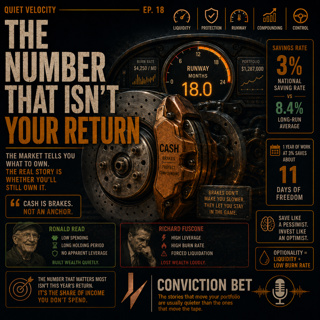
The Quietest Edge: Why Your Fund’s Return Isn’t Your ReturnPicture two people buying the same fund and holding it through the same market. On paper, they own the same investment. In practice, they can...

25 Kesä 26min

Who Settles the Check: Who Really Pays for the AI Build-Out

Who Settles the Check: Who Really Pays for the AI Build-Out

Who Settles the Check: Who Really Pays for the AI Build-OutPicture the most expensive dinner ever ordered. The finest of everything, courses still arriving, nobody checking the price. The whole mood o...

19 Kesä 27min

The Oracle, Decoded: How They Reverse-Engineered Warren Buffett

The Oracle, Decoded: How They Reverse-Engineered Warren Buffett

For fifty years, Warren Buffett's record looked like magic — a once-in-a-century gift you either have or you don't. Then three quantitative researchers took that genius apart, piece by piece, and foun...

10 Kesä 26min

Read the Label: What's Actually Inside the S&P 500

Read the Label: What's Actually Inside the S&P 500

Buying the S&P 500 feels like the most diversified decision in investing. It has quietly become one of the most concentrated.The index everyone owns hasn't changed — but the recipe underneath has. Sev...

1 Kesä 23min

Dead Reckoning: What the 4% Rule Cannot See

Dead Reckoning: What the 4% Rule Cannot See

Most retirement planning math is correct. The problem is the question it's answering.The 4% rule was built for a 30-year retirement. An early retiree who leaves work at 35 and lives to 90 needs a port...

27 Touko 33min

The Ouroboros Quarter

The Ouroboros Quarter

In most earnings seasons, the profit reported is the profit earned. Q1 2026 was different. The most important number in Alphabet's results was not on the revenue line, not in the cloud segment, and no...

21 Touko 29min

Fluent in Money, Illiterate in Wealth

Fluent in Money, Illiterate in Wealth

In most languages, the word for wealth still carries traces of its origin — wellbeing, capability, the conditions of a good life. In English, that meaning was stripped out somewhere between the Champa...

14 Touko 31min

Suosittua kategoriassa Liike-elämä ja talous

sijotuskasti
psykopodiaa-podcast
rss-oivalluksia-rahasta-elamasta
mimmit-sijoittaa
rss-rahapodi
rahapuhetta
rss-karon-grilli
ostan-asuntoja-podcast
asuntoasiaa-paivakirjat
inderespodi
oppimisen-psykologia
rss-inderes
herrasmieshakkerit
rss-sami-miettinen-neuvottelija
hyva-paha-johtaminen
rss-rahamania
rss-porssipuhetta
rss-bisnesta-bebeja
rss-myynti-ei-ole-kirosana
rss-talouden-jaljilla