What is Facilitated Communication? BOP Rewind | Session 199/336 | Jason Travers

What is Facilitated Communication? BOP Rewind | Session 199/336 | Jason Travers

Welcome to Session 336 The Behavioral Observations Podcast.

Well technically, this is actually Session 199, and I wanted to take a minute to explain why you're hearing a rebroadcast.

This conversation with Dr. Jason Travers originally aired back in September of 2022, but I've decided it's worth bringing back because, unfortunately, the issues surrounding Facilitated Communication haven't gone away. In fact, if anything, they've become more relevant.

Over the past several years, we've continued to see heartwarming news stories and viral social media posts featuring non-speaking autistic individuals who appear to be communicating through methods such as Facilitated Communication, the Rapid Prompting Method, or Spelling to Communicate. These stories are understandably compelling. We all want people with significant communication challenges to have access to effective ways to express themselves.

The problem is that hope, by itself, isn't evidence.

Facilitated Communication has been studied extensively for decades, and the scientific record is remarkably consistent. The evidence has repeatedly shown that the messages produced through FC originate with the facilitator, not the individual. Despite that, these practices continue to find new audiences under different names and in different settings.

As behavior analysts—and really, as anyone who cares about helping people with disabilities—we have an obligation to evaluate interventions based on evidence, even when the conclusions are uncomfortable. That's especially true when the potential harms are so significant, not only for the individuals using these methods, but also for their families, educators, and support teams.

I also think this episode serves as a useful foundation because I plan to cover this topic in greater depth over the coming months, along with other interventions that have gained popularity despite lacking scientific support. Rather than assuming everyone has heard this discussion before, I thought it made sense to revisit what I think is one of the clearest introductions to the topic.

So whether you're hearing this conversation for the first time or giving it another listen, I hope you'll pay particular attention to the history of Facilitated Communication, how it was scientifically evaluated, why those findings matter, and how Dr. Travers recommends discussing these issues with colleagues and families in a way that's both accurate and compassionate.

Please note that I edited out the "how did you get into ABA segment," so you can get right to the heart of the topic. I'll include links to the original recording if you want to go back and hear more about Jason's background.

Here are the shownotes from the original broadcast:

If your social media consumption is anything like mine, you've likely seen some feel-good stories in the media as of late that report on non-speaking students - generally students with Autism - who are graduating from college, giving valedictorian speeches, and so forth.

Unfortunately, what's often underpinning many of these cases is a form of Facilitated Communication, or FC for short. What is FC? Glad you asked!

In today's episode, Dr. Jason Travers, Associate Professor at Temple University, joins me today to answer this very question (follow him on Twitter here).

We covered the history of Facilitated Communication, the early scientific investigations that discredited this practice, FC's variants like the Rapid Prompting Method and Spelling to Communicate, where the practice of FC stands today, the harms that Facilitated Communication causes both users and caregivers, and how Behavior Analysts should both view and talk about these practices.

Jason also provides the audience with a treasure trove of additional resources:

Sponsor shoutouts!
  • Behavior University. Their mission is to provide university quality professional development for the busy Behavior Analyst. Learn about their CEU offerings, including their 8-hour Supervision Course, as well as their RBT offerings over at behavioruniversity.com/observations. Don't forget to use the coupon code, PODCAST to save at checkout!
  • Safety-Care is a crisis prevention and de-escalation training program designed for professionals who support individuals with challenging behavior. More than 300,000 professionals have been trained in Safety-Care's evidence-based approach to recognizing early warning signs and responding with confidence. To learn more, visit QBS.com/podcast.
  • Learn from your favorite podcast guests while you're commuting, walking the dog, or whatever else you do while listening to podcasts. New events are being added all the time, so check them out here.
  • HRIC Recruting. Cut out the middleman and speak directly with Barbara Voss, who's been placing BCBAs in great jobs all across the US for 15 years.
  • The BOP Patreon. Do you want to get the show ad-free and before everyone else? Click here to learn how!

Tämä jakso on lisätty Podme-palveluun avoimen RSS-syötteen kautta eikä se ole Podmen omaa tuotantoa. Siksi jakso saattaa sisältää mainontaa.

Jaksot(338)

Conducta Verbal: Cultura, Contexto y Comunicación Funcional | BOP en ESP 18 con Janet Enriquez

Conducta Verbal: Cultura, Contexto y Comunicación Funcional | BOP en ESP 18 con Janet Enriquez

En este episodio, Miguel conversa con Janet sobre la conducta verbal desde una perspectiva práctica y cultural. A lo largo de la conversación, exploran por qué la conducta verbal sigue siendo una de l...

14 Heinä 1h 23min
Essential for Living in Action: Building Meaningful Skills Through Everyday Events | Session 334 with Kristina Montgomery and Emily Beal Wilkinson

Essential for Living in Action: Building Meaningful Skills Through Everyday Events | Session 334 with Kristina Montgomery and Emily Beal Wilkinson

Many behavior analysts have experienced the frustration of teaching a skill successfully in one setting only to discover that it doesn't transfer to the situations where it actually matters. In this e...

30 Kesä 1h 24min
Beyond 80% Correct: Rethinking Mastery Criteria in ABA: Session 333 with Sarah Richling & Dan Fienup

Beyond 80% Correct: Rethinking Mastery Criteria in ABA: Session 333 with Sarah Richling & Dan Fienup

How do we determine when a learner has truly mastered a skill? In behavior analysis, performance criteria such as "80% correct across two sessions" have become nearly ubiquitous. Yet despite their wid...

12 Kesä 1h 12min
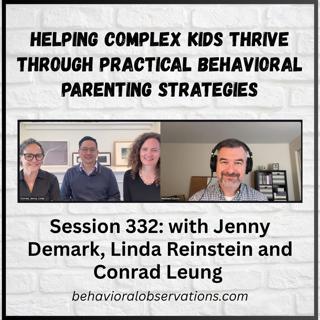
Helping Complex Kids Thrive Through Practical Behavioral Parenting Strategies: Jenny Demark, Linda Reinstein and Conrad Leung | Session 332

Helping Complex Kids Thrive Through Practical Behavioral Parenting Strategies: Jenny Demark, Linda Reinstein and Conrad Leung | Session 332

In this episode, I'm joined by Dr. Jenny Demark, Conrad Leung, and Dr. Linda Reinstein to talk about their new book, Complex Kids, Simple Solutions: How to Raise Resilient, Confident, Likable Kids. Th...

27 Touko 1h 9min
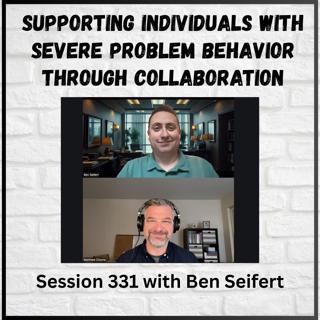
Supporting Individuals With Severe Problem Behavior Through Collaboration: Session 331 with Ben Seifert

Supporting Individuals With Severe Problem Behavior Through Collaboration: Session 331 with Ben Seifert

In Session 331, I sat down with Dr. Ben Seifert to talk about some of the most challenging — and important — work happening in applied behavior analysis today: supporting individuals with severe probl...

14 Touko 1h 3min
Supporting Health and Wellness in Developmental Disabilities: Session 330: Brandon May, Maggie Pavone, and Kate Heersink

Supporting Health and Wellness in Developmental Disabilities: Session 330: Brandon May, Maggie Pavone, and Kate Heersink

In this episode, I'm joined by Drs. Brandon May and Maggie Pavone, and Kate Heersink to talk about how we can better support healthier lifestyles for individuals with developmental disabilities. We st...

25 Huhti 1h 13min

Train Smarter, Not Harder: Heart Rate Zones, VO2 Max, and Better Fitness: Session 329 with Nick Green

Train Smarter, Not Harder: Heart Rate Zones, VO2 Max, and Better Fitness: Session 329 with Nick Green

In Session 329, I'm joined once again by Dr. Nick Green, Ph.D., BCBA-D, who's been doing some really interesting work at the intersection of fitness and behavior science. In this episode, Nick walks u...

8 Huhti 1h 1min

Suosittua kategoriassa Tiede

tiedekulma-podcast
rss-mita-tulisi-tietaa
utelias-mieli
rss-poliisin-mieli
docemilia
mielipaivakirja
rss-hereilla
rss-kasvatuspsykologiaa-kaikille
rss-ylistys-elaimille
rss-lihavuudesta-podcast
rss-totuuden-liepeilla
hippokrateen-vastaanotolla
rss-kipinoita-podcast
rss-duodecim-lehti
rss-laakaripodi
rss-tiedetta-vai-tarinaa
rss-ilmasto-kriisissa