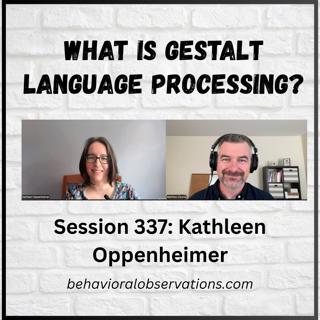
What is Gestalt Language Processing? Session 337 with Kathleen Oppenheimer

What is Gestalt Language Processing? Session 337 with Kathleen Oppenheimer

Gestalt Language Processing (GLP) and Natural Language Acquisition (NLA) have become extraordinarily popular in speech-language pathology, particularly in conversations about autistic children who use echolalia.

But what exactly is a "Gestalt Language Processor?" How would we know if someone is one? And perhaps most importantly, what does the research actually tell us about the claims and treatment recommendations associated with GLP and NLA?

In this episode, I'm joined by speech-language pathologist Kathleen Oppenheimer, who has spent considerable time examining these questions through the lens of language science and psycholinguistics.

Kathleen describes how she first encountered GLP and NLA on social media during the pandemic and why some of the claims she encountered immediately raised questions for her as someone trained in linguistics.

We unpack the distinction between language production and language processing, and discuss why observing the words and phrases a child says cannot necessarily tell us how that child is processing language.

We also explore an important nuance in this debate: Many practices commonly associated with NLA are quite reasonable—and in some cases very well aligned with established, evidence-based approaches. Following the child's lead, building strong therapeutic relationships, recognizing echolalia as meaningful communication, and honoring multiple forms of communication are all valuable practices.

But those practices aren't unique to NLA.

Kathleen contrasts NLA recommendations with research-supported approaches such as Enhanced Milieu Teaching, and explains why recommendations involving prompting, single-word models, verbs, and grammatical language input matter for language development.

Along the way, we discuss:
  • What GLP and NLA actually claim about language development.
  • Why defining and reliably identifying a "Gestalt Language Processor" is more difficult than social media might suggest.
  • The difference between what a child says and how researchers determine what a child is actually processing.
  • What psycholinguistic methods such as the visual world paradigm can tell us about real-time language comprehension.
  • Why echolalia can be meaningful communication without accepting the larger GLP/NLA framework.
  • The substantial areas of common ground between NLA proponents and research-aligned language interventions.
  • Why following a child's lead and honoring their communication does not require adopting NLA stages.
  • How Enhanced Milieu Teaching differs from NLA-based intervention.
  • Concerns about recommendations to avoid or delay modeling single words, verbs, and certain grammatical forms.
  • What we know—and don't know—about the empirical evidence supporting GLP/NLA.
  • How social media can turn nuanced clinical ideas into much broader claims.
  • The potential costs of implementing unsupported interventions, even when those interventions appear benign.
  • How clinicians can have productive conversations with colleagues and families who have embraced GLP/NLA.
  • Why clear, jargon-free explanations of what we're doing in therapy—and why we're doing it—matter.

One thing I especially appreciated about this conversation is that Kathleen doesn't approach this as a simple choice between being "for" or "against" GLP/NLA. Instead, she encourages us to pull apart the individual claims and practices, retain the components that are supported by evidence, and scrutinize those that aren't.

For clinicians navigating an increasingly complicated landscape of research, social media, and rapidly spreading treatment approaches, I think that's an incredibly useful framework.

Resources discussed in this episode: Sponsor shoutouts:
  • Behavior University. Their mission is to provide university quality professional development for the busy Behavior Analyst. Learn about their CEU offerings, including their 8-hour Supervision Course, as well as their RBT offerings over at behavioruniversity.com/observations. Don't forget to use the coupon code, PODCAST to save at checkout!
  • Safety-Care is a crisis prevention and de-escalation training program designed for professionals who support individuals with challenging behavior. More than 300,000 professionals have been trained in Safety-Care's evidence-based approach to recognizing early warning signs and responding with confidence. To learn more, visit QBS.com/podcast.
  • Learn from your favorite podcast guests while you're commuting, walking the dog, or whatever else you do while listening to podcasts. New events are being added all the time, so check them out here.
  • HRIC Recruting. Cut out the middleman and speak directly with Barbara Voss, who's been placing BCBAs in great jobs all across the US for 15 years.
  • The BOP Patreon. Do you want to get the show ad-free and before everyone else? Click here to learn how!

Tämä jakso on lisätty Podme-palveluun avoimen RSS-syötteen kautta eikä se ole Podmen omaa tuotantoa. Siksi jakso saattaa sisältää mainontaa.

Jaksot(339)

What is Facilitated Communication? BOP Rewind | Session 199/336 | Jason Travers

What is Facilitated Communication? BOP Rewind | Session 199/336 | Jason Travers

Welcome to Session 336 The Behavioral Observations Podcast. Well technically, this is actually Session 199, and I wanted to take a minute to explain why you're hearing a rebroadcast. This conversation...

24 Heinä 1h 13min
Conducta Verbal: Cultura, Contexto y Comunicación Funcional | BOP en ESP 18 con Janet Enriquez

Conducta Verbal: Cultura, Contexto y Comunicación Funcional | BOP en ESP 18 con Janet Enriquez

En este episodio, Miguel conversa con Janet sobre la conducta verbal desde una perspectiva práctica y cultural. A lo largo de la conversación, exploran por qué la conducta verbal sigue siendo una de l...

14 Heinä 1h 23min
Essential for Living in Action: Building Meaningful Skills Through Everyday Events | Session 334 with Kristina Montgomery and Emily Beal Wilkinson

Essential for Living in Action: Building Meaningful Skills Through Everyday Events | Session 334 with Kristina Montgomery and Emily Beal Wilkinson

Many behavior analysts have experienced the frustration of teaching a skill successfully in one setting only to discover that it doesn't transfer to the situations where it actually matters. In this e...

30 Kesä 1h 24min
Beyond 80% Correct: Rethinking Mastery Criteria in ABA: Session 333 with Sarah Richling & Dan Fienup

Beyond 80% Correct: Rethinking Mastery Criteria in ABA: Session 333 with Sarah Richling & Dan Fienup

How do we determine when a learner has truly mastered a skill? In behavior analysis, performance criteria such as "80% correct across two sessions" have become nearly ubiquitous. Yet despite their wid...

12 Kesä 1h 12min
Helping Complex Kids Thrive Through Practical Behavioral Parenting Strategies: Jenny Demark, Linda Reinstein and Conrad Leung | Session 332

Helping Complex Kids Thrive Through Practical Behavioral Parenting Strategies: Jenny Demark, Linda Reinstein and Conrad Leung | Session 332

In this episode, I'm joined by Dr. Jenny Demark, Conrad Leung, and Dr. Linda Reinstein to talk about their new book, Complex Kids, Simple Solutions: How to Raise Resilient, Confident, Likable Kids. Th...

27 Touko 1h 9min
Supporting Individuals With Severe Problem Behavior Through Collaboration: Session 331 with Ben Seifert

Supporting Individuals With Severe Problem Behavior Through Collaboration: Session 331 with Ben Seifert

In Session 331, I sat down with Dr. Ben Seifert to talk about some of the most challenging — and important — work happening in applied behavior analysis today: supporting individuals with severe probl...

14 Touko 1h 3min
Supporting Health and Wellness in Developmental Disabilities: Session 330: Brandon May, Maggie Pavone, and Kate Heersink

Supporting Health and Wellness in Developmental Disabilities: Session 330: Brandon May, Maggie Pavone, and Kate Heersink

In this episode, I'm joined by Drs. Brandon May and Maggie Pavone, and Kate Heersink to talk about how we can better support healthier lifestyles for individuals with developmental disabilities. We st...

25 Huhti 1h 13min

Suosittua kategoriassa Tiede

rss-poliisin-mieli
tiedekulma-podcast
rss-mita-tulisi-tietaa
rss-tiedetta-vai-tarinaa
utelias-mieli
rss-tervetta-skeptisyytta
rss-ammamafia
rss-duodecim-lehti
rss-ylistys-elaimille
rss-kasvikutsut
rss-radplus
rss-luontopodi-samuel-glassar-tutkii-luonnon-ihmeita
rss-ranskaa-raakana
hippokrateen-vastaanotolla
mielipaivakirja
rss-bios-podcast
filocast-filosofian-perusteet
rss-astetta-parempi-elama-podcast