The Number That Isn't Your Return
Conviction Bet30 Heinä

The Number That Isn't Your Return

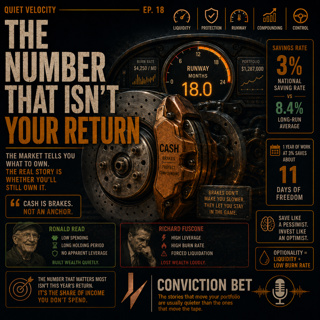
A Vermont gas station attendant died in 2014 holding $8 million and a five-inch stack of stock certificates. That same year, a former Merrill Lynch executive who once ran the firm's Latin America arm lost an 18,000-square-foot house at foreclosure. His bankruptcy filing listed debts to American Express, Mercedes-Benz — and the local pet store.

The visible difference was not credentials. This episode is about what actually sets a long-term investor's outcome: not what you own, but whether you'll ever be forced to sell it — and why the number with the most direct line to that is the share of income you never spend.

In this episode:

Two ledgers that shouldn't both exist. Ronald Read pumped gas for about 25 years, then spent 17 as a JCPenney janitor, drove a second-hand Toyota Yaris, and left $4.8 million to his local hospital and $1.2 million to its library. Richard Fuscone had the MBA, the "40 under 40" listing, and a house whose upkeep reportedly ran over $90,000 a month. Finance is unusually tolerant of a gap between credentials and outcomes.

Cash is brakes, not an anchor. On a spec sheet, brakes look like a pure negative. They're also the only reason a car can go fast. Morgan Housel has described keeping roughly a fifth of his investment holdings in cash and owning his house outright — not because cash is safe, but so the equities need never be touched. Bill Gates paired the most aggressive bet in modern business history with twelve months of payroll in the bank.

A record $397 billion. Berkshire closed Q1 2026 with $397.4 billion in cash and short-term Treasuries, more than a third of the entire company's market value, after 14 consecutive quarters of selling more stock than it bought. The most celebrated equity investor in history built an institution now paying an enormous opportunity cost for optionality — in public, on purpose.

Eleven days. The U.S. personal saving rate was 3.0% in May, against an 8.4% average since 1959 — and it's an aggregate, not a typical household's rate. But run it as a hypothetical: at a personal savings rate of 3%, on a deliberately simplified no-return calculation, every year you work funds about 11 days of current spending. At 8.4%, about 33.

Wanting is not liking. Kent Berridge and Terry Robinson established that the two are separable, supported by partly different brain systems. Plus what the 2023 Killingsworth–Kahneman–Mellers reconciliation actually found about income and well-being, and the one category where money converts most cleanly into it — which nearly half of 800-plus millionaires surveyed spent nothing on.

Thirteen households. A Canadian six-digit postal code holds a median of 13 households, smaller than a city block. Across 7,377 lottery prizes, a win equal to median annual income was associated with roughly 6.6% more bankruptcies among neighbors who won nothing, whose balance sheets showed more visible assets and drift toward riskier holdings. A few blocks out, the effect largely vanished.

The steel man. Morningstar's 1.2-percentage-point investor return gap has done years of load-bearing work in behavioral finance. In May 2026, Fulkerson, Jordan, Riley and Yan re-examined the same sample and put wealth-destroying bad timing at about one tenth of a point. The gap is real as a calculation; the interpretation is now contested. Why the thesis survives it anyway — and where the cash drag has to be priced, not denied.

What it means for you. Two computable numbers instead of "save more": a floor for later, and runway now. Plus an honest boundary — this is strongest early in accumulation, when annual contributions are still large relative to the portfolio. For a big existing portfolio or a retiree drawing down, allocation, fees and taxes matter more.

New episodes weekly. Subscribe on Apple Podcasts, Spotify, YouTube, or Amazon Music.

Conviction Bet is independent investment commentary. Nothing in this episode is investment advice.

Tämä jakso on lisätty Podme-palveluun avoimen RSS-syötteen kautta eikä se ole Podmen omaa tuotantoa. Siksi jakso saattaa sisältää mainontaa.

Jaksot(21)

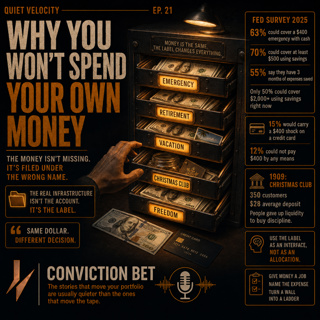
Why You Won't Spend Your Own Money

Why You Won't Spend Your Own Money

Your balance tells you what you have. The label shapes what you'll actually use. And you're the one who wrote it.The Federal Reserve asked Americans two versions of the same question. 70% said they co...

25 Elo 32min

You Can Copy The Key, Not The Locksmith: Nick Sleep's 921% Manual Is Free

You Can Copy The Key, Not The Locksmith: Nick Sleep's 921% Manual Is Free

Two men, no analysts, no leverage, two letters a year. Twelve and a quarter years later: 921.1% against 116.9% for the MSCI World. A dollar became $10.21. Then they closed the fund, handed the capital...

13 Elo 37min

Can You Survive Being Right Too Early?

Can You Survive Being Right Too Early?

In late July, the market decided the AI build-out had gone too far. The Nasdaq fell into its second correction of the year, the Philadelphia Semiconductor Index dropped into a technical bear market, a...

6 Elo 32min

He Knew Better. He Did It Anyway

He Knew Better. He Did It Anyway

In March 2000, Stanley Druckenmiller had the internet bubble exactly right. He had shorted it, written the thesis, and run money for two decades without a losing year. Then he watched two junior trade...

23 Heinä 33min

Deferred Maintenance: Cash, Muscle, Sleep

Deferred Maintenance: Cash, Muscle, Sleep

The four biggest tech companies are planning as much as $725 billion of capital spending this year — up 77% in a single year — much of it on machines that never have to sleep. The people underwriting ...

16 Heinä 39min

The Rulebook You Never Read

The Rulebook You Never Read

At Monday's close, funds tracking the Nasdaq-100 lined up to buy an estimated $4 billion of SpaceX stock. Nobody at those funds decided SpaceX was worth owning — a rulebook decided. And three weeks ea...

9 Heinä 32min

The Four Cards You're Not Playing

The Four Cards You're Not Playing

79% of professional large-cap fund managers lost to the S&P 500 last year. Stretch the window to fifteen years and the failure rate hits roughly 90%. The internet's favorite conclusion: if the pros ca...

1 Heinä 28min

Suosittua kategoriassa Liike-elämä ja talous

sijotuskasti
vallattomat
psykopodiaa-podcast
rss-rahapodi
mimmit-sijoittaa
rss-oivalluksia-rahasta-elamasta
ostan-asuntoja-podcast
lakicast
oppimisen-psykologia
rss-inderes
rss-paasipodi
juristipodi
hyva-paha-johtaminen
rss-karon-grilli
rss-rahamania
rss-pinnan-alle
rss-alanvaihtajat
rss-startup-ministerio
rahapuhetta
rss-siksi-viestinta