You Can Copy The Key, Not The Locksmith: Nick Sleep's 921% Manual Is Free

You Can Copy The Key, Not The Locksmith: Nick Sleep's 921% Manual Is Free

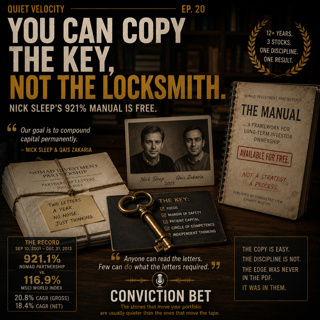
Two men, no analysts, no leverage, two letters a year. Twelve and a quarter years later: 921.1% against 116.9% for the MSCI World. A dollar became $10.21. Then they closed the fund, handed the capital back, and published all 110,000 words of their partnership letters on a charity website — free, for anyone.

Which is exactly why most people take the wrong lesson from Nick Sleep and Qais Zakaria. When the manual is free and the record is spectacular, the obvious move is to read the manual and copy the answer. This episode is about why the copy is worth far less than people think, what happens to a framework once it stops being a process and becomes a document, and what a serious investor should actually be watching instead.

In this episode:

921.1%, and the number everyone quotes wrongThe final letter reports 20.8% a year before performance fees; for a partner in from inception, the net-of-all-fees result was 18.4%. September 2001 to December 2013 is twelve and a quarter years, not thirteen — and the arithmetic only works that way. Roughly $2 billion made, mostly for charities and university endowments.

The mistake the whole framework grew out ofBefore the compounders, Nomad bought cigar butts — Xerox at 7% of its peak, 25 companies, 8 countries. Then Stagecoach: bought at 14p, Sleep's own written fair value 60p, sold into strength, up six-fold from purchase by the end of 2003. He wrote about it with controlled fury, because opportunity costs go unrecorded in performance records. Nobody audits the position you sold too early.

Two million pairs of jeans, and the sentence that made a careerCostco entered the fund at 3.1%, at $30 a share. A 14% markup on branded goods, 15% on private label, and a founder who refused a bigger markup on cheap denim: "if I let you do it this time, you will do it again." By 2004 it had a name on a whiteboard — scale efficiencies shared — and by 2005 a measuring stick: roughly five dollars saved for the customer per dollar Costco kept. And his answer to why nobody else noticed: investors discount every stock for the risk of eventual failure, including the ones that never fail. Great businesses can stay cheap — not for a quarter, but for decades.

They ran the model on their own fundTen basis points inside Marathon; on spinning out, a cost-reimbursement fee capped at 1% and falling as assets grew. 20% of profits above a 6% hurdle — then Sleep spotted a conflict in his own contract and rewrote it against himself, putting the fee at risk for five years. He closed the fund at just over $100 million. Three questions you can ask of anything you own come from this.

After the workshop closedThe 2021 preamble, where they called 20% a year for twenty years "all but inevitable." The 2018 decision to sell half his Amazon at $1,500 — "I hated it" — and the honest case that trimming a position at 70% of your net worth isn't the error his letters warned about. Then ASOS: revenue down 14%, gross margin up 330bps to 48.5%, a £93m free cash outflow — and a conclusion the evidence won't let us reach cleanly.

The bear case, and the contrast caseSurvivorship bias with excellent prose attached — given its best shot. Plus Jeremy Hosking: same firm, same intellectual ancestry, still holding memory chipmakers bought in 2013 on capital-cycle logic, as the number of serious players fell from thirty-plus to three.

What it means for youCostco and Amazon still run the loop the letters described. But you're holding a copy of a key cut in 2004, for a world that has had the internet rebuilt underneath it twice. It may still fit. You won't be told the day it stops. So don't test your framework by whether it's producing winners — that lags by years. Test whether it's still producing new questions.

New episodes weekly. Subscribe on Apple Podcasts, Spotify, YouTube, or Amazon Music.

Conviction Bet is independent investment commentary. Nothing in this episode is investment advice.

Tämä jakso on lisätty Podme-palveluun avoimen RSS-syötteen kautta eikä se ole Podmen omaa tuotantoa. Siksi jakso saattaa sisältää mainontaa.

Jaksot(21)

Why You Won't Spend Your Own Money

Why You Won't Spend Your Own Money

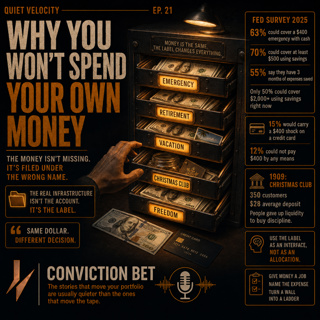
Your balance tells you what you have. The label shapes what you'll actually use. And you're the one who wrote it.The Federal Reserve asked Americans two versions of the same question. 70% said they co...

25 Elo 32min

Can You Survive Being Right Too Early?

Can You Survive Being Right Too Early?

In late July, the market decided the AI build-out had gone too far. The Nasdaq fell into its second correction of the year, the Philadelphia Semiconductor Index dropped into a technical bear market, a...

6 Elo 32min
The Number That Isn't Your Return

The Number That Isn't Your Return

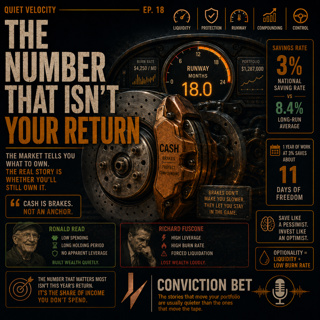
A Vermont gas station attendant died in 2014 holding $8 million and a five-inch stack of stock certificates. That same year, a former Merrill Lynch executive who once ran the firm's Latin America arm ...

30 Heinä 39min
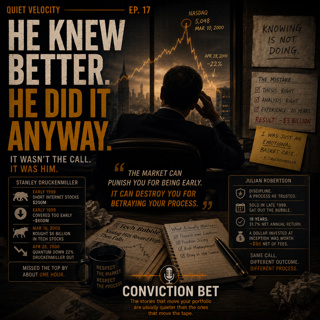
He Knew Better. He Did It Anyway

He Knew Better. He Did It Anyway

In March 2000, Stanley Druckenmiller had the internet bubble exactly right. He had shorted it, written the thesis, and run money for two decades without a losing year. Then he watched two junior trade...

23 Heinä 33min
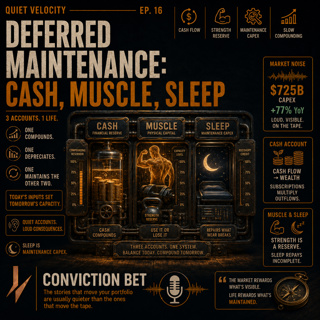
Deferred Maintenance: Cash, Muscle, Sleep

Deferred Maintenance: Cash, Muscle, Sleep

The four biggest tech companies are planning as much as $725 billion of capital spending this year — up 77% in a single year — much of it on machines that never have to sleep. The people underwriting ...

16 Heinä 39min
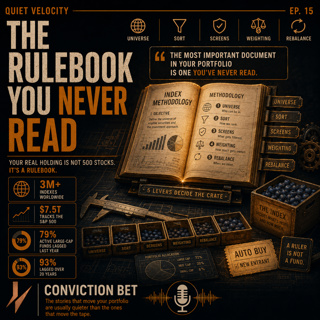
The Rulebook You Never Read

The Rulebook You Never Read

At Monday's close, funds tracking the Nasdaq-100 lined up to buy an estimated $4 billion of SpaceX stock. Nobody at those funds decided SpaceX was worth owning — a rulebook decided. And three weeks ea...

9 Heinä 32min

The Four Cards You're Not Playing

The Four Cards You're Not Playing

79% of professional large-cap fund managers lost to the S&P 500 last year. Stretch the window to fifteen years and the failure rate hits roughly 90%. The internet's favorite conclusion: if the pros ca...

1 Heinä 28min

Suosittua kategoriassa Liike-elämä ja talous

sijotuskasti
vallattomat
psykopodiaa-podcast
rss-rahapodi
mimmit-sijoittaa
rss-oivalluksia-rahasta-elamasta
ostan-asuntoja-podcast
lakicast
oppimisen-psykologia
rss-inderes
rss-paasipodi
juristipodi
hyva-paha-johtaminen
rss-karon-grilli
rss-rahamania
rss-pinnan-alle
rss-alanvaihtajat
rss-startup-ministerio
rahapuhetta
rss-siksi-viestinta