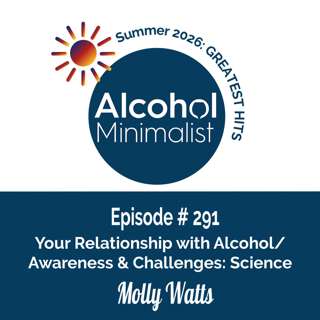
Summer's Greatest Hits: Your Relationship with Alcohol-Awareness & Challenges: Science

Summer's Greatest Hits: Your Relationship with Alcohol-Awareness & Challenges: Science

For the Alcohol Minimalist Summer’s Greatest Hits series, Molly revisits the most downloaded episode in the podcast’s catalog.

In this episode, she explores one of the biggest challenges to changing your relationship with alcohol: understanding what is happening in your brain.

Alcohol affects neurotransmitters involved in relaxation, inhibition, pleasure, and motivation. Over time, repeated drinking teaches the brain to associate alcohol with rewards such as relief, connection, celebration, or escape. Eventually, drinking can become an automatic response to familiar cues—like the end of the workday, the weekend, stress, or uncomfortable emotions.

But an automatic habit is not proof that you are broken, powerless, or destined to struggle forever.

Your brain learned the habit, and it can learn a new one.

In This Episode

  • Why shame and labels can keep people from seeking help
  • The difference between a drinking habit and physical dependence
  • How dopamine reinforces the desire to keep drinking
  • Why alcohol can make you feel better and worse at the same time
  • How repeated drinking becomes automatic
  • Why awareness is the first step toward lasting change
  • How your future-focused brain can interrupt reactive urges

Key Takeaway

Changing your drinking begins with observing your thoughts and habits without judgment.

When you understand what your brain is doing, you can stop treating your drinking as evidence of a personal flaw and start practicing new responses.

Awareness is the brain’s fuel for change.

Resources Mentioned

  • The Sober Truth by Lance Dodes, MD, and Zachary Dodes
  • CDC and SAMHSA research on excessive drinking and alcohol dependence
  • The Alcohol Minimalist Podcast Listening Guide

Next week, Molly continues the conversation by exploring how society and the alcohol industry influence our drinking habits.


Low risk drinking guidelines from the NIAAA:
Healthy men under 65:
No more than 4 drinks in one day and no more than 14 drinks per week.
Healthy women (all ages) and healthy men 65 and older:
No more than 3 drinks in one day and no more than 7 drinks per week.
One drink is defined as 12 ounces of beer, 5 ounces of wine, or 1.5 ounces of 80-proof liquor. So remember that a mixed drink or full glass of wine are probably more than one drink.

Abstinence from alcohol
Abstinence from alcohol is the best choice for people who take medication(s) that interact with alcohol, have health conditions that could be exacerbated by alcohol (e.g. liver disease), are pregnant or may become pregnant or have had a problem with alcohol or another substance in the past.
Benefits of “low-risk” drinking
Following these guidelines reduces the risk of health problems such as cancer, liver disease, reduced immunity, ulcers, sleep problems, complications of existing conditions, and more. It also reduces the risk of depression, social problems, and difficulties at school or work.

★ Support this podcast ★

Tämä jakso on lisätty Podme-palveluun avoimen RSS-syötteen kautta eikä se ole Podmen omaa tuotantoa. Siksi jakso saattaa sisältää mainontaa.

Jaksot(399)

Summer's Greatest Hits:Your Relationship with Alcohol-Awareness & Challenges: Society & Industry

Summer's Greatest Hits:Your Relationship with Alcohol-Awareness & Challenges: Society & Industry

This week on the Alcohol Minimalist Podcast, Molly continues the Summer’s Greatest Hits series by revisiting one of the earliest episodes of the show.Last week focused on the science behind alcohol an...

10 Elo 20min

Think Thursday: The Effort Paradox

Think Thursday: The Effort Paradox

When does persistence help us grow—and when does it keep us stuck?In this Think Thursday episode, Molly explores the effort paradox, effort justification, and the sunk-cost effect. We often value some...

6 Elo 13min

Think Thursday: Why Endings Matter More Than We Realize

Think Thursday: Why Endings Matter More Than We Realize

Why can the final moments of an experience shape how we remember the whole thing?In this Think Thursday episode, Molly explores the peak-end rule—the brain’s tendency to remember an experience largely...

30 Heinä 12min

Your Evening Brain: Work With It - Not Against It

Your Evening Brain: Work With It - Not Against It

Why does the commitment you make over your morning coffee sometimes feel so much harder to keep after dinner?In this episode, Molly explores the neuroscience behind what she calls your Evening Brain—t...

27 Heinä 14min

Think Thursday: A Love Letter to Your Beautiful Brilliant Human Brain for World Brain Day

Think Thursday: A Love Letter to Your Beautiful Brilliant Human Brain for World Brain Day

In honor of World Brain Day on July 22, this Think Thursday episode celebrates the extraordinary organ behind every thought, memory, feeling, and behavior.Molly explores how the brain functions as:A p...

23 Heinä 14min

Revisiting: Drinking Alone & Drinking Secrecy-Why It's Important to Change

Revisiting: Drinking Alone & Drinking Secrecy-Why It's Important to Change

This week, Molly is revisiting an important episode about drinking alone, drinking secrecy, and what these behaviors may reveal about your relationship with alcohol.Drinking alone does not automatical...

20 Heinä 25min

Think Thursday: Why Your Future Self Feels Like A Stranger

Think Thursday: Why Your Future Self Feels Like A Stranger

Why do we make choices today that we know will make life harder tomorrow?In this Think Thursday episode, Molly explores the science of temporal discounting and future-self continuity—and why the perso...

16 Heinä 14min

Suosittua kategoriassa Koulutus

rss-murhan-anatomia
psykopodiaa-podcast
kesken
ilona-rauhala
adhd-podi
psykologia
rss-vapaudu-voimaasi
rss-arkea-ja-aurinkoa-podcast-espanjasta
rss-laadukasta-ensihoitoa
rss-koira-haudattuna
voi-hyvin-meditaatiot-2
jari-sarasvuo-podcast
rss-hereilla
rss-liian-kuuma-peruna
rss-loyda-voimasi
filocast-filosofian-perusteet
aamupore
rss-xamk-podcast
rss-spessu
rss-tietoinen-yhteys-podcast-2