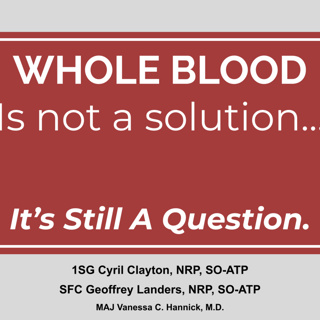

SOMA 26' - Fresh Whole Blood is Not The Answer: It's Still a Question

SOMA 26' - Fresh Whole Blood is Not The Answer: It's Still a Question

Whole Blood Is Not a Solution (Until Conventional Forces Can Deliver It)

Recorded live at SOMA 26

Dr. Vanessa Hanick (emergency physician, former active-duty Army, now National Guard) and 1SG Cy Clayton (Ranger Regiment veteran, currently a conventional Role 2 first sergeant) deliver a blunt assessment of a critical readiness gap: while whole blood is the agreed standard of care for damage control resuscitation, conventional forces remain largely unprepared to provide it in support of SOF or any large-scale operations. Drawing on recent deployment experience, unit surveys, and Joint Trauma System training observations, they outline three lethal capability gaps—planning, logistics, and training—and call for proactive SOF-conventional collaboration, institutional reform, and immediate use of available Joint Trauma System mobile training teams.

Sponsored by the Special Operations Medical Association.

Key Takeaways

  • The 2021 Joint Trauma System / Defense Committee on Trauma position statement establishes whole blood as the resuscitative fluid of choice that must be available at every echelon and on every evacuation platform within 30 minutes of injury. This is an operational standard, not an aspiration.
  • Conventional forces currently fail this standard across three critical gaps: failure to plan (MASCAL and walking blood bank plans are incomplete, unilateral, or nonexistent), logistical incompetence (unreliable cold chain, storage, transport, and warming), and inadequate training (high failure rates on whole blood transfusion even among medics who pass TCCC recertification).
  • Survey data from conventional brigade-sized elements show near-zero SOPs for walking blood banks, minimal storage capacity, zero transport or warming capability in many units, and cold-chain training limited to vaccines rather than blood.
  • SOF leaders and medics cannot assume conventional support will materialize when needed. Early, deliberate linking with conventional Role 1/2 counterparts—sharing knowledge, training together, and validating capabilities—is essential.
  • Joint Trauma System mobile training teams (including the Blood Whole Blood Training Program) already exist and can travel to conventional units to build pre-hospital, Role 2, and Role 3 whole blood and walking blood bank competency. These resources should be used now.
  • In future large-scale combat operations the problem only intensifies; the time to close the gap is before the emergency, not during it.


Chapters00:00 – Introduction and disclosures

01:30 – Why SOF–conventional collaboration matters now

03:40 – The 2021 JTS whole blood standard and its implications

05:50 – Three critical capability gaps in conventional forces

06:50 – Gap 1: Failure to plan (Kuwait MASCAL and walking blood bank case study)

11:20 – Gap 2: Logistical incompetence (cold-chain failures on deployment)

13:20 – Gap 3: Training shortfalls (high failure rates on whole blood transfusion)

15:40 – Survey data from conventional units: near-zero capabilities

19:20 – Institutional, organizational, and individual solutions

21:40 – SOF responsibility: link early, train together, validate capabilities

24:40 – Joint Trauma System resources and call to action

28:00 – Closing remarks

Tämä jakso on lisätty Podme-palveluun avoimen RSS-syötteen kautta eikä se ole Podmen omaa tuotantoa. Siksi jakso saattaa sisältää mainontaa.

Jaksot(624)

294 - Do Antibiotics Really Reduce Mortality in Trauma? Wound Care First in Prolonged Field Care

294 - Do Antibiotics Really Reduce Mortality in Trauma? Wound Care First in Prolonged Field Care

Antibiotics are not magic. In this episode of the PFC Podcast, Dennis sits down with Ryan to cut through the common myth that “I’ve given antibiotics, so the wound is protected.” They unpack why vigor...

31 Elo 36min
293 - Dead Tissue Kills in Prolonged Field Care: 4 C’s, Early Debridement & Delayed Primary Closure Lessons from the Field

293 - Dead Tissue Kills in Prolonged Field Care: 4 C’s, Early Debridement & Delayed Primary Closure Lessons from the Field

In this episode of the PFC Podcast, Dennis sits down with missionary surgeon Jason to cut through the noise on real-world wound care in austere and unconventional warfare environments. From the bridge...

24 Elo 49min
SOMA 26' - European Medical Preparations for Major Engagements and Large-Scale Combat Operations

SOMA 26' - European Medical Preparations for Major Engagements and Large-Scale Combat Operations

Recorded live at SOMA 26Pierre Pasquier (France) and his German counterpart deliver a clear-eyed assessment of how European military medical systems are preparing for large-scale combat operations and...

20 Elo 31min
292-Building Mobile Surgical Capability in Denied Environments

292-Building Mobile Surgical Capability in Denied Environments

In this episode of the Prolonged Field Care Podcast, Dennis sits down with Mitch (U.S. family practice/ER physician) and Augustine (frontline surgeon with five years of experience) to unpack what it a...

17 Elo 41min
SOMA 26 - Optimizing the Efficacy of Commonly Used Tactical Medical Gear and Medications In The Arctic Extreme Cold Operational Environment

SOMA 26 - Optimizing the Efficacy of Commonly Used Tactical Medical Gear and Medications In The Arctic Extreme Cold Operational Environment

Recorded live at SOMA 26Dr. Emily Johnston (Cascadia Mountain Institute) and SFC Ezequiel Mendoza (Arctic Dustoff, Fairbanks) deliver a hard-hitting, field-validated look at how standard tactical medi...

13 Elo 29min
291 - Pediatric Burns In Prolonged Field Care Assessment, Resuscitation & Airway Management

291 - Pediatric Burns In Prolonged Field Care Assessment, Resuscitation & Airway Management

In this essential episode of the Prolonged Field Care Podcast, Dennis sits down with pediatric intensivist Dr. Sara Bibbens to tackle one of the most challenging and anxiety-inducing scenarios in aust...

10 Elo 30min
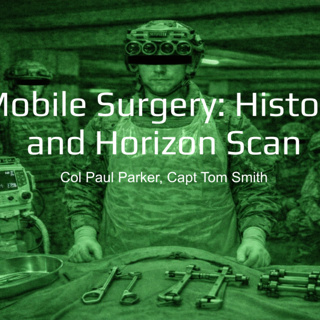
SOMA 26 - A History of Mobile Surgical Teams Role 1-3 and Horizon Scan

SOMA 26 - A History of Mobile Surgical Teams Role 1-3 and Horizon Scan

In this presentation, we take a deep dive into the 300-year history of mobile surgery supporting land campaigns — from Dominique Larrey’s ambulance volantes through the Letterman system, Arnhem, the F...

6 Elo 28min

Suosittua kategoriassa Koulutus

rss-murhan-anatomia
psykopodiaa-podcast
adhd-podi
voi-hyvin-meditaatiot-2
ihminen-tavattavissa-tommy-hellsten-instituutti
rss-vapaudu-voimaasi
rss-niinku-asia-on
rss-arkea-ja-aurinkoa-podcast-espanjasta
rss-uskonto-on-tylsaa
rss-liian-kuuma-peruna
kesken
rss-keskeneraiset-aidit
rahapuhetta
koulu-podcast-2
rss-koira-haudattuna
psykologia
esa-saarinen-filosofia-ja-systeemiajattelu
rss-rahamania
leveli
rss-valo-minussa-2