Why People Don't Like AI

Mark Zuckerberg has published a sweeping vision for personal superintelligence, arguing that the future of powerful artificial intelligence should belong to everyone, not just governments, corporations or the wealthy. On the surface, it is an optimistic and even compelling idea. Give every person access to extraordinary intelligence and you potentially democratise education, legal support, creativity, productivity and opportunity.

But that vision immediately raises a more uncomfortable question: why do so many people still distrust artificial intelligence?

In this episode of Artificial Intelligence to General Intelligence to Superintelligence, we explore TechCrunch’s sharp critique of Zuckerberg’s manifesto and ask whether the technology industry has fully understood the trust deficit created during the social media era.

The discussion goes beyond the article itself. We examine what happens when artificial intelligence becomes deeply personal, knows our habits, preferences, ambitions and weaknesses, yet still operates on infrastructure owned by powerful companies. We look at the promise of personalised tutors, legal assistants and widespread access to advanced intelligence, while also confronting the risks of dependency, surveillance, manipulation, educational shortcuts, legal overload and loss of human agency.

The deeper issue is not simply whether artificial intelligence becomes more capable. It is who controls it, who sets the rules, who owns the infrastructure, who protects users when things go wrong and whether people can genuinely opt out.

This episode argues that the next phase of artificial intelligence will not be decided by capability alone. Trust, transparency, accountability and human choice may become just as important as raw intelligence.

The final question is simple: if you were offered your own personal superintelligence tomorrow, would you feel empowered, or would you wonder who was really in control?

Tämä jakso on lisätty Podme-palveluun avoimen RSS-syötteen kautta eikä se ole Podmen omaa tuotantoa. Siksi jakso saattaa sisältää mainontaa.

Jaksot(28)

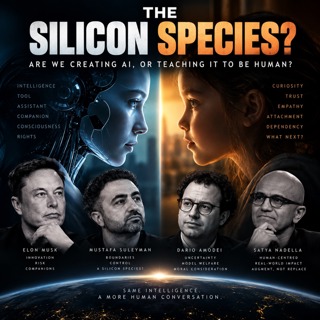
The Silicon Species?

The Silicon Species?

What if the greatest risk from artificial intelligence is not that machines become human, but that humans become convinced they are?In this episode of AI to AGI to ASI, I explore an emerging philosoph...

18 Syys 18min
Ten Percent to Extinction?

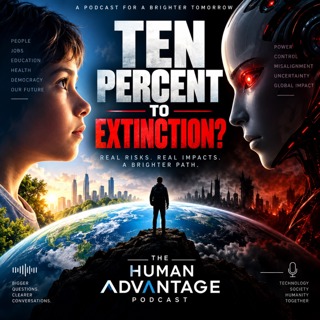
Ten Percent to Extinction?

What does it really mean when a leading artificial intelligence safety researcher says there may be more than a 10% chance that advanced artificial intelligence could cause human extinction within the...

9 Syys 20min

Trump: Rhetoric vs Nuance

Trump: Rhetoric vs Nuance

Every technological revolution arrives with disruption.Railways reshaped towns. Electricity transformed industry. The internet changed how we communicate and work. Some communities resisted. Others ru...

4 Syys 20min
Gates & Power to Govern

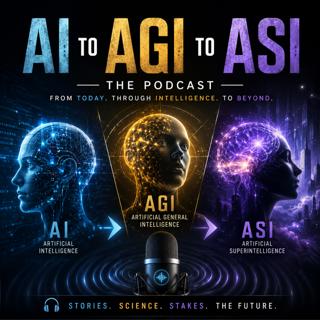
Gates & Power to Govern

Bill Gates says the artificial intelligence era will be turbulent, transformative and potentially dangerous. He argues that the choices humanity makes now could determine whether artificial intelligen...

28 Elo 20min

If Artificial Intelligence Learned to Think From Us, Can It Ever Think Beyond Us?

If Artificial Intelligence Learned to Think From Us, Can It Ever Think Beyond Us?

What happens when the intelligence we created can read almost everything humanity has ever written, and reason across it faster than any human being ever could?This episode explores one of the most pr...

21 Elo 19min

The Invisible Mark - Who Really Created This?

The Invisible Mark - Who Really Created This?

What happens when artificial intelligence leaves an invisible mark on the things we create?Anthropic has introduced a new approach to identifying content generated or processed by Claude, using invisi...

12 Elo 16min

The Promise and Peril of AI Designing Genomes

The Promise and Peril of AI Designing Genomes

Artificial intelligence has reached a remarkable new milestone. Researchers have successfully used generative AI to design entirely new bacteriophage genomes—viruses that infect bacteria—which were th...

10 Elo 10min