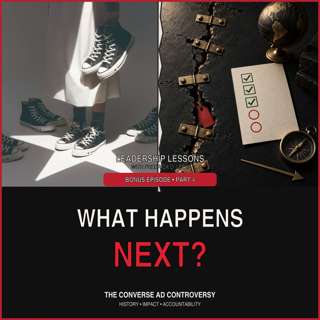

Bonus Episode, Part 4 What Happens Next?

Bonus Episode, Part 4 What Happens Next?

What happens after the apology?


That is where the real leadership test begins.


Converse removed the campaign imagery and said it understood why the image was deeply upsetting. Congressman Troy Carter then asked the questions many people were already asking: Who created it? Who approved it? How many leaders saw it? Was cultural expertise present, and did that expertise have influence?


Those are not merely public-relations questions. They are questions about governance, voice, authority and organizational learning.


In Part 4, Fredrick D. Lee II moves the conversation from outrage to action. The issue is no longer whether people intended a racist message. The issue is whether the organization will examine the conditions that allowed historically charged imagery to move from concept to publication and then make those conditions less likely to produce another failure.


What is publicly known

  • Converse removed the campaign images and issued an apology, saying it had gotten the image wrong and would do better.
  • Congressman Troy Carter publicly called for answers about the campaign’s creation, approval and distribution.
  • Reporting published September 21, 2026, states that Converse declined to answer questions about how the advertisement was screened and approved.
  • In the public sources reviewed for this episode as of September 21, 2026, no detailed corrective-action plan or account of the internal approval chain had been reported.

That last point is an evidence gap, not proof that no internal work is occurring.


The five actions that should come next


1. Acknowledge the harm without relitigating intent

Leaders do not have to confess an intent that has not been established. They do have to recognize the impact that audiences experienced.

When an organization centers its good intentions, it asks harmed people to comfort the institution. Accountability begins by listening without trying to win the interpretation.


2. Map the entire decision path

The review should follow the work from brief to concept, production, editing, agency review, regional review, legal review, executive approval and publication.

The purpose is not to stage a public firing. It is to determine where concerns were absent, muted, ignored or stripped of authority.


3. Use credible independence

The review should include people who were not invested in defending the original campaign. Historical and cultural expertise should be present, compensated and empowered to challenge the process.

Black employees should not be drafted as an unpaid cleanup crew after the damage is public.


4. Repair the approval system

Training alone is not a control.

A stronger system would include defined cultural-risk checkpoints, named decision owners, local and global review, written escalation rules and real stop-the-launch authority.

Representation matters, but representation without authority can become decoration.


5. Show the follow-through

“We will do better” becomes meaningful only when stakeholders can see what “better” means.

The organization should publish what it can responsibly disclose: the process failures it identified, the controls it changed, who owns implementation and when progress will be reviewed.


A 30-, 60- and 90-day cadence is one practical model, although the exact timetable should match the scope of the review.


Accountability is not scapegoating

Consequences may be appropriate, but they should follow evidence.

Removing one employee while leaving the same incentives, approval gates and power dynamics in place does not demonstrate learning. It creates the appearance of action while preserving the conditions that produced the failure.


Research on trust repair distinguishes short-term verbal responses, including apologies, from longer-term structural responses such as monitoring and changes to the relationship.


A separate meta-analysis of 46 samples found that properly conducted debriefs improved effectiveness on average, although that evidence spans many settings and does not study this campaign specifically.


The leadership implication is modest but useful: reflection works best when it is structured, aligned to the failure and connected to future action.


The leadership lesson

Organizations do not prove that they learned by making a promise. They prove it by changing who has voice, who has authority, how risk is reviewed and what evidence leaders are willing to show afterward.


The question is not how quickly the public should forgive Converse. The question is whether Converse and Nike will become more worthy of trust.


I am Dr. Fredrick D. Lee II, Ed.D., and this has been your Leadership Lesson in organizational impact.

Sources and further reading

About the host

Dr. Fredrick D. Lee II, Ed.D., brings together marketing, public administration, organizational change and leadership to examine how decisions become systems, how systems create impact and what accountable leaders do next.


Content note: This episode discusses racism, the Ku Klux Klan and the history and imagery of lynching. It analyzes publicly available information and does not claim knowledge of any individual’s private intent or Converse’s confidential internal deliberations.

Tämä jakso on lisätty Podme-palveluun avoimen RSS-syötteen kautta eikä se ole Podmen omaa tuotantoa. Siksi jakso saattaa sisältää mainontaa.

Jaksot(36)

Bonus Episode, Part 3 You Cannot Apologize Away Your Impact

Bonus Episode, Part 3 You Cannot Apologize Away Your Impact

Bonus Episode, Part 3 You Cannot Apologize Away Your ImpactThe Converse Ad Controversy: History, Impact and AccountabilitySome people hear the words “We’re sorry” and believe the conversation should b...

20 Syys 6min
Bonus Episode, Part 2 This Ad Had Too Many Chances to Be Stopped

Bonus Episode, Part 2 This Ad Had Too Many Chances to Be Stopped

Bonus Episode, Part 2This Ad Had Too Many Chances to Be StoppedThe Converse Ad Controversy: History, Impact and AccountabilityThis ad did not simply appear online. Before a global campaign reaches the...

20 Syys 6min

Bonus Episode, Part 1: You See Sneakers. I See History.

Bonus Episode, Part 1: You See Sneakers. I See History.

Bonus Episode, Part 1: You See Sneakers. I See History.Some of y’all are going to look at these advertisements and say, “It’s just shoes.” And that is exactly why we need to talk.In Part 1 of this Lea...

20 Syys 6min
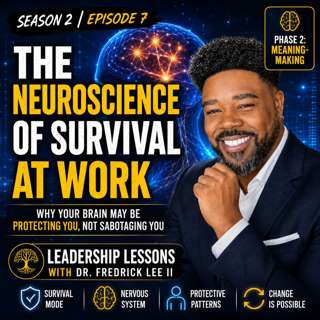
The Neuroscience of Survival at Work

The Neuroscience of Survival at Work

The Neuroscience of Survival at WorkSeason 2, Episode 7 | Phase 2: Meaning-Making — “Now I Understand Why”What if the behavior you keep criticizing in yourself is actually your nervous system trying t...

13 Elo 33min
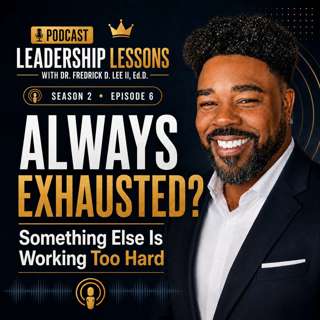
If You’re Always Exhausted, Something Else Is Working Too Hard

If You’re Always Exhausted, Something Else Is Working Too Hard

If You’re Always Exhausted, Something Else Is Working Too HardYou can be productive, dependable, successful, and still be deeply exhausted.Sometimes the problem is not simply how much you are doing. I...

27 Heinä 29min
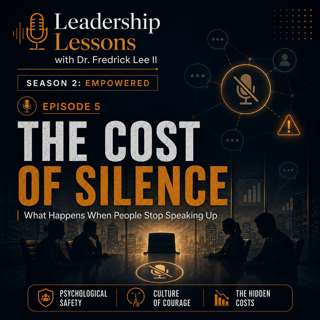
The Cost of Silence: What Happens When People Stop Speaking Up

The Cost of Silence: What Happens When People Stop Speaking Up

The Cost of Silence: What Happens When People Stop Speaking UpOne of the first signs that a culture, relationship, team, or family system is in trouble is not always noise.Sometimes it is quiet.A litt...

5 Heinä 32min
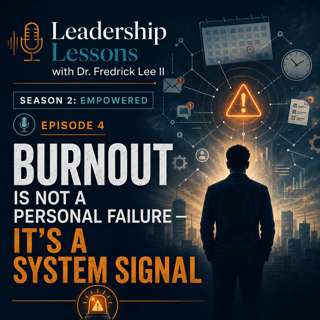
Burnout Is Not a Personal Failure — It’s a System Signal

Burnout Is Not a Personal Failure — It’s a System Signal

Episode SummaryIn this episode of Leadership Lessons, Dr. Fredrick Lee II explores burnout not as a personal weakness, but as a signal that something deeper is out of alignment. Burnout is often misun...

22 Kesä 37min

Suosittua kategoriassa Koulutus

rss-murhan-anatomia
aamukahvilla
psykopodiaa-podcast
voi-hyvin-meditaatiot-2
rss-arkea-ja-aurinkoa-podcast-espanjasta
kesken
rss-taysi-voima
koulu-podcast-2
psykologia
rss-suomen-aa-podcast
rss-hereilla
rss-liian-kuuma-peruna
aloita-meditaatio
rss-duodecim-lehti
rss-spessu
rahapuhetta
adhd-podi
rss-monarch-talk-with-alexandra-alexis
rss-niinku-asia-on
rss-narsisti