Michael Walford-Williams on Ethical Hacking of Human Controls

Michael Walford-Williams on Ethical Hacking of Human Controls

How can we assess the level of human risk we’re running in a control framework? Unlike technology, humans aren’t always reliable and how they behave under pressure may well be different to how they behave in normal situations.

My guest on this episode, Michael Walford-Willaims is a risk professional who specialises in how to plan for when things go wrong, covering areas like business continuity, operational resilience and crisis management.

Michael helps companies by testing out the human components of control frameworks to see where there might be weaknesses. He goes into organisations and tries to ethically hack them by trying to circumvent controls with human elements — that might be trying to get a fraudulent invoice paid or simply tailgating employees to see if he can get physical access to buildings.

His work serves two purposes:

Firstly it identifies potential weaknesses in controls. If he can get a fake invoice paid, then so can a fraudster. If he can get access to buildings, then so can thieves. By seeing how easy it is to bypass controls, organisations can get a better handle on their risk profile. Until you’ve actually tested the human controls, it’s impossible to know how weak or strong they actually are.

Secondly, it serves as a training exercise. Just like a fire evacuation drill, it’s better to have employees learn what to do or not do, by experiencing a simulation, than letting them learn from real-life situations.


This is human risk management in action. Of course there are ethical components to the work that Michael does — how far is it appropriate to test out your employees and what do you if you discover they are the weakest link in your security chain?

As Michael explains, we have to also think about what impact the exercise will have on those involved in it. If you think you’ve been tricked by your employer, that you’re somehow not trusted, or that your employer is prepared to deceive you and therefore the organisation is unethical, the exercise could actually make things worse. So the expertise Michael brings isn’t just about testing the proverbial fences. It’s planning exercises that don’t cross ethical lines and then using the information gleaned from them, sensitively and intelligently.

About Michael
Michael has worked for over 15 years in various aspects of risk management and compliance with a specialism in Business Continuity and Crisis Management and more recently third party risk management. He has worked in a number of countries globally having been based in London, Singapore and New York. Working in house and for the last 7 years as a consultant, Michael has worked across many industries for some of the largest organisations in the world including some of the worlds largest banks. and through his work in the field of crisis management has worked on a number of major incidents including the Japanese Tsunami and Fukushima incident, terror attacks in Mumbai, Boston and Moscow and numerous natural disasters, and technology & infrastructure failure related incidents. In 2014 Michael worked to set up one of the UK's first CrowdFunding platforms and as head of Operations and Compliance oversaw the first successful direct FCA authorisation of a platform for both Debt and Equity-based crowdfunding. Michael continues to work as a consultant as has just set up a new brand "Westbourne" to pull together a number of offerings in the risk management space.

You can contact him via LinkedIn: https://www.linkedin.com/in/michael-walford-williams-2302a78a/

Tämä jakso on lisätty Podme-palveluun avoimen RSS-syötteen kautta eikä se ole Podmen omaa tuotantoa. Siksi jakso saattaa sisältää mainontaa.

Jaksot(368)

Charlie Hurst, Tom Noble and Will Sudlow on Flat White or F*ck Off

Charlie Hurst, Tom Noble and Will Sudlow on Flat White or F*ck Off

What happens when someone runs with a business idea they've heard as a thought experiment on a podcast? Can a business have an expletive in its name? And is it possible to run a business that sells a ...

22 Helmi 1h 15min
Amy Watson on Violence Against Women & Girls

Amy Watson on Violence Against Women & Girls

What if we stopped telling women how to stay safe, and started asking why violence against them keeps happening in the first place? On this episode, I’m joined for a second time, by Amy Watson, the fo...

15 Helmi 1h 39min
Professor Veronica Root Martinez on Purpose-Driven Compliance

Professor Veronica Root Martinez on Purpose-Driven Compliance

Who determines what 'good' Compliance actually looks like?  The obvious answer is regulators (and in some jurisdictions) prosecutors. But what if it were the regulated Firms themselves?  That's the id...

7 Helmi 1h 2min
Professor Tina Weisser on Trusting AI In An Uncertain World

Professor Tina Weisser on Trusting AI In An Uncertain World

As Artificial Intelligence (AI) gets smarter and tkaes over more tasks, what happens to human dynamics like trust, transparency, leadership and empathy. How can humans and machines wowrk togehter effe...

27 Tammi 1h 9min
Becky Holmes on Romance Scams

Becky Holmes on Romance Scams

What lies behind Romance Fraud? Romance fraud is one of the fastest-growing forms of fraud worldwide, and one of the most emotionally devastating. It’s also one of the most misunderstood.On this epis...

21 Tammi 1h 8min
Amy Kean on Grief

Amy Kean on Grief

Why do we struggle to talk about grief? Why that matters and what we can do about it, is the subject of this episode.SummaryGrief is something almost all of us will experience, and yet something we st...

12 Tammi 1h 4min
Dr Guy Champniss on Business, BeSci and AI

Dr Guy Champniss on Business, BeSci and AI

Are we losing our ability to think critically as we rely more on AI?Episode SummaryMy guest is social psychologist Dr Guy Champniss to explore the role of behavioural science in business and the emerg...

7 Joulu 20251h 1min
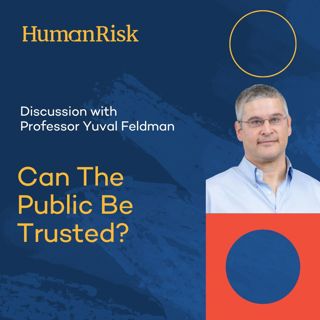
Professor Yuval Feldman on Can The Public Be Trusted?

Professor Yuval Feldman on Can The Public Be Trusted?

Why do governments rely on coercion and punishment when voluntary cooperation often produces better, more sustainable outcomes?Episode SummaryOn this episode, I’m joined once again by Professor Yuval ...

23 Marras 20251h 5min

Suosittua kategoriassa Tiede

rss-poliisin-mieli
tiedekulma-podcast
rss-mita-tulisi-tietaa
docemilia
filocast-filosofian-perusteet
rss-tiedetta-vai-tarinaa
rss-lapsuuden-rakentajat-podcast
sotataidon-ytimessa
menologeja-tutkimusmatka-vaihdevuosiin
rss-duodecim-lehti
rss-lihavuudesta-podcast
radio-antro
rss-bios-podcast
rss-metsantuntijat-podcast
rss-luontopodi-samuel-glassar-tutkii-luonnon-ihmeita