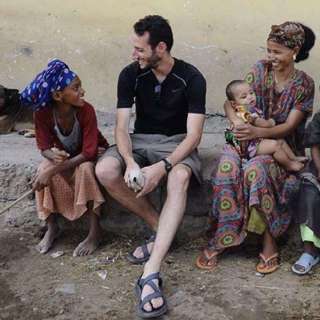

#18 - Ofir Reich on using data science to end poverty & the spurious action-inaction distinction

#18 - Ofir Reich on using data science to end poverty & the spurious action-inaction distinction

Ofir Reich started out doing math in the military, before spending 8 years in tech startups - but then made a sharp turn to become a data scientist focussed on helping the global poor.

At UC Berkeley’s Center for Effective Global Action he helps prevent tax evasion by identifying fake companies in India, enable Afghanistan to pay its teachers electronically, and raise yields for Ethiopian farmers by messaging them when local conditions make it ideal to apply fertiliser. Or at least that’s the hope - he’s also working on ways to test whether those interventions actually work.

Full post about this episode, including a transcript and relevant links to learn more.

Why dedicate his life to helping the global poor?

Ofir sees little moral difference between harming people and failing to help them. After all, if you had to press a button to keep all of your money from going to charity, and you pressed that button, would that be an action, or an inaction? Is there even an answer?

After reflecting on cases like this, he decided that to not engage with a problem is an active choice, one whose consequences he is just as morally responsible for as if he were directly involved. On top of his life philosophy we also discuss:

* The benefits of working in a top academic environment
* How best to start a career in global development
* Are RCTs worth the money? Should we focus on big picture policy change instead? Or more economic theory?
* How the delivery standards of nonprofits compare to top universities
* Why he doesn’t enjoy living in the San Francisco bay area
* How can we fix the problem of most published research being false?
* How good a career path is data science?
* How important is experience in development versus technical skills?
* How he learned much of what he needed to know in the army
* How concerned should effective altruists be about burnout?

Keiran Harris helped produce today’s episode.

Jaksot(326)

#92 – Brian Christian on the alignment problem

#92 – Brian Christian on the alignment problem

Brian Christian is a bestselling author with a particular knack for accurately communicating difficult or technical ideas from both mathematics and computer science. Listeners loved our episode abo...

5 Maalis 20212h 55min

#91 – Lewis Bollard on big wins against factory farming and how they happened

#91 – Lewis Bollard on big wins against factory farming and how they happened

I suspect today's guest, Lewis Bollard, might be the single best person in the world to interview to get an overview of all the methods that might be effective for putting an end to factory farming an...

15 Helmi 20212h 33min

Rob Wiblin on how he ended up the way he is

Rob Wiblin on how he ended up the way he is

This is a crosspost of an episode of the Eureka Podcast. The interviewer is Misha Saul, a childhood friend of Rob's, who he has known for over 20 years. While it's not an episode of our own show, we...

3 Helmi 20211h 57min

#90 – Ajeya Cotra on worldview diversification and how big the future could be

#90 – Ajeya Cotra on worldview diversification and how big the future could be

You wake up in a mysterious box, and hear the booming voice of God: “I just flipped a coin. If it came up heads, I made ten boxes, labeled 1 through 10 — each of which has a human in it. If it ca...

21 Tammi 20212h 59min

Rob Wiblin on self-improvement and research ethics

Rob Wiblin on self-improvement and research ethics

This is a crosspost of an episode of the Clearer Thinking Podcast: 022: Self-Improvement and Research Ethics with Rob Wiblin. Rob chats with Spencer Greenberg, who has been an audience favourite in...

13 Tammi 20212h 30min

#73 - Phil Trammell on patient philanthropy and waiting to do good [re-release]

#73 - Phil Trammell on patient philanthropy and waiting to do good [re-release]

Rebroadcast: this episode was originally released in March 2020. To do good, most of us look to use our time and money to affect the world around us today. But perhaps that's all wrong. If you too...

7 Tammi 20212h 41min

#75 – Michelle Hutchinson on what people most often ask 80,000 Hours [re-release]

#75 – Michelle Hutchinson on what people most often ask 80,000 Hours [re-release]

Rebroadcast: this episode was originally released in April 2020. Since it was founded, 80,000 Hours has done one-on-one calls to supplement our online content and offer more personalised advice. We ...

30 Joulu 20202h 14min
#89 – Owen Cotton-Barratt on epistemic systems and layers of defense against potential global catastrophes

#89 – Owen Cotton-Barratt on epistemic systems and layers of defense against potential global catastrophes

From one point of view academia forms one big 'epistemic' system — a process which directs attention, generates ideas, and judges which are good. Traditional print media is another such system, and we...

17 Joulu 20202h 38min

Suosittua kategoriassa Koulutus

rss-murhan-anatomia
voi-hyvin-meditaatiot-2
rss-narsisti
psykopodiaa-podcast
adhd-podi
rahapuhetta
rss-uskonto-on-tylsaa
rss-liian-kuuma-peruna
rss-rahamania
kesken
rss-vapaudu-voimaasi
rss-niinku-asia-on
salainen-paivakirja
rss-duodecim-lehti
rss-tietoinen-yhteys-podcast-2
rss-koira-haudattuna
aloita-meditaatio
mielipaivakirja
esa-saarinen-filosofia-ja-systeemiajattelu
filocast-filosofian-perusteet