#28 - Owen Cotton-Barratt on why scientists should need insurance, PhD strategy & fast AI progresses

#28 - Owen Cotton-Barratt on why scientists should need insurance, PhD strategy & fast AI progresses

A researcher is working on creating a new virus – one more dangerous than any that exist naturally. They believe they’re being as careful as possible. After all, if things go wrong, their own life and that of their colleagues will be in danger. But if an accident is capable of triggering a global pandemic – hundreds of millions of lives might be at risk. How much additional care will the researcher actually take in the face of such a staggering death toll?

In a new paper Dr Owen Cotton-Barratt, a Research Fellow at Oxford University’s Future of Humanity Institute, argues it’s impossible to expect them to make the correct adjustments. If they have an accident that kills 5 people – they’ll feel extremely bad. If they have an accident that kills 500 million people, they’ll feel even worse – but there’s no way for them to feel 100 million times worse. The brain simply doesn’t work that way.

So, rather than relying on individual judgement, we could create a system that would lead to better outcomes: research liability insurance.

Links to learn more, summary and full transcript.

Once an insurer assesses how much damage a particular project is expected to cause and with what likelihood – in order to proceed, the researcher would need to take out insurance against the predicted risk. In return, the insurer promises that they’ll pay out – potentially tens of billions of dollars – if things go really badly.

This would force researchers think very carefully about the cost and benefits of their work – and incentivize the insurer to demand safety standards on a level that individual researchers can’t be expected to impose themselves.

***Get this episode by subscribing to our podcast on the world’s most pressing problems and how to solve them: type '80,000 Hours' into your podcasting app.***

Owen is currently hiring for a selective, two-year research scholars programme at Oxford.

In this wide-ranging conversation Owen and I also discuss:

* Are academics wrong to value personal interest in a topic over its importance?
* What fraction of research has very large potential negative consequences?
* Why do we have such different reactions to situations where the risks are known and unknown?
* The downsides of waiting for tenure to do the work you think is most important.
* What are the benefits of specifying a vague problem like ‘make AI safe’ more clearly?
* How should people balance the trade-offs between having a successful career and doing the most important work?
* Are there any blind alleys we’ve gone down when thinking about AI safety?
* Why did Owen give to an organisation whose research agenda he is skeptical of?

Get this episode by subscribing to our podcast on the world’s most pressing problems and how to solve them: search for '80,000 Hours' in your podcasting app.

The 80,000 Hours Podcast is produced by Keiran Harris.

Tämä jakso on lisätty Podme-palveluun avoimen RSS-syötteen kautta eikä se ole Podmen omaa tuotantoa. Siksi jakso saattaa sisältää mainontaa.

Jaksot(346)

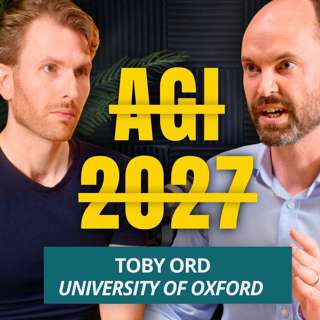
Where AGI timelines go wrong | Toby Ord, Oxford University

Where AGI timelines go wrong | Toby Ord, Oxford University

Both Silicon Valley and the public can’t get enough of ‘AGI timelines.’ But Toby Ord, senior researcher at Oxford’s AI Governance Initiative and author of The Precipice, believes we consistently make ...

6 Elo 2h 46min

What the hell happened with AGI timelines in 2026? – Rob Wiblin

What the hell happened with AGI timelines in 2026? – Rob Wiblin

Last October, famed coder Andrej Karpathy called AI agents “slop.” Two months later he completely reversed his view, describing them as “alien tools” that are “rocking the profession.”He was far from ...

4 Elo 49min

#249 – Spencer Greenberg on staying sane while trying to save the world

#249 – Spencer Greenberg on staying sane while trying to save the world

If you genuinely believe that humanity could be wiped out by AI or a pandemic, what is the appropriate amount of fear to feel?“As much as possible” can seem like the only reasonable answer. If the wor...

28 Heinä 2h 9min

#248 – Jasmine Sun on what the people building AI really believe

#248 – Jasmine Sun on what the people building AI really believe

Many AI researchers believe mass job displacement is coming — and some even think there’s a chance their technology will kill everyone. But they’re building it anyway. Writer and journalist Jasmine Su...

21 Heinä 1h 6min

#247 – Anton Leicht on how middle powers avoid losing everything in a post-AI world

#247 – Anton Leicht on how middle powers avoid losing everything in a post-AI world

In a post-AGI world, can a country without access to frontier AI even be considered sovereign anymore?Anton Leicht says once frontier AI becomes a core economic input, the countries that own it will p...

14 Heinä 1h 33min

#246 – Sneha Revanur on how a small team of activists helped pass America's landmark AI safety laws

#246 – Sneha Revanur on how a small team of activists helped pass America's landmark AI safety laws

Six years ago, aged just 15, Sneha Revanur founded the AI advocacy nonprofit Encode AI — back when AI felt like a niche issue. Now the world’s caught up with her, and she’s ready to share everything s...

8 Heinä 52min

We can guess what intergalactic war would look like. And strangely, it matters.

We can guess what intergalactic war would look like. And strangely, it matters.

Intergalactic war is probably billions of years away — yet physics can already tell us how it ends. And strangely that conclusion is relevant to decisions people have to make today.In this video, Rob ...

18 Kesä 15min

How AI could create the world’s biggest problems (article by Zershaaneh Qureshi)

How AI could create the world’s biggest problems (article by Zershaaneh Qureshi)

Imagine you’re living 15,000 years ago. Your people are hunter-gatherers and you sleep under the stars. If someone told you humans would one day build cities with millions of people, fly through the a...

11 Kesä 1h 29min

Suosittua kategoriassa Koulutus

rss-murhan-anatomia
psykopodiaa-podcast
voi-hyvin-meditaatiot-2
rss-vapaudu-voimaasi
psykologia
adhd-podi
ilona-rauhala
kesken
rss-luonnollinen-synnytys-podcast
rss-hereilla
rss-niinku-asia-on
jari-sarasvuo-podcast
aamukahvilla
rss-narsisti
rss-spessu
rss-laadukasta-ensihoitoa
rss-arkea-ja-aurinkoa-podcast-espanjasta
aamupore
rss-rahamania
rss-rouva-keto