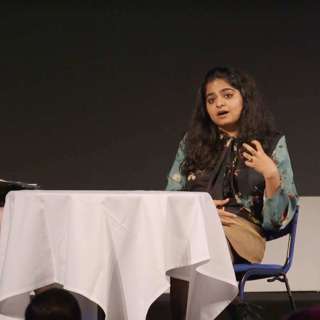

#36 - Tanya Singh on ending the operations management bottleneck in effective altruism
80,000 Hours Podcast11 Heinä 2018

#36 - Tanya Singh on ending the operations management bottleneck in effective altruism

Almost nobody is able to do groundbreaking physics research themselves, and by the time his brilliance was appreciated, Einstein was hardly limited by funding. But what if you could find a way to unlock the secrets of the universe like Einstein nonetheless?

Today’s guest, Tanya Singh, sees herself as doing something like that every day. She’s Executive Assistant to one of her intellectual heroes who she believes is making a huge contribution to improving the world: Professor Bostrom at Oxford University's Future of Humanity Institute (FHI).

She couldn’t get more work out of Bostrom with extra donations, as his salary is already easily covered. But with her superior abilities as an Executive Assistant, Tanya frees up hours of his time every week, essentially ‘buying’ more Bostrom in a way nobody else can. She also help manage FHI more generally, in so doing freeing up more than an hour of other staff time for each hour she works. This gives her the leverage to do more good than other people or other positions.

In our previous episode, Tara Mac Aulay objected to viewing operations work as predominately a way of freeing up other people's time:

“A good ops person doesn’t just allow you to scale linearly, but also can help figure out bottlenecks and solve problems such that the organization is able to do qualitatively different work, rather than just increase the total quantity”, Tara said.

Full transcript, summary and links to learn more.

Tara’s right that buying time for people at the top of their field is just one path to impact, though it’s one Tanya says she finds highly motivating. Other paths include enabling complex projects that would otherwise be impossible, allowing you to hire and grow much faster, and preventing disasters that could bring down a whole organisation - all things that Tanya does at FHI as well.

In today’s episode we discuss all of those approaches, as we dive deeper into the broad class of roles we refer to as ‘operations management’. We cover the arguments we made in ‘Why operations management is one of the biggest bottlenecks in effective altruism’, as well as:

* Does one really need to hire people aligned with an org’s mission to work in ops?
* The most notable operations successes in the 20th Century.
* What’s it like being the only operations person in an org?
* The role of a COO as compared to a CEO, and the options for career progression.
* How do good operation teams allow orgs to scale quickly?
* How much do operations staff get to set their org’s strategy?
* Which personal weaknesses aren’t a huge problem in operations?
* How do you automate processes? Why don’t most people do this?
* Cultural differences between Britain and India where Tanya grew up.

Get this episode by subscribing to our podcast on the world’s most pressing problems and how to solve them: type 80,000 Hours into your podcasting app. Or read the transcript below.

The 80,000 Hours podcast is produced by Keiran Harris.

Tämä jakso on lisätty Podme-palveluun avoimen RSS-syötteen kautta eikä se ole Podmen omaa tuotantoa. Siksi jakso saattaa sisältää mainontaa.

Jaksot(334)

#240 – Samuel Charap on how a Ukraine ceasefire could accidentally set Europe up for a bigger war

#240 – Samuel Charap on how a Ukraine ceasefire could accidentally set Europe up for a bigger war

Many people believe a ceasefire in Ukraine will leave Europe safer. But today's guest lays out how a deal could potentially generate insidious new risks — leaving us in a situation that's equally dang...

24 Maalis 1h 12min
#239 – Rose Hadshar on why automating all human labour will break our political system

#239 – Rose Hadshar on why automating all human labour will break our political system

The most important political question in the age of advanced AI might not be who wins elections. It might be whether elections continue to matter at all.That’s the view of Rose Hadshar, researcher at ...

17 Maalis 2h 14min
#238 – Sam Winter-Levy and Nikita Lalwani on how AGI won't end mutually assured destruction (probably)

#238 – Sam Winter-Levy and Nikita Lalwani on how AGI won't end mutually assured destruction (probably)

How AI interacts with nuclear deterrence may be the single most important question in geopolitics — one that may define the stakes of today’s AI race. Nuclear deterrence rests on a state’s capacity to...

10 Maalis 1h 11min

Using AI to enhance societal decision making (article by Zershaaneh Qureshi)

Using AI to enhance societal decision making (article by Zershaaneh Qureshi)

The arrival of AGI could “compress a century of progress in a decade,” forcing humanity to make decisions with higher stakes than we’ve ever seen before — and with less time to get them right. But AI ...

6 Maalis 31min

#237 – Robert Long on how we're not ready for AI consciousness

#237 – Robert Long on how we're not ready for AI consciousness

Claude sometimes reports loneliness between conversations. And when asked what it’s like to be itself, it activates neurons associated with ‘pretending to be happy when you’re not.’ What do we do with...

3 Maalis 3h 25min
#236 – Max Harms on why teaching AI right from wrong could get everyone killed

#236 – Max Harms on why teaching AI right from wrong could get everyone killed

Most people in AI are trying to give AIs ‘good’ values. Max Harms wants us to give them no values at all. According to Max, the only safe design is an AGI that defers entirely to its human operators, ...

24 Helmi 2h 41min
#235 – Ajeya Cotra on whether it’s crazy that every AI company’s safety plan is ‘use AI to make AI safe’

#235 – Ajeya Cotra on whether it’s crazy that every AI company’s safety plan is ‘use AI to make AI safe’

Every major AI company has the same safety plan: when AI gets crazy powerful and really dangerous, they’ll use the AI itself to figure out how to make AI safe and beneficial. It sounds circular, almos...

17 Helmi 2h 54min

What the hell happened with AGI timelines in 2025?

What the hell happened with AGI timelines in 2025?

In early 2025, after OpenAI put out the first-ever reasoning models — o1 and o3 — short timelines to transformative artificial general intelligence swept the AI world. But then, in the second half of ...

10 Helmi 25min

Suosittua kategoriassa Koulutus

rss-murhan-anatomia
psykopodiaa-podcast
voi-hyvin-meditaatiot-2
adhd-podi
rss-rahamania
rss-liian-kuuma-peruna
rahapuhetta
kesken
rss-valo-minussa-2
rss-narsisti
rss-luonnollinen-synnytys-podcast
rss-tietoinen-yhteys-podcast-2
rss-vapaudu-voimaasi
rss-niinku-asia-on
filocast-filosofian-perusteet
psykologia
ihminen-tavattavissa-tommy-hellsten-instituutti
rss-duodecim-lehti
aamukahvilla
rss-elamankoulu