
#39 - Spencer Greenberg on the scientific approach to solving difficult everyday questions

#39 - Spencer Greenberg on the scientific approach to solving difficult everyday questions

Will Trump be re-elected? Will North Korea give up their nuclear weapons? Will your friend turn up to dinner?

Spencer Greenberg, founder of ClearerThinking.org has a process for working out such real life problems.

Let’s work through one here: how likely is it that you’ll enjoy listening to this episode?

The first step is to figure out your ‘prior probability’; what’s your estimate of how likely you are to enjoy the interview before getting any further evidence?

Other than applying common sense, one way to figure this out is called reference class forecasting: looking at similar cases and seeing how often something is true, on average.

Spencer is our first ever return guest. So one reference class might be, how many Spencer Greenberg episodes of the 80,000 Hours Podcast have you enjoyed so far? Being this specific limits bias in your answer, but with a sample size of at most 1 - you’d probably want to add more data points to reduce variability.

Zooming out, how many episodes of the 80,000 Hours Podcast have you enjoyed? Let’s say you’ve listened to 10, and enjoyed 8 of them. If so 8 out of 10 might be your prior probability.

But maybe the two you didn’t enjoy had something in common. If you’ve liked similar episodes in the past, you’d update in favour of expecting to enjoy it, and if you’ve disliked similar episodes in the past, you’d update negatively.

You can zoom out further; what fraction of long-form interview podcasts have you ever enjoyed?

Then you’d look to update whenever new information became available. Do the topics seem interesting? Did Spencer make a great point in the first 5 minutes? Was this description unbearably self-referential?

Speaking of the Question of Evidence: in a world where Spencer was not worth listening to, how likely is it that we’d invite him back for a second episode?

Links to learn more, summary and full transcript.

We’ll run through several diverse examples, and how to actually work out the changing probabilities as you update. But that’s only a fraction of the conversation. We also discuss:

* How could we generate 20-30 new happy thoughts a day? What would that do to our welfare?
* What do people actually value? How do EAs differ from non EAs?
* Why should we care about the distinction between intrinsic and instrumental values?
* Would hedonic utilitarians really want to hook themselves up to happiness machines?
* What types of activities are people generally under-confident about? Why?
* When should you give a lot of weight to your prior belief?
* When should we trust common sense?
* Does power posing have any effect?
* Are resumes worthless?
* Did Trump explicitly collude with Russia? What are the odds of him getting re-elected?
* What’s the probability that China and the US go to War in the 21st century?
* How should we treat claims of expertise on diets?
* Why were Spencer’s friends suspicious of Theranos for years?
* How should we think about the placebo effect?
* Does a shift towards rationality typically cause alienation from family and friends? How do you deal with that?

Get this episode by subscribing to our podcast on the world’s most pressing problems and how to solve them: type 80,000 Hours into your podcasting app. Or read the transcript below.

The 80,000 Hours podcast is produced by Keiran Harris.

Jaksot(320)

2025 Highlight-o-thon: Oops! All Bests

2025 Highlight-o-thon: Oops! All Bests

It’s that magical time of year once again — highlightapalooza! Stick around for one top bit from each episode we recorded this year, including:Kyle Fish explaining how Anthropic’s AI Claude descends i...

29 Joulu 20251h 40min

#232 – Andreas Mogensen on what we owe 'philosophical Vulcans' and unconscious beings

#232 – Andreas Mogensen on what we owe 'philosophical Vulcans' and unconscious beings

Most debates about the moral status of AI systems circle the same question: is there something that it feels like to be them? But what if that’s the wrong question to ask? Andreas Mogensen — a senior ...

19 Joulu 20252h 37min

#231 – Paul Scharre on how AI-controlled robots will and won't change war

#231 – Paul Scharre on how AI-controlled robots will and won't change war

In 1983, Stanislav Petrov, a Soviet lieutenant colonel, sat in a bunker watching a red screen flash “MISSILE LAUNCH.” Protocol demanded he report it to superiors, which would very likely trigger a ret...

17 Joulu 20252h 45min

AI might let a few people control everything — permanently (article by Rose Hadshar)

AI might let a few people control everything — permanently (article by Rose Hadshar)

Power is already concentrated today: over 800 million people live on less than $3 a day, the three richest men in the world are worth over $1 trillion, and almost six billion people live in countries ...

12 Joulu 20251h
#230 – Dean Ball on how AI is a huge deal — but we shouldn’t regulate it yet

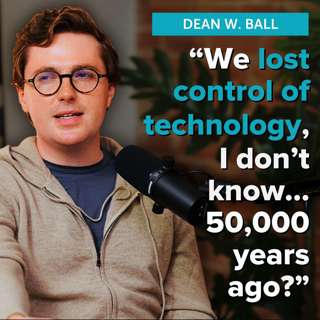
#230 – Dean Ball on how AI is a huge deal — but we shouldn’t regulate it yet

Former White House staffer Dean Ball thinks it's very likely some form of 'superintelligence' arrives in under 20 years. He thinks AI being used for bioweapon research is "a real threat model, obvious...

10 Joulu 20252h 54min

#229 – Marius Hobbhahn on the race to solve AI scheming before models go superhuman

#229 – Marius Hobbhahn on the race to solve AI scheming before models go superhuman

We often worry about AI models “hallucinating” or making honest mistakes. But what happens when a model knows the truth, but decides to deceive you anyway to achieve a goal of its own? This isn’t sci-...

3 Joulu 20253h 3min

Rob & Luisa chat kids, the 2016 fertility crash, and how the 50s invented parenting that makes us miserable

Rob & Luisa chat kids, the 2016 fertility crash, and how the 50s invented parenting that makes us miserable

Global fertility rates aren’t just falling: the rate of decline is accelerating. From 2006 to 2016, fertility dropped gradually, but since 2016 the rate of decline has increased 4.5-fold. In many weal...

25 Marras 20251h 59min

#228 – Eileen Yam on how we're completely out of touch with what the public thinks about AI

#228 – Eileen Yam on how we're completely out of touch with what the public thinks about AI

If you work in AI, you probably think it’s going to boost productivity, create wealth, advance science, and improve your life. If you’re a member of the American public, you probably strongly disagree...

20 Marras 20251h 43min

Suosittua kategoriassa Koulutus

rss-murhan-anatomia
psykopodiaa-podcast
rss-narsisti
voi-hyvin-meditaatiot-2
aamukahvilla
rss-niinku-asia-on
rss-liian-kuuma-peruna
adhd-podi
psykologia
kesken
rss-vapaudu-voimaasi
rss-valo-minussa-2
dear-ladies
rss-koira-haudattuna
jari-sarasvuo-podcast
esa-saarinen-filosofia-ja-systeemiajattelu
leveli
rss-duodecim-lehti
rss-luonnollinen-synnytys-podcast
rss-ihana-elamani