
#39 - Spencer Greenberg on the scientific approach to solving difficult everyday questions

#39 - Spencer Greenberg on the scientific approach to solving difficult everyday questions

Will Trump be re-elected? Will North Korea give up their nuclear weapons? Will your friend turn up to dinner?

Spencer Greenberg, founder of ClearerThinking.org has a process for working out such real life problems.

Let’s work through one here: how likely is it that you’ll enjoy listening to this episode?

The first step is to figure out your ‘prior probability’; what’s your estimate of how likely you are to enjoy the interview before getting any further evidence?

Other than applying common sense, one way to figure this out is called reference class forecasting: looking at similar cases and seeing how often something is true, on average.

Spencer is our first ever return guest. So one reference class might be, how many Spencer Greenberg episodes of the 80,000 Hours Podcast have you enjoyed so far? Being this specific limits bias in your answer, but with a sample size of at most 1 - you’d probably want to add more data points to reduce variability.

Zooming out, how many episodes of the 80,000 Hours Podcast have you enjoyed? Let’s say you’ve listened to 10, and enjoyed 8 of them. If so 8 out of 10 might be your prior probability.

But maybe the two you didn’t enjoy had something in common. If you’ve liked similar episodes in the past, you’d update in favour of expecting to enjoy it, and if you’ve disliked similar episodes in the past, you’d update negatively.

You can zoom out further; what fraction of long-form interview podcasts have you ever enjoyed?

Then you’d look to update whenever new information became available. Do the topics seem interesting? Did Spencer make a great point in the first 5 minutes? Was this description unbearably self-referential?

Speaking of the Question of Evidence: in a world where Spencer was not worth listening to, how likely is it that we’d invite him back for a second episode?

Links to learn more, summary and full transcript.

We’ll run through several diverse examples, and how to actually work out the changing probabilities as you update. But that’s only a fraction of the conversation. We also discuss:

* How could we generate 20-30 new happy thoughts a day? What would that do to our welfare?
* What do people actually value? How do EAs differ from non EAs?
* Why should we care about the distinction between intrinsic and instrumental values?
* Would hedonic utilitarians really want to hook themselves up to happiness machines?
* What types of activities are people generally under-confident about? Why?
* When should you give a lot of weight to your prior belief?
* When should we trust common sense?
* Does power posing have any effect?
* Are resumes worthless?
* Did Trump explicitly collude with Russia? What are the odds of him getting re-elected?
* What’s the probability that China and the US go to War in the 21st century?
* How should we treat claims of expertise on diets?
* Why were Spencer’s friends suspicious of Theranos for years?
* How should we think about the placebo effect?
* Does a shift towards rationality typically cause alienation from family and friends? How do you deal with that?

Get this episode by subscribing to our podcast on the world’s most pressing problems and how to solve them: type 80,000 Hours into your podcasting app. Or read the transcript below.

The 80,000 Hours podcast is produced by Keiran Harris.

Jaksot(321)

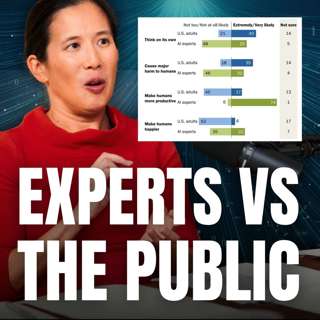
#228 – Eileen Yam on how we're completely out of touch with what the public thinks about AI

#228 – Eileen Yam on how we're completely out of touch with what the public thinks about AI

If you work in AI, you probably think it’s going to boost productivity, create wealth, advance science, and improve your life. If you’re a member of the American public, you probably strongly disagree...

20 Marras 20251h 43min
OpenAI: The nonprofit refuses to be killed (with Tyler Whitmer)

OpenAI: The nonprofit refuses to be killed (with Tyler Whitmer)

Last December, the OpenAI business put forward a plan to completely sideline its nonprofit board. But two state attorneys general have now blocked that effort and kept that board very much alive and k...

11 Marras 20251h 56min
#227 – Helen Toner on the geopolitics of AGI in China and the Middle East

#227 – Helen Toner on the geopolitics of AGI in China and the Middle East

With the US racing to develop AGI and superintelligence ahead of China, you might expect the two countries to be negotiating how they’ll deploy AI, including in the military, without coming to blows. ...

5 Marras 20252h 20min

#226 – Holden Karnofsky on unexploited opportunities to make AI safer — and all his AGI takes

#226 – Holden Karnofsky on unexploited opportunities to make AI safer — and all his AGI takes

For years, working on AI safety usually meant theorising about the ‘alignment problem’ or trying to convince other people to give a damn. If you could find any way to help, the work was frustrating an...

30 Loka 20254h 30min

#225 – Daniel Kokotajlo on what a hyperspeed robot economy might look like

#225 – Daniel Kokotajlo on what a hyperspeed robot economy might look like

When Daniel Kokotajlo talks to security experts at major AI labs, they tell him something chilling: “Of course we’re probably penetrated by the CCP already, and if they really wanted something, they c...

27 Loka 20252h 12min

#224 – There's a cheap and low-tech way to save humanity from any engineered disease | Andrew Snyder-Beattie

#224 – There's a cheap and low-tech way to save humanity from any engineered disease | Andrew Snyder-Beattie

Conventional wisdom is that safeguarding humanity from the worst biological risks — microbes optimised to kill as many as possible — is difficult bordering on impossible, making bioweapons humanity’s ...

2 Loka 20252h 31min

Inside the Biden admin’s AI policy approach | Jake Sullivan, Biden’s NSA | via The Cognitive Revolution

Inside the Biden admin’s AI policy approach | Jake Sullivan, Biden’s NSA | via The Cognitive Revolution

Jake Sullivan was the US National Security Advisor from 2021-2025. He joined our friends on The Cognitive Revolution podcast in August to discuss AI as a critical national security issue. We thought i...

26 Syys 20251h 5min

#223 – Neel Nanda on leading a Google DeepMind team at 26 – and advice if you want to work at an AI company (part 2)

#223 – Neel Nanda on leading a Google DeepMind team at 26 – and advice if you want to work at an AI company (part 2)

At 26, Neel Nanda leads an AI safety team at Google DeepMind, has published dozens of influential papers, and mentored 50 junior researchers — seven of whom now work at major AI companies. His secret?...

15 Syys 20251h 46min

Suosittua kategoriassa Koulutus

rss-murhan-anatomia
rss-narsisti
psykopodiaa-podcast
voi-hyvin-meditaatiot-2
rss-liian-kuuma-peruna
rss-vapaudu-voimaasi
rss-hereilla
rss-valo-minussa-2
rss-uskonto-on-tylsaa
psykologia
kesken
dear-ladies
rss-luonnollinen-synnytys-podcast
rahapuhetta
rss-niinku-asia-on
ihminen-tavattavissa-tommy-hellsten-instituutti
leveli
rss-duodecim-lehti
rss-tietoinen-yhteys-podcast-2
rss-arkea-ja-aurinkoa-podcast-espanjasta