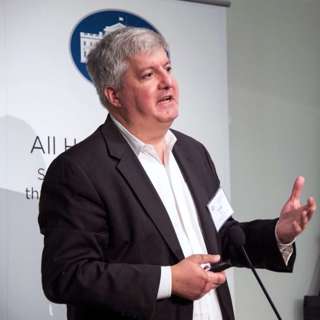

#57 – Tom Kalil on how to do the most good in government

#57 – Tom Kalil on how to do the most good in government

You’re 29 years old, and you’ve just been given a job in the White House. How do you quickly figure out how the US Executive Branch behemoth actually works, so that you can have as much impact as possible - before you quit or get kicked out?

That was the challenge put in front of Tom Kalil in 1993.

He had enough success to last a full 16 years inside the Clinton and Obama administrations, working to foster the development of the internet, then nanotechnology, and then cutting-edge brain modelling, among other things.

But not everyone figures out how to move the needle. In today's interview, Tom shares his experience with how to increase your chances of getting an influential role in government, and how to make the most of the opportunity if you get in.

Links to learn more, summary and full transcript.

Interested in US AI policy careers? Apply for one-on-one career advice here.

Vacancies at the Center for Security and Emerging Technology.

Our high-impact job board, which features other related opportunities.

He believes that Congressional gridlock leads people to greatly underestimate how much the Executive Branch can and does do on its own every day. Decisions by individuals change how billions of dollars are spent; regulations are enforced, and then suddenly they aren't; and a single sentence in the State of the Union can get civil servants to pay attention to a topic that would otherwise go ignored.

Over years at the White House Office of Science and Technology Policy, 'Team Kalil' built up a white board of principles. For example, 'the schedule is your friend': setting a meeting date with the President can force people to finish something, where they otherwise might procrastinate.

Or 'talk to who owns the paper'. People would wonder how Tom could get so many lines into the President's speeches. The answer was "figure out who's writing the speech, find them with the document, and tell them to add the line." Obvious, but not something most were doing.

Not everything is a precise operation though. Tom also tells us the story of NetDay, a project that was put together at the last minute because the President incorrectly believed it was already organised – and decided he was going to announce it in person.

In today's episode we get down to nuts & bolts, and discuss:
• How did Tom spin work on a primary campaign into a job in the next White House?
• Why does Tom think hiring is the most important work he did, and how did he decide who to bring onto the team?
• How do you get people to do things when you don't have formal power over them?
• What roles in the US government are most likely to help with the long-term future, or reducing existential risks?
• Is it possible, or even desirable, to get the general public interested in abstract, long-term policy ideas?
• What are 'policy entrepreneurs' and why do they matter?
• What is the role for prizes in promoting science and technology? What are other promising policy ideas?
• Why you can get more done by not taking credit.
• What can the White House do if an agency isn't doing what it wants?
• How can the effective altruism community improve the maturity of our policy recommendations?
• How much can talented individuals accomplish during a short-term stay in government?

Get this episode by subscribing to our podcast on the world’s most pressing problems and how to solve them: type '80,000 Hours' into your podcasting app.

The 80,000 Hours Podcast is produced by Keiran Harris.

Jaksot(321)

#165 – Anders Sandberg on war in space, whether civilisations age, and the best things possible in our universe

#165 – Anders Sandberg on war in space, whether civilisations age, and the best things possible in our universe

"Now, the really interesting question is: How much is there an attacker-versus-defender advantage in this kind of advanced future? Right now, if somebody's sitting on Mars and you're going to war agai...

6 Loka 20232h 48min

#164 – Kevin Esvelt on cults that want to kill everyone, stealth vs wildfire pandemics, and how he felt inventing gene drives

#164 – Kevin Esvelt on cults that want to kill everyone, stealth vs wildfire pandemics, and how he felt inventing gene drives

"Imagine a fast-spreading respiratory HIV. It sweeps around the world. Almost nobody has symptoms. Nobody notices until years later, when the first people who are infected begin to succumb. They might...

2 Loka 20233h 3min

Great power conflict (Article)

Great power conflict (Article)

Today’s release is a reading of our Great power conflict problem profile, written and narrated by Stephen Clare.If you want to check out the links, footnotes and figures in today’s article, you can fi...

22 Syys 20231h 19min
#163 – Toby Ord on the perils of maximising the good that you do

#163 – Toby Ord on the perils of maximising the good that you do

Effective altruism is associated with the slogan "do the most good." On one level, this has to be unobjectionable: What could be bad about helping people more and more?But in today's interview, Toby O...

8 Syys 20233h 7min
The 80,000 Hours Career Guide (2023)

The 80,000 Hours Career Guide (2023)

An audio version of the 2023 80,000 Hours career guide, also available on our website, on Amazon, and on Audible.If you know someone who might find our career guide helpful, you can get a free copy se...

4 Syys 20234h 41min

#162 – Mustafa Suleyman on getting Washington and Silicon Valley to tame AI

#162 – Mustafa Suleyman on getting Washington and Silicon Valley to tame AI

Mustafa Suleyman was part of the trio that founded DeepMind, and his new AI project is building one of the world's largest supercomputers to train a large language model on 10–100x the compute used to...

1 Syys 202359min

#161 – Michael Webb on whether AI will soon cause job loss, lower incomes, and higher inequality — or the opposite

#161 – Michael Webb on whether AI will soon cause job loss, lower incomes, and higher inequality — or the opposite

"Do you remember seeing these photographs of generally women sitting in front of these huge panels and connecting calls, plugging different calls between different numbers? The automated version of th...

23 Elo 20233h 30min

#160 – Hannah Ritchie on why it makes sense to be optimistic about the environment

#160 – Hannah Ritchie on why it makes sense to be optimistic about the environment

"There's no money to invest in education elsewhere, so they almost get trapped in the cycle where they don't get a lot from crop production, but everyone in the family has to work there to just stay a...

14 Elo 20232h 36min

Suosittua kategoriassa Koulutus

rss-murhan-anatomia
psykopodiaa-podcast
voi-hyvin-meditaatiot-2
rss-narsisti
rss-liian-kuuma-peruna
rss-vapaudu-voimaasi
rss-hereilla
dear-ladies
rss-uskonto-on-tylsaa
rss-valo-minussa-2
ihminen-tavattavissa-tommy-hellsten-instituutti
leveli
rss-luonnollinen-synnytys-podcast
rss-tietoinen-yhteys-podcast-2
adhd-podi
aloita-meditaatio
kesken
psykologia
rss-duodecim-lehti
esa-saarinen-filosofia-ja-systeemiajattelu