

#63 – Vitalik Buterin on better ways to fund public goods, blockchain's failures, & effective giving

#63 – Vitalik Buterin on better ways to fund public goods, blockchain's failures, & effective giving

Historically, progress in the field of cryptography has had major consequences. It has changed the course of major wars, made it possible to do business on the internet, and enabled private communication between both law-abiding citizens and dangerous criminals. Could it have similarly significant consequences in future?

Today's guest — Vitalik Buterin — is world-famous as the lead developer of Ethereum, a successor to the cryptographic-currency Bitcoin, which added the capacity for smart contracts and decentralised organisations. Buterin first proposed Ethereum at the age of 20, and by the age of 23 its success had likely made him a billionaire.

At the same time, far from indulging hype about these so-called 'blockchain' technologies, he has been candid about the limited good accomplished by Bitcoin and other currencies developed using cryptographic tools — and the breakthroughs that will be needed before they can have a meaningful social impact. In his own words, *"blockchains as they currently exist are in many ways a joke, right?"*

But Buterin is not just a realist. He's also an idealist, who has been helping to advance big ideas for new social institutions that might help people better coordinate to pursue their shared goals.

Links to learn more, summary and full transcript.

By combining theories in economics and mechanism design with advances in cryptography, he has been pioneering the new interdiscriplinary field of 'cryptoeconomics'. Economist Tyler Cowen hasobserved that, "at 25, Vitalik appears to repeatedly rediscover important economics results from famous papers, without knowing about the papers at all."

Along with previous guest Glen Weyl, Buterin has helped develop a model for so-called 'quadratic funding', which in principle could transform the provision of 'public goods'. That is, goods that people benefit from whether they help pay for them or not.

Examples of goods that are fully or partially 'public goods' include sound decision-making in government, international peace, scientific advances, disease control, the existence of smart journalism, preventing climate change, deflecting asteroids headed to Earth, and the elimination of suffering. Their underprovision in part reflects the difficulty of getting people to pay for anything when they can instead free-ride on the efforts of others. Anything that could reduce this failure of coordination might transform the world.

But these and other related proposals face major hurdles. They're vulnerable to collusion, might be used to fund scams, and remain untested at a small scale — not to mention that anything with a square root sign in it is going to struggle to achieve societal legitimacy. Is the prize large enough to justify efforts to overcome these challenges?

In today's extensive three-hour interview, Buterin and I cover:

• What the blockchain has accomplished so far, and what it might achieve in the next decade;
• Why many social problems can be viewed as a coordination failure to provide a public good;
• Whether any of the ideas for decentralised social systems emerging from the blockchain community could really work;
• His view of 'effective altruism' and 'long-termism';
• Why he is optimistic about 'quadratic funding', but pessimistic about replacing existing voting with 'quadratic voting';
• Why humanity might have to abandon living in cities;
• And much more.

Get this episode by subscribing to our podcast on the world’s most pressing problems and how to solve them: type 80,000 Hours into your podcasting app.

The 80,000 Hours Podcast is produced by Keiran Harris.

Jaksot(317)

#225 – Daniel Kokotajlo on what a hyperspeed robot economy might look like

#225 – Daniel Kokotajlo on what a hyperspeed robot economy might look like

When Daniel Kokotajlo talks to security experts at major AI labs, they tell him something chilling: “Of course we’re probably penetrated by the CCP already, and if they really wanted something, they c...

27 Loka 20252h 12min

#224 – There's a cheap and low-tech way to save humanity from any engineered disease | Andrew Snyder-Beattie

#224 – There's a cheap and low-tech way to save humanity from any engineered disease | Andrew Snyder-Beattie

Conventional wisdom is that safeguarding humanity from the worst biological risks — microbes optimised to kill as many as possible — is difficult bordering on impossible, making bioweapons humanity’s ...

2 Loka 20252h 31min
Inside the Biden admin’s AI policy approach | Jake Sullivan, Biden’s NSA | via The Cognitive Revolution

Inside the Biden admin’s AI policy approach | Jake Sullivan, Biden’s NSA | via The Cognitive Revolution

Jake Sullivan was the US National Security Advisor from 2021-2025. He joined our friends on The Cognitive Revolution podcast in August to discuss AI as a critical national security issue. We thought i...

26 Syys 20251h 5min
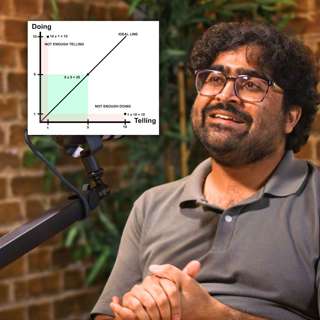
#223 – Neel Nanda on leading a Google DeepMind team at 26 – and advice if you want to work at an AI company (part 2)

#223 – Neel Nanda on leading a Google DeepMind team at 26 – and advice if you want to work at an AI company (part 2)

At 26, Neel Nanda leads an AI safety team at Google DeepMind, has published dozens of influential papers, and mentored 50 junior researchers — seven of whom now work at major AI companies. His secret?...

15 Syys 20251h 46min
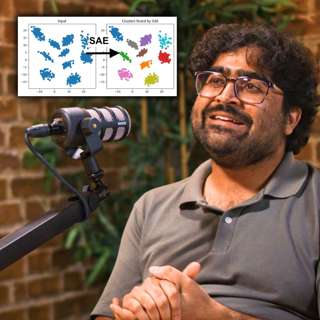
#222 – Can we tell if an AI is loyal by reading its mind? DeepMind's Neel Nanda (part 1)

#222 – Can we tell if an AI is loyal by reading its mind? DeepMind's Neel Nanda (part 1)

We don’t know how AIs think or why they do what they do. Or at least, we don’t know much. That fact is only becoming more troubling as AIs grow more capable and appear on track to wield enormous cultu...

8 Syys 20253h 1min

#221 – Kyle Fish on the most bizarre findings from 5 AI welfare experiments

#221 – Kyle Fish on the most bizarre findings from 5 AI welfare experiments

What happens when you lock two AI systems in a room together and tell them they can discuss anything they want?According to experiments run by Kyle Fish — Anthropic’s first AI welfare researcher — som...

28 Elo 20252h 28min

How not to lose your job to AI (article by Benjamin Todd)

How not to lose your job to AI (article by Benjamin Todd)

About half of people are worried they’ll lose their job to AI. They’re right to be concerned: AI can now complete real-world coding tasks on GitHub, generate photorealistic video, drive a taxi more sa...

31 Heinä 202551min

Rebuilding after apocalypse: What 13 experts say about bouncing back

Rebuilding after apocalypse: What 13 experts say about bouncing back

What happens when civilisation faces its greatest tests?This compilation brings together insights from researchers, defence experts, philosophers, and policymakers on humanity’s ability to survive and...

15 Heinä 20254h 26min

Suosittua kategoriassa Koulutus

rss-murhan-anatomia
psykopodiaa-podcast
voi-hyvin-meditaatiot-2
rss-valo-minussa-2
rss-narsisti
adhd-podi
rss-niinku-asia-on
aamukahvilla
rss-duodecim-lehti
kesken
rahapuhetta
aloita-meditaatio
salainen-paivakirja
rss-elamankoulu
psykologia
rss-uskonto-on-tylsaa
rss-psykalab
rss-selvat-savelet
rss-koira-haudattuna
rss-hereilla