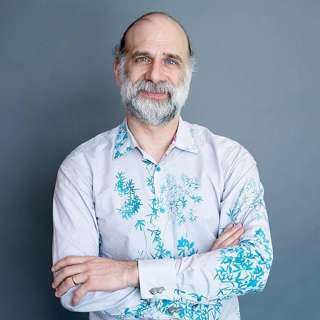

#64 – Bruce Schneier on how insecure electronic voting could break the United States — and surveillance without tyranny

#64 – Bruce Schneier on how insecure electronic voting could break the United States — and surveillance without tyranny

November 3 2020, 10:32PM: CNN, NBC, and FOX report that Donald Trump has narrowly won Florida, and with it, re-election.

November 3 2020, 11:46PM: The NY Times and Wall Street Journal report that some group has successfully hacked electronic voting systems across the country, including Florida. The malware has spread to tens of thousands of machines and deletes any record of its activity, so the returning officer of Florida concedes they actually have no idea who won the state — and don't see how they can figure it out.

What on Earth happens next?

Today’s guest — world-renowned computer security expert Bruce Schneier — thinks this scenario is plausible, and the ensuing chaos would sow so much distrust that half the country would never accept the election result.

Unfortunately the US has no recovery system for a situation like this, unlike parliamentary democracies, which can just rerun the election a few weeks later.

The Constitution says the state legislature decides, and they can do so however they like; one tied local election in Texas was settled by playing a hand of poker.

Elections serve two purposes. The first is the obvious one: to pick a winner. The second, but equally important, is to convince the loser to go along with it — which is why hacks often focus on convincing the losing side that the election wasn't fair.

Schneier thinks there's a need to agree how this situation should be handled before something like it happens, and America falls into severe infighting as everyone tries to turn the situation to their political advantage.

And to fix our voting systems, we urgently need two things: a voter-verifiable paper ballot and risk-limiting audits.

According to Schneier, computer security experts look at current electronic voting machines and can barely believe their eyes. But voting machine designers never understand the security weakness of what they're designing, because they have a bureaucrat's rather than a hacker's mindset.

The ideal computer security expert walks into a shop and thinks, "You know, here's how I would shoplift." They automatically see where the cameras are, whether there are alarms, and where the security guards aren't watching.

In this episode we discuss this hacker mindset, and how to use a career in security to protect democracy and guard dangerous secrets from people who shouldn't get access to them.


We also cover:
• How can we have surveillance of dangerous actors, without falling back into authoritarianism?
• When if ever should information about weaknesses in society's security be kept secret?
• How secure are nuclear weapons systems around the world?
• How worried should we be about deep-fakes?
• Schneier’s critiques of blockchain technology
• How technologists should be vital in shaping policy
• What are the most consequential computer security problems today?
• Could a career in information security be very useful for reducing global catastrophic risks?
• And more.


Chapters:

  • Rob’s intro (00:00:00)
  • Bruce’s Codex talk (00:02:23)
  • The interview begins (00:15:42)
  • What is Bruce working on at the moment? (00:16:35)
  • How technologists could be vital in shaping policy (00:18:52)
  • Most consequential computer security problems today (00:24:12)
  • How secure are nuclear weapons systems around the world? (00:34:41)
  • Stuxnet and NotPetya (00:42:29)
  • Messing with democracy (00:44:44)
  • How worried should we be about deepfakes? (00:50:02)
  • The similarities between hacking computers and potentially hacking biology in the future (00:55:08)
  • Bruce’s critiques of crypto (01:00:05)
  • What are some of the most kind of widely-held but incorrect beliefs among computer security people? (01:03:04)
  • The hacking mindset (01:05:35)
  • Voting machines (01:09:22)
  • How secretive should people be about potentially harmful information? (01:16:48)
  • Could a career in information security be very useful for reducing global catastrophic risks? (01:21:46)
  • How to develop the skills needed in computer security (01:33:44)
  • Ubiquitous surveillance (01:52:46)
  • Why is Bruce optimistic? (02:05:28)
  • Rob’s outro (02:06:43)


The 80,000 Hours Podcast is produced by Keiran Harris.

Jaksot(317)

AI might let a few people control everything — permanently (article by Rose Hadshar)

AI might let a few people control everything — permanently (article by Rose Hadshar)

Power is already concentrated today: over 800 million people live on less than $3 a day, the three richest men in the world are worth over $1 trillion, and almost six billion people live in countries ...

12 Joulu 20251h

#230 – Dean Ball on how AI is a huge deal — but we shouldn’t regulate it yet

#230 – Dean Ball on how AI is a huge deal — but we shouldn’t regulate it yet

Former White House staffer Dean Ball thinks it's very likely some form of 'superintelligence' arrives in under 20 years. He thinks AI being used for bioweapon research is "a real threat model, obvious...

10 Joulu 20252h 54min

#229 – Marius Hobbhahn on the race to solve AI scheming before models go superhuman

#229 – Marius Hobbhahn on the race to solve AI scheming before models go superhuman

We often worry about AI models “hallucinating” or making honest mistakes. But what happens when a model knows the truth, but decides to deceive you anyway to achieve a goal of its own? This isn’t sci-...

3 Joulu 20253h 3min

Rob & Luisa chat kids, the 2016 fertility crash, and how the 50s invented parenting that makes us miserable

Rob & Luisa chat kids, the 2016 fertility crash, and how the 50s invented parenting that makes us miserable

Global fertility rates aren’t just falling: the rate of decline is accelerating. From 2006 to 2016, fertility dropped gradually, but since 2016 the rate of decline has increased 4.5-fold. In many weal...

25 Marras 20251h 59min

#228 – Eileen Yam on how we're completely out of touch with what the public thinks about AI

#228 – Eileen Yam on how we're completely out of touch with what the public thinks about AI

If you work in AI, you probably think it’s going to boost productivity, create wealth, advance science, and improve your life. If you’re a member of the American public, you probably strongly disagree...

20 Marras 20251h 43min

OpenAI: The nonprofit refuses to be killed (with Tyler Whitmer)

OpenAI: The nonprofit refuses to be killed (with Tyler Whitmer)

Last December, the OpenAI business put forward a plan to completely sideline its nonprofit board. But two state attorneys general have now blocked that effort and kept that board very much alive and k...

11 Marras 20251h 56min

#227 – Helen Toner on the geopolitics of AGI in China and the Middle East

#227 – Helen Toner on the geopolitics of AGI in China and the Middle East

With the US racing to develop AGI and superintelligence ahead of China, you might expect the two countries to be negotiating how they’ll deploy AI, including in the military, without coming to blows. ...

5 Marras 20252h 20min

#226 – Holden Karnofsky on unexploited opportunities to make AI safer — and all his AGI takes

#226 – Holden Karnofsky on unexploited opportunities to make AI safer — and all his AGI takes

For years, working on AI safety usually meant theorising about the ‘alignment problem’ or trying to convince other people to give a damn. If you could find any way to help, the work was frustrating an...

30 Loka 20254h 30min

Suosittua kategoriassa Koulutus

rss-murhan-anatomia
psykopodiaa-podcast
voi-hyvin-meditaatiot-2
rss-valo-minussa-2
rss-niinku-asia-on
aamukahvilla
rss-narsisti
adhd-podi
rss-duodecim-lehti
rahapuhetta
aloita-meditaatio
kesken
rss-elamankoulu
koulu-podcast-2
salainen-paivakirja
rss-uskonto-on-tylsaa
rss-liian-kuuma-peruna
rss-luonnollinen-synnytys-podcast
rss-koira-haudattuna
rss-hereilla