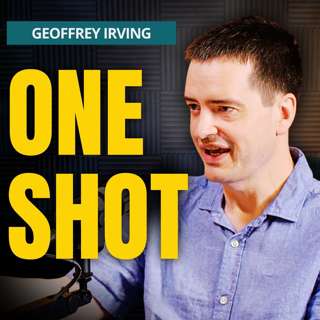
#68 - Will MacAskill on the paralysis argument, whether we're at the hinge of history, & his new priorities

#68 - Will MacAskill on the paralysis argument, whether we're at the hinge of history, & his new priorities

You’re given a box with a set of dice in it. If you roll an even number, a person's life is saved. If you roll an odd number, someone else will die. Each time you shake the box you get $10. Should you do it?

A committed consequentialist might say, "Sure! Free money!" But most will think it obvious that you should say no. You've only gotten a tiny benefit, in exchange for moral responsibility over whether other people live or die.

And yet, according to today’s return guest, philosophy Prof Will MacAskill, in a real sense we’re shaking this box every time we leave the house, and those who think shaking the box is wrong should probably also be shutting themselves indoors and minimising their interactions with others.

Links to learn more, summary and full transcript.
Job opportunities at the Global Priorities Institute.

To see this, imagine you’re deciding whether to redeem a coupon for a free movie. If you go, you’ll need to drive to the cinema. By affecting traffic throughout the city, you’ll have slightly impacted the schedules of thousands or tens of thousands of people. The average life is about 30,000 days, and over the course of a life the average person will have about two children. So — if you’ve impacted at least 7,500 days — then, statistically speaking, you've probably influenced the exact timing of a conception event. With 200 million sperm in the running each time, changing the moment of copulation, even by a fraction of a second, will almost certainly mean you've changed the identity of a future person.

That different child will now impact all sorts of things as they go about their life, including future conception events. And then those new people will impact further future conceptions events, and so on. After 100 or maybe 200 years, basically everybody alive will be a different person because you went to the movies.

As a result, you’ll have changed when many people die. Take car crashes as one example: about 1.3% of people die in car crashes. Over that century, as the identities of everyone change as a result of your action, many of the 'new' people will cause car crashes that wouldn't have occurred in their absence, including crashes that prematurely kill people alive today.

Of course, in expectation, exactly the same number of people will have been saved from car crashes, and will die later than they would have otherwise.

So, if you go for this drive, you’ll save hundreds of people from premature death, and cause the early death of an equal number of others. But you’ll get to see a free movie, worth $10. Should you do it?

This setup forms the basis of ‘the paralysis argument’, explored in one of Will’s recent papers.

Because most 'non-consequentialists' endorse an act/omission distinction… post truncated due to character limit, finish reading the full explanation here.

So what's the best way to fix this strange conclusion? We discuss a few options, but the most promising might bring people a lot closer to full consequentialism than is immediately apparent. In this episode Will and I also cover:

• Are, or are we not, living in the most influential time in history?
• The culture of the effective altruism community
• Will's new lower estimate of the risk of human extinction
• Why Will is now less focused on AI
• The differences between Americans and Brits
• Why feeling guilty about characteristics you were born with is crazy
• And plenty more.

Chapters:

  • Rob’s intro (00:00:00)
  • The interview begins (00:04:03)
  • The paralysis argument (00:15:42)
  • The case for strong longtermism (00:55:21)
  • Longtermism for risk-averse altruists (00:58:01)
  • Are we living in the most influential time in history? (01:14:37)
  • The risk of human extinction in the next hundred years (02:15:20)
  • Implications for the effective altruism community (02:50:03)
  • Culture of the effective altruism community (03:06:28)

Producer: Keiran Harris.
Audio mastering: Ben Cordell.
Transcriptions: Zakee Ulhaq.

Tämä jakso on lisätty Podme-palveluun avoimen RSS-syötteen kautta eikä se ole Podmen omaa tuotantoa. Siksi jakso saattaa sisältää mainontaa.

Jaksot(333)

'95% of AI Pilots Fail': The hidden agenda behind the viral stat that misled millions

'95% of AI Pilots Fail': The hidden agenda behind the viral stat that misled millions

You might have heard that '95% of corporate AI pilots' are failing. It was one of the most widely cited AI statistics of 2025, parroted by media outlets everywhere. It helped trigger a Nasdaq selloff ...

28 Huhti 10min

#242 – Will MacAskill on how we survive the 'intelligence explosion,' AI character, and the case for 'viatopia'

#242 – Will MacAskill on how we survive the 'intelligence explosion,' AI character, and the case for 'viatopia'

Hundreds of millions already turn to AI on the most personal of topics — therapy, political opinions, and how to treat others. And as AI takes over more of the economy, the character of these systems ...

22 Huhti 3h 9min

Risks from power-seeking AI systems (article narration by Zershaaneh Qureshi)

Risks from power-seeking AI systems (article narration by Zershaaneh Qureshi)

Hundreds of prominent AI scientists and other notable figures signed a statement in 2023 saying that mitigating the risk of extinction from AI should be a global priority. At 80,000 Hours, we’ve consi...

16 Huhti 1h 29min

How scary is Claude Mythos? 303 pages in 21 minutes

How scary is Claude Mythos? 303 pages in 21 minutes

With Claude Mythos we have an AI that knows when it's being tested, can obscure its reasoning when it wants, and is better at breaking into (and out of) computers than any human alive. Rob Wiblin work...

10 Huhti 21min

Village gossip, pesticide bans, and gene drives: 17 experts on the future of global health

Village gossip, pesticide bans, and gene drives: 17 experts on the future of global health

What does it really take to lift millions out of poverty and prevent needless deaths?In this special compilation episode, 17 past guests — including economists, nonprofit founders, and policy advisors...

7 Huhti 4h 6min

What everyone is missing about Anthropic vs the Pentagon. And: The Meta leaks are worse than you think.

What everyone is missing about Anthropic vs the Pentagon. And: The Meta leaks are worse than you think.

When the Pentagon tried to strong-arm Anthropic into dropping its ban on AI-only kill decisions and mass domestic surveillance, the company refused. Its critics went on the attack: Anthropic and its s...

3 Huhti 20min

#241 – Richard Moulange on how now AI codes viable genomes from scratch and outperforms virologists at lab work — what could go wrong?

#241 – Richard Moulange on how now AI codes viable genomes from scratch and outperforms virologists at lab work — what could go wrong?

Last September, scientists used an AI model to design genomes for entirely new bacteriophages (viruses that infect bacteria). They then built them in a lab. Many were viable. And despite being entirel...

31 Maalis 3h 7min

#240 – Samuel Charap on how a Ukraine ceasefire could accidentally set Europe up for a bigger war

#240 – Samuel Charap on how a Ukraine ceasefire could accidentally set Europe up for a bigger war

Many people believe a ceasefire in Ukraine will leave Europe safer. But today's guest lays out how a deal could potentially generate insidious new risks — leaving us in a situation that's equally dang...

24 Maalis 1h 12min

Suosittua kategoriassa Koulutus

rss-murhan-anatomia
psykopodiaa-podcast
voi-hyvin-meditaatiot-2
adhd-podi
rss-niinku-asia-on
rss-rahamania
rss-arkea-ja-aurinkoa-podcast-espanjasta
taytta-tavaraa
kesken
rss-liian-kuuma-peruna
rahapuhetta
kehossa
rss-duodecim-lehti
rss-valo-minussa-2
rss-narsisti
rss-hereilla
dear-ladies
psykologia
ihminen-tavattavissa-tommy-hellsten-instituutti
rss-tyohyvinvoinnin-aakkoset