#68 - Will MacAskill on the paralysis argument, whether we're at the hinge of history, & his new priorities

#68 - Will MacAskill on the paralysis argument, whether we're at the hinge of history, & his new priorities

You’re given a box with a set of dice in it. If you roll an even number, a person's life is saved. If you roll an odd number, someone else will die. Each time you shake the box you get $10. Should you do it?

A committed consequentialist might say, "Sure! Free money!" But most will think it obvious that you should say no. You've only gotten a tiny benefit, in exchange for moral responsibility over whether other people live or die.

And yet, according to today’s return guest, philosophy Prof Will MacAskill, in a real sense we’re shaking this box every time we leave the house, and those who think shaking the box is wrong should probably also be shutting themselves indoors and minimising their interactions with others.

Links to learn more, summary and full transcript.
Job opportunities at the Global Priorities Institute.

To see this, imagine you’re deciding whether to redeem a coupon for a free movie. If you go, you’ll need to drive to the cinema. By affecting traffic throughout the city, you’ll have slightly impacted the schedules of thousands or tens of thousands of people. The average life is about 30,000 days, and over the course of a life the average person will have about two children. So — if you’ve impacted at least 7,500 days — then, statistically speaking, you've probably influenced the exact timing of a conception event. With 200 million sperm in the running each time, changing the moment of copulation, even by a fraction of a second, will almost certainly mean you've changed the identity of a future person.

That different child will now impact all sorts of things as they go about their life, including future conception events. And then those new people will impact further future conceptions events, and so on. After 100 or maybe 200 years, basically everybody alive will be a different person because you went to the movies.

As a result, you’ll have changed when many people die. Take car crashes as one example: about 1.3% of people die in car crashes. Over that century, as the identities of everyone change as a result of your action, many of the 'new' people will cause car crashes that wouldn't have occurred in their absence, including crashes that prematurely kill people alive today.

Of course, in expectation, exactly the same number of people will have been saved from car crashes, and will die later than they would have otherwise.

So, if you go for this drive, you’ll save hundreds of people from premature death, and cause the early death of an equal number of others. But you’ll get to see a free movie, worth $10. Should you do it?

This setup forms the basis of ‘the paralysis argument’, explored in one of Will’s recent papers.

Because most 'non-consequentialists' endorse an act/omission distinction… post truncated due to character limit, finish reading the full explanation here.

So what's the best way to fix this strange conclusion? We discuss a few options, but the most promising might bring people a lot closer to full consequentialism than is immediately apparent. In this episode Will and I also cover:

• Are, or are we not, living in the most influential time in history?
• The culture of the effective altruism community
• Will's new lower estimate of the risk of human extinction
• Why Will is now less focused on AI
• The differences between Americans and Brits
• Why feeling guilty about characteristics you were born with is crazy
• And plenty more.

Chapters:

  • Rob’s intro (00:00:00)
  • The interview begins (00:04:03)
  • The paralysis argument (00:15:42)
  • The case for strong longtermism (00:55:21)
  • Longtermism for risk-averse altruists (00:58:01)
  • Are we living in the most influential time in history? (01:14:37)
  • The risk of human extinction in the next hundred years (02:15:20)
  • Implications for the effective altruism community (02:50:03)
  • Culture of the effective altruism community (03:06:28)

Producer: Keiran Harris.
Audio mastering: Ben Cordell.
Transcriptions: Zakee Ulhaq.

Jaksot(317)

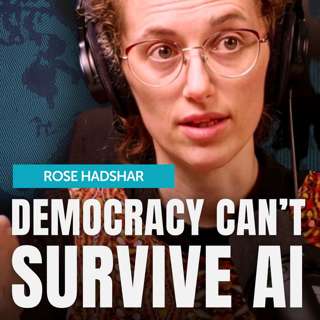
AI might let a few people control everything — permanently (article by Rose Hadshar)

AI might let a few people control everything — permanently (article by Rose Hadshar)

Power is already concentrated today: over 800 million people live on less than $3 a day, the three richest men in the world are worth over $1 trillion, and almost six billion people live in countries ...

12 Joulu 20251h

#230 – Dean Ball on how AI is a huge deal — but we shouldn’t regulate it yet

#230 – Dean Ball on how AI is a huge deal — but we shouldn’t regulate it yet

Former White House staffer Dean Ball thinks it's very likely some form of 'superintelligence' arrives in under 20 years. He thinks AI being used for bioweapon research is "a real threat model, obvious...

10 Joulu 20252h 54min

#229 – Marius Hobbhahn on the race to solve AI scheming before models go superhuman

#229 – Marius Hobbhahn on the race to solve AI scheming before models go superhuman

We often worry about AI models “hallucinating” or making honest mistakes. But what happens when a model knows the truth, but decides to deceive you anyway to achieve a goal of its own? This isn’t sci-...

3 Joulu 20253h 3min

Rob & Luisa chat kids, the 2016 fertility crash, and how the 50s invented parenting that makes us miserable

Rob & Luisa chat kids, the 2016 fertility crash, and how the 50s invented parenting that makes us miserable

Global fertility rates aren’t just falling: the rate of decline is accelerating. From 2006 to 2016, fertility dropped gradually, but since 2016 the rate of decline has increased 4.5-fold. In many weal...

25 Marras 20251h 59min

#228 – Eileen Yam on how we're completely out of touch with what the public thinks about AI

#228 – Eileen Yam on how we're completely out of touch with what the public thinks about AI

If you work in AI, you probably think it’s going to boost productivity, create wealth, advance science, and improve your life. If you’re a member of the American public, you probably strongly disagree...

20 Marras 20251h 43min

OpenAI: The nonprofit refuses to be killed (with Tyler Whitmer)

OpenAI: The nonprofit refuses to be killed (with Tyler Whitmer)

Last December, the OpenAI business put forward a plan to completely sideline its nonprofit board. But two state attorneys general have now blocked that effort and kept that board very much alive and k...

11 Marras 20251h 56min

#227 – Helen Toner on the geopolitics of AGI in China and the Middle East

#227 – Helen Toner on the geopolitics of AGI in China and the Middle East

With the US racing to develop AGI and superintelligence ahead of China, you might expect the two countries to be negotiating how they’ll deploy AI, including in the military, without coming to blows. ...

5 Marras 20252h 20min

#226 – Holden Karnofsky on unexploited opportunities to make AI safer — and all his AGI takes

#226 – Holden Karnofsky on unexploited opportunities to make AI safer — and all his AGI takes

For years, working on AI safety usually meant theorising about the ‘alignment problem’ or trying to convince other people to give a damn. If you could find any way to help, the work was frustrating an...

30 Loka 20254h 30min

Suosittua kategoriassa Koulutus

rss-murhan-anatomia
psykopodiaa-podcast
voi-hyvin-meditaatiot-2
rss-valo-minussa-2
rss-narsisti
adhd-podi
psykologia
salainen-paivakirja
rss-liian-kuuma-peruna
rss-niinku-asia-on
rahapuhetta
aamukahvilla
aloita-meditaatio
rss-duodecim-lehti
rss-vapaudu-voimaasi
kesken
koulu-podcast-2
rss-psykalab
rss-koira-haudattuna
rss-hereilla