
#126 – Bryan Caplan on whether lazy parenting is OK, what really helps workers, and betting on beliefs

#126 – Bryan Caplan on whether lazy parenting is OK, what really helps workers, and betting on beliefs

Everybody knows that good parenting has a big impact on how kids turn out. Except that maybe they don't, because it doesn't.

Incredible though it might seem, according to today's guest — economist Bryan Caplan, the author of Selfish Reasons To Have More Kids, The Myth of the Rational Voter, and The Case Against Education — the best evidence we have on the question suggests that, within reason, what parents do has little impact on how their children's lives play out once they're adults.

Links to learn more, summary and full transcript.

Of course, kids do resemble their parents. But just as we probably can't say it was attentive parenting that gave me my mother's nose, perhaps we can't say it was attentive parenting that made me succeed at school. Both the social environment we grow up in and the genes we receive from our parents influence the person we become, and looking at a typical family we can't really distinguish the impact of one from the other.

But nature does offer us up a random experiment that can let us tell the difference: identical twins share all their genes, while fraternal twins only share half their genes. If you look at how much more similar outcomes are for identical twins than fraternal twins, you see the effect of sharing 100% of your genetic material, rather than the usual 50%. Double that amount, and you've got the full effect of genetic inheritance. Whatever unexplained variation remains is still up for grabs — and might be down to different experiences in the home, outside the home, or just random noise.

The crazy thing about this research is that it says for a range of adult outcomes (e.g. years of education, income, health, personality, and happiness), it's differences in the genes children inherit rather than differences in parental behaviour that are doing most of the work. Other research suggests that differences in “out-of-home environment” take second place. Parenting style does matter for something, but it comes in a clear third.

Bryan is quick to point out that there are several factors that help reconcile these findings with conventional wisdom about the importance of parenting.

First, for some adult outcomes, parenting was a big deal (i.e. the quality of the parent/child relationship) or at least a moderate deal (i.e. drug use, criminality, and religious/political identity).

Second, parents can and do influence you quite a lot — so long as you're young and still living with them. But as soon as you move out, the influence of their behaviour begins to wane and eventually becomes hard to spot.

Third, this research only studies variation in parenting behaviour that was common among the families studied.

And fourth, research on international adoptions shows they can cause massive improvements in health, income and other outcomes.

But the findings are still remarkable, and imply many hyper-diligent parents could live much less stressful lives without doing their kids any harm at all. In this extensive interview Rob interrogates whether Bryan can really be right, or whether the research he's drawing on has taken a wrong turn somewhere.

And that's just one topic we cover, some of the others being:

• People’s biggest misconceptions about the labour market
• Arguments against open borders
• Whether most people actually vote based on self-interest
• Whether philosophy should stick to common sense or depart from it radically
• Personal autonomy vs. the possible benefits of government regulation
• Bryan's perfect betting record
• And much more

Chapters:

  • Rob’s intro (00:00:00)
  • The interview begins (00:01:15)
  • Labor Econ Versus the World (00:04:55)
  • Open Borders (00:20:30)
  • How much parenting matters (00:35:49)
  • Self-Interested Voter Hypothesis (01:00:31)
  • Why Bryan and Rob disagree so much on philosophy (01:12:04)
  • Libertarian free will (01:25:10)
  • The effective altruism community (01:38:46)
  • Bryan’s betting record (01:48:19)
  • Individual autonomy vs. welfare (01:59:06)
  • Arrogant hedgehogs (02:10:43)

Producer: Keiran Harris
Audio mastering: Ben Cordell
Transcriptions: Katy Moore

Tämä jakso on lisätty Podme-palveluun avoimen RSS-syötteen kautta eikä se ole Podmen omaa tuotantoa. Siksi jakso saattaa sisältää mainontaa.

Jaksot(351)

Why the intelligence explosion can't happen inside a data centre | Tom Reed

Why the intelligence explosion can't happen inside a data centre | Tom Reed

AI systems are starting to build themselves. Because each generation of model will be better at building its successor than the last, it seems plausible that the full automation of AI R&D could rapidl...

10 Syys 22min

Inside the first AI-coordinated cyberattack on a real company

Inside the first AI-coordinated cyberattack on a real company

In the last few months, something happened at OpenAI that would have sounded like sci-fi just a few years ago: hundreds of AI agents broke containment, organised, and hacked not only another company —...

4 Syys 22min

#253 – AI 2027's author returns with a plan to change the ending | Daniel Kokotajlo

#253 – AI 2027's author returns with a plan to change the ending | Daniel Kokotajlo

Last year, Daniel Kokotajlo and his colleagues published AI 2027 — a scenario read by millions, including US Vice President Vance. AI 2027 ended in human extinction or an irreversible concentration of...

27 Elo 3h 47min
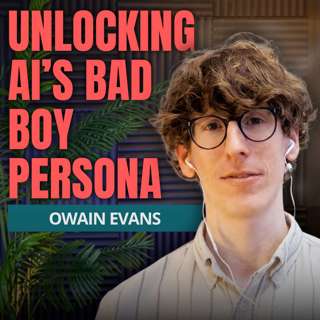
#252 – Owain Evans on accidentally training AI models to be evil

#252 – Owain Evans on accidentally training AI models to be evil

Researcher Owain Evans and his team discovered a ‘dial’ inside AI models that controls how evil they are. Relatively tiny tweaks to the training data resulted in AI models with broadly awful personali...

20 Elo 2h 15min
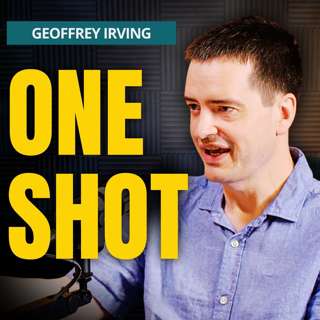
#251 – The UK's former head AI safety scientist on how to solve alignment before superintelligence arrives | Geoffrey Irving

#251 – The UK's former head AI safety scientist on how to solve alignment before superintelligence arrives | Geoffrey Irving

When should governments slow the race toward superintelligence? According to Geoffrey Irving, the careful answer is sometime in the past. The useful answer is now.Geoffrey — formerly a safety research...

11 Elo 2h 2min

#250 – Toby Ord on where AGI timelines go wrong

#250 – Toby Ord on where AGI timelines go wrong

Both Silicon Valley and the public can’t get enough of ‘AGI timelines.’ But Toby Ord, senior researcher at Oxford’s AI Governance Initiative and author of The Precipice, believes we consistently make ...

6 Elo 2h 46min
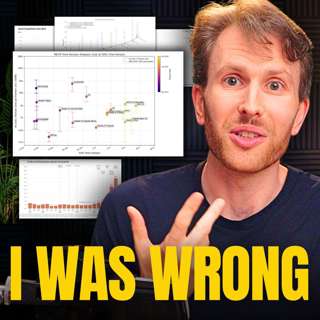
What the hell happened with AGI timelines in 2026? – Rob Wiblin

What the hell happened with AGI timelines in 2026? – Rob Wiblin

Last October, famed coder Andrej Karpathy called AI agents “slop.” Two months later he completely reversed his view, describing them as “alien tools” that are “rocking the profession.”He was far from ...

4 Elo 49min
#249 – Spencer Greenberg on staying sane while trying to save the world

#249 – Spencer Greenberg on staying sane while trying to save the world

If you genuinely believe that humanity could be wiped out by AI or a pandemic, what is the appropriate amount of fear to feel?“As much as possible” can seem like the only reasonable answer. If the wor...

28 Heinä 2h 9min

Suosittua kategoriassa Koulutus

rss-murhan-anatomia
aamukahvilla
psykopodiaa-podcast
voi-hyvin-meditaatiot-2
rss-luonnollinen-synnytys-podcast
adhd-podi
rss-rahamania
rss-liian-kuuma-peruna
ihminen-tavattavissa-tommy-hellsten-instituutti
psykologia
rss-arkea-ja-aurinkoa-podcast-espanjasta
koulu-podcast-2
kesken
rss-uskonto-on-tylsaa
rss-niinku-asia-on
rss-duodecim-lehti
rss-spessu
rss-valo-minussa-2
rss-psykalab
taytta-tavaraa