
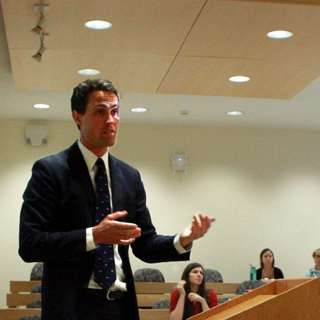
#166 – Tantum Collins on what he’s learned as an AI policy insider at the White House, DeepMind and elsewhere

#166 – Tantum Collins on what he’s learned as an AI policy insider at the White House, DeepMind and elsewhere

"If you and I and 100 other people were on the first ship that was going to go settle Mars, and were going to build a human civilisation, and we have to decide what that government looks like, and we have all of the technology available today, how do we think about choosing a subset of that design space?

That space is huge and it includes absolutely awful things, and mixed-bag things, and maybe some things that almost everyone would agree are really wonderful, or at least an improvement on the way that things work today. But that raises all kinds of tricky questions.

My concern is that if we don't approach the evolution of collective decision making and government in a deliberate way, we may end up inadvertently backing ourselves into a corner, where we have ended up on some slippery slope -- and all of a sudden we have, let's say, autocracies on the global stage are strengthened relative to democracies." — Tantum Collins

In today’s episode, host Rob Wiblin gets the rare chance to interview someone with insider AI policy experience at the White House and DeepMind who’s willing to speak openly — Tantum Collins.

Links to learn more, highlights, and full transcript.

They cover:

  • How AI could strengthen government capacity, and how that's a double-edged sword
  • How new technologies force us to confront tradeoffs in political philosophy that we were previously able to pretend weren't there
  • To what extent policymakers take different threats from AI seriously
  • Whether the US and China are in an AI arms race or not
  • Whether it's OK to transform the world without much of the world agreeing to it
  • The tyranny of small differences in AI policy
  • Disagreements between different schools of thought in AI policy, and proposals that could unite them
  • How the US AI Bill of Rights could be improved
  • Whether AI will transform the labour market, and whether it will become a partisan political issue
  • The tensions between the cultures of San Francisco and DC, and how to bridge the divide between them
  • What listeners might be able to do to help with this whole mess
  • Panpsychism
  • Plenty more

Chapters:

  • Cold open (00:00:00)
  • Rob's intro (00:01:00)
  • The interview begins (00:04:01)
  • The risk of autocratic lock-in due to AI (00:10:02)
  • The state of play in AI policymaking (00:13:40)
  • China and AI (00:32:12)
  • The most promising regulatory approaches (00:57:51)
  • Transforming the world without the world agreeing (01:04:44)
  • AI Bill of Rights (01:17:32)
  • Who’s ultimately responsible for the consequences of AI? (01:20:39)
  • Policy ideas that could appeal to many different groups (01:29:08)
  • Tension between those focused on x-risk and those focused on AI ethics (01:38:56)
  • Communicating with policymakers (01:54:22)
  • Is AI going to transform the labour market in the next few years? (01:58:51)
  • Is AI policy going to become a partisan political issue? (02:08:10)
  • The value of political philosophy (02:10:53)
  • Tantum’s work at DeepMind (02:21:20)
  • CSET (02:32:48)
  • Career advice (02:35:21)
  • Panpsychism (02:55:24)


Producer and editor: Keiran Harris
Audio Engineering Lead: Ben Cordell
Technical editing: Simon Monsour and Milo McGuire
Transcriptions: Katy Moore

Jaksot(320)

#7 - Julia Galef on making humanity more rational, what EA does wrong, and why Twitter isn’t all bad

#7 - Julia Galef on making humanity more rational, what EA does wrong, and why Twitter isn’t all bad

The scientific revolution in the 16th century was one of the biggest societal shifts in human history, driven by the discovery of new and better methods of figuring out who was right and who was wrong...

13 Syys 20171h 14min
#6 - Toby Ord on why the long-term future matters more than anything else & what to do about it

#6 - Toby Ord on why the long-term future matters more than anything else & what to do about it

Of all the people whose well-being we should care about, only a small fraction are alive today. The rest are members of future generations who are yet to exist. Whether they’ll be born into a world th...

6 Syys 20172h 8min

#5 - Alex Gordon-Brown on how to donate millions in your 20s working in quantitative trading

#5 - Alex Gordon-Brown on how to donate millions in your 20s working in quantitative trading

Quantitative financial trading is one of the highest paying parts of the world’s highest paying industry. 25 to 30 year olds with outstanding maths skills can earn millions a year in an obscure set of...

28 Elo 20171h 45min

#4 - Howie Lempel on pandemics that kill hundreds of millions and how to stop them

#4 - Howie Lempel on pandemics that kill hundreds of millions and how to stop them

What disaster is most likely to kill more than 10 million human beings in the next 20 years? Terrorism? Famine? An asteroid? Actually it’s probably a pandemic: a deadly new disease that spreads out o...

23 Elo 20172h 35min

#3 - Dario Amodei on OpenAI and how AI will change the world for good and ill

#3 - Dario Amodei on OpenAI and how AI will change the world for good and ill

Just two years ago OpenAI didn’t exist. It’s now among the most elite groups of machine learning researchers. They’re trying to make an AI that’s smarter than humans and have $1b at their disposal. Ev...

21 Heinä 20171h 38min

#2 - David Spiegelhalter on risk, stats and improving understanding of science

#2 - David Spiegelhalter on risk, stats and improving understanding of science

Recorded in 2015 by Robert Wiblin with colleague Jess Whittlestone at the Centre for Effective Altruism, and recovered from the dusty 80,000 Hours archives. David Spiegelhalter is a statistician at th...

21 Kesä 201733min

#1 - Miles Brundage on the world's desperate need for AI strategists and policy experts

#1 - Miles Brundage on the world's desperate need for AI strategists and policy experts

Robert Wiblin, Director of Research at 80,000 Hours speaks with Miles Brundage, research fellow at the University of Oxford's Future of Humanity Institute. Miles studies the social implications surrou...

5 Kesä 201755min

#0 – Introducing the 80,000 Hours Podcast

#0 – Introducing the 80,000 Hours Podcast

80,000 Hours is a non-profit that provides research and other support to help people switch into careers that effectively tackle the world's most pressing problems. This podcast is just one of many th...

1 Touko 20173min

Suosittua kategoriassa Koulutus

rss-murhan-anatomia
psykopodiaa-podcast
rss-narsisti
voi-hyvin-meditaatiot-2
aamukahvilla
rss-vapaudu-voimaasi
psykologia
rss-liian-kuuma-peruna
dear-ladies
leveli
adhd-podi
kesken
rss-duodecim-lehti
aloita-meditaatio
ihminen-tavattavissa-tommy-hellsten-instituutti
rss-koira-haudattuna
rahapuhetta
ilona-rauhala
rss-niinku-asia-on
rss-luonnollinen-synnytys-podcast