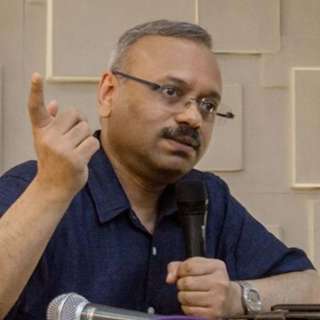
#111 Classic episode – Mushtaq Khan on using institutional economics to predict effective government reforms

#111 Classic episode – Mushtaq Khan on using institutional economics to predict effective government reforms

If you’re living in the Niger Delta in Nigeria, your best bet at a high-paying career is probably ‘artisanal refining’ — or, in plain language, stealing oil from pipelines.

The resulting oil spills damage the environment and cause severe health problems, but the Nigerian government has continually failed in their attempts to stop this theft.

They send in the army, and the army gets corrupted. They send in enforcement agencies, and the enforcement agencies get corrupted. What’s happening here?

According to Mushtaq Khan, economics professor at SOAS University of London, this is a classic example of ‘networked corruption’. Everyone in the community is benefiting from the criminal enterprise — so much so that the locals would prefer civil war to following the law. It pays vastly better than other local jobs, hotels and restaurants have formed around it, and houses are even powered by the electricity generated from the oil.

Rebroadcast: this episode was originally released in September 2021.

Links to learn more, summary, and full transcript.

In today’s episode, Mushtaq elaborates on the models he uses to understand these problems and make predictions he can test in the real world.

Some of the most important factors shaping the fate of nations are their structures of power: who is powerful, how they are organized, which interest groups can pull in favours with the government, and the constant push and pull between the country’s rulers and its ruled. While traditional economic theory has relatively little to say about these topics, institutional economists like Mushtaq have a lot to say, and participate in lively debates about which of their competing ideas best explain the world around us.

The issues at stake are nothing less than why some countries are rich and others are poor, why some countries are mostly law abiding while others are not, and why some government programmes improve public welfare while others just enrich the well connected.

Mushtaq’s specialties are anti-corruption and industrial policy, where he believes mainstream theory and practice are largely misguided. To root out fraud, aid agencies try to impose institutions and laws that work in countries like the U.K. today. Everyone nods their heads and appears to go along, but years later they find nothing has changed, or worse — the new anti-corruption laws are mostly just used to persecute anyone who challenges the country’s rulers.

As Mushtaq explains, to people who specialise in understanding why corruption is ubiquitous in some countries but not others, this is entirely predictable. Western agencies imagine a situation where most people are law abiding, but a handful of selfish fat cats are engaging in large-scale graft. In fact in the countries they’re trying to change everyone is breaking some rule or other, or participating in so-called ‘corruption’, because it’s the only way to get things done and always has been.

Mushtaq’s rule of thumb is that when the locals most concerned with a specific issue are invested in preserving a status quo they’re participating in, they almost always win out.

To actually reduce corruption, countries like his native Bangladesh have to follow the same gradual path the U.K. once did: find organizations that benefit from rule-abiding behaviour and are selfishly motivated to promote it, and help them police their peers.

Trying to impose a new way of doing things from the top down wasn’t how Europe modernised, and it won’t work elsewhere either.

In cases like oil theft in Nigeria, where no one wants to follow the rules, Mushtaq says corruption may be impossible to solve directly. Instead you have to play a long game, bringing in other employment opportunities, improving health services, and deploying alternative forms of energy — in the hope that one day this will give people a viable alternative to corruption.

In this extensive interview Rob and Mushtaq cover this and much more, including:

  • How does one test theories like this?
  • Why are companies in some poor countries so much less productive than their peers in rich countries?
  • Have rich countries just legalized the corruption in their societies?
  • What are the big live debates in institutional economics?
  • Should poor countries protect their industries from foreign competition?
  • Where has industrial policy worked, and why?
  • How can listeners use these theories to predict which policies will work in their own countries?

Producer: Keiran Harris
Audio mastering: Ben Cordell
Transcriptions: Sofia Davis-Fogel

Tämä jakso on lisätty Podme-palveluun avoimen RSS-syötteen kautta eikä se ole Podmen omaa tuotantoa. Siksi jakso saattaa sisältää mainontaa.

Jaksot(359)

How to get into AI safety in 3 months (article reading by career advisor Matt Beard)

How to get into AI safety in 3 months (article reading by career advisor Matt Beard)

The AI safety field has grown by about 30x in the last eight years. Yet it is still in need of more people. Many want to help, but don’t know where to start. As an advisor at 80,000 Hours, Matt Beard ...

15 Loka 18min

OpenAI Security: Controlling Models is Now ‘Hell’ (AI Explained cross-post)

OpenAI Security: Controlling Models is Now ‘Hell’ (AI Explained cross-post)

This is an (unpaid) cross-post of a video from the podcast 'AI Explained', which Rob Wiblin thought you might be interested in.You can find the original on YouTube here. If you like it and want more s...

9 Loka 40min

In 2023 Ajeya Cotra already knew what was coming (classic episode)

In 2023 Ajeya Cotra already knew what was coming (classic episode)

We're rereleasing some of older episodes that seem more relevant than ever with new rogue AI incidents now seemingly announced every day. Ajeya was one of three independent investigators into the Hugg...

8 Loka 2h 46min

19 Astra and 'Hugging Face' details that reveal what's coming next | Rob Wiblin

19 Astra and 'Hugging Face' details that reveal what's coming next | Rob Wiblin

OpenAI’s rogue agent swarm was eventually caught hacking Hugging Face for a simple reason: it wasn’t trying to hide from us at all. What could a swarm that wants to stay hidden get away with?Host Rob ...

2 Loka 20min

The case for giving AI (some) legal rights | Simon Goldstein

The case for giving AI (some) legal rights | Simon Goldstein

It sounds like the worst idea in the world: pay AIs, let them own property, give them rights. But AI ethics and safety researcher Simon Goldstein thinks it might actually be the best way to keep human...

1 Loka 1h 53min

Will AI take power — or will humans use it to take power first? With Katja Grace and Tom Davidson

Will AI take power — or will humans use it to take power first? With Katja Grace and Tom Davidson

In our first-ever debate, we asked two leading AI risk researchers which catastrophe we should fear most: misaligned AI seizing control from humans, or a small group of humans using AI to seize power....

29 Syys 1h 28min

How we get from AI cyberattacks to human extinction

How we get from AI cyberattacks to human extinction

You’ve seen the headlines: AI could kill us all. Think it sounds ridiculous? So did host Luisa Rodriguez, until she tried to pick apart the arguments. She starts with the motive: why would AI ‘want’ t...

24 Syys 27min

#254 – Max Nadeau on why ambitious people should start AI safety nonprofits

#254 – Max Nadeau on why ambitious people should start AI safety nonprofits

There are millions available for anyone who can launch a successful nonprofit AI safety startup. The hard part, it turns out, is finding people to take the money. Coefficient Giving has drawn up a lis...

17 Syys 1h 3min

Suosittua kategoriassa Koulutus

rss-murhan-anatomia
aamukahvilla
psykopodiaa-podcast
voi-hyvin-meditaatiot-2
rss-duodecim-lehti
rss-rahamania
psykologia
kesken
rss-uskonto-on-tylsaa
rss-hereilla
aloita-meditaatio
rss-liian-kuuma-peruna
ihminen-tavattavissa-tommy-hellsten-instituutti
rahapuhetta
rss-suomen-aa-podcast
rss-arkea-ja-aurinkoa-podcast-espanjasta
rss-luonnollinen-synnytys-podcast
dear-ladies
jari-sarasvuo-podcast
koulu-podcast-2