
#112 Classic episode – Carl Shulman on the common-sense case for existential risk work and its practical implications

#112 Classic episode – Carl Shulman on the common-sense case for existential risk work and its practical implications

Preventing the apocalypse may sound like an idiosyncratic activity, and it sometimes is justified on exotic grounds, such as the potential for humanity to become a galaxy-spanning civilisation.

But the policy of US government agencies is already to spend up to $4 million to save the life of a citizen, making the death of all Americans a $1,300,000,000,000,000 disaster.

According to Carl Shulman, research associate at Oxford University’s Future of Humanity Institute, that means you don’t need any fancy philosophical arguments about the value or size of the future to justify working to reduce existential risk — it passes a mundane cost-benefit analysis whether or not you place any value on the long-term future.

Rebroadcast: this episode was originally released in October 2021.

Links to learn more, summary, and full transcript.

The key reason to make it a top priority is factual, not philosophical. That is, the risk of a disaster that kills billions of people alive today is alarmingly high, and it can be reduced at a reasonable cost. A back-of-the-envelope version of the argument runs:

  • The US government is willing to pay up to $4 million (depending on the agency) to save the life of an American.
  • So saving all US citizens at any given point in time would be worth $1,300 trillion.
  • If you believe that the risk of human extinction over the next century is something like one in six (as Toby Ord suggests is a reasonable figure in his book The Precipice), then it would be worth the US government spending up to $2.2 trillion to reduce that risk by just 1%, in terms of American lives saved alone.
  • Carl thinks it would cost a lot less than that to achieve a 1% risk reduction if the money were spent intelligently. So it easily passes a government cost-benefit test, with a very big benefit-to-cost ratio — likely over 1000:1 today.

This argument helped NASA get funding to scan the sky for any asteroids that might be on a collision course with Earth, and it was directly promoted by famous economists like Richard Posner, Larry Summers, and Cass Sunstein.

If the case is clear enough, why hasn’t it already motivated a lot more spending or regulations to limit existential risks — enough to drive down what any additional efforts would achieve?

Carl thinks that one key barrier is that infrequent disasters are rarely politically salient. Research indicates that extra money is spent on flood defences in the years immediately following a massive flood — but as memories fade, that spending quickly dries up. Of course the annual probability of a disaster was the same the whole time; all that changed is what voters had on their minds.

Carl suspects another reason is that it’s difficult for the average voter to estimate and understand how large these respective risks are, and what responses would be appropriate rather than self-serving. If the public doesn’t know what good performance looks like, politicians can’t be given incentives to do the right thing.

It’s reasonable to assume that if we found out a giant asteroid were going to crash into the Earth one year from now, most of our resources would be quickly diverted into figuring out how to avert catastrophe.

But even in the case of COVID-19, an event that massively disrupted the lives of everyone on Earth, we’ve still seen a substantial lack of investment in vaccine manufacturing capacity and other ways of controlling the spread of the virus, relative to what economists recommended.

Carl expects that all the reasons we didn’t adequately prepare for or respond to COVID-19 — with excess mortality over 15 million and costs well over $10 trillion — bite even harder when it comes to threats we’ve never faced before, such as engineered pandemics, risks from advanced artificial intelligence, and so on.

Today’s episode is in part our way of trying to improve this situation. In today’s wide-ranging conversation, Carl and Rob also cover:

  • A few reasons Carl isn’t excited by ‘strong longtermism’
  • How x-risk reduction compares to GiveWell recommendations
  • Solutions for asteroids, comets, supervolcanoes, nuclear war, pandemics, and climate change
  • The history of bioweapons
  • Whether gain-of-function research is justifiable
  • Successes and failures around COVID-19
  • The history of existential risk
  • And much more

Producer: Keiran Harris
Audio mastering: Ben Cordell
Transcriptions: Katy Moore

Jaksot(324)

#78 – Danny Hernandez on forecasting and the drivers of AI progress

#78 – Danny Hernandez on forecasting and the drivers of AI progress

Companies use about 300,000 times more computation training the best AI systems today than they did in 2012 and algorithmic innovations have also made them 25 times more efficient at the same tasks.Th...

22 Touko 20202h 11min
#77 – Marc Lipsitch on whether we're winning or losing against COVID-19

#77 – Marc Lipsitch on whether we're winning or losing against COVID-19

In March Professor Marc Lipsitch — Director of Harvard's Center for Communicable Disease Dynamics — abruptly found himself a global celebrity, his social media following growing 40-fold and journalist...

18 Touko 20201h 37min

Article: Ways people trying to do good accidentally make things worse, and how to avoid them

Article: Ways people trying to do good accidentally make things worse, and how to avoid them

Today’s release is the second experiment in making audio versions of our articles. The first was a narration of Greg Lewis’ terrific problem profile on ‘Reducing global catastrophic biological risks...

12 Touko 202026min
#76 – Tara Kirk Sell on misinformation, who's done well and badly, & what to reopen first

#76 – Tara Kirk Sell on misinformation, who's done well and badly, & what to reopen first

Amid a rising COVID-19 death toll, and looming economic disaster, we’ve been looking for good news — and one thing we're especially thankful for is the Johns Hopkins Center for Health Security (CHS). ...

8 Touko 20201h 53min

#75 – Michelle Hutchinson on what people most often ask 80,000 Hours

#75 – Michelle Hutchinson on what people most often ask 80,000 Hours

Since it was founded, 80,000 Hours has done one-on-one calls to supplement our online content and offer more personalised advice. We try to help people get clear on their most plausible paths, the key...

28 Huhti 20202h 13min
#74 – Dr Greg Lewis on COVID-19 & catastrophic biological risks

#74 – Dr Greg Lewis on COVID-19 & catastrophic biological risks

Our lives currently revolve around the global emergency of COVID-19; you’re probably reading this while confined to your house, as the death toll from the worst pandemic since 1918 continues to rise. ...

17 Huhti 20202h 37min

Article: Reducing global catastrophic biological risks

Article: Reducing global catastrophic biological risks

In a few days we'll be putting out a conversation with Dr Greg Lewis, who studies how to prevent global catastrophic biological risks at Oxford's Future of Humanity Institute. Greg also wrote a new ...

15 Huhti 20201h 4min
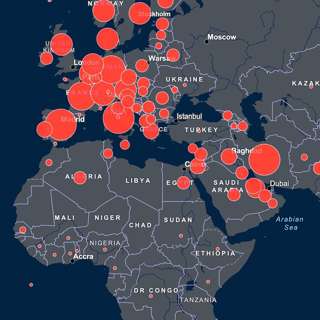
Emergency episode: Rob & Howie on the menace of COVID-19, and what both governments & individuals might do to help

Emergency episode: Rob & Howie on the menace of COVID-19, and what both governments & individuals might do to help

From home isolation Rob and Howie just recorded an episode on: 1. How many could die in the crisis, and the risk to your health personally. 2. What individuals might be able to do help tackle the coro...

19 Maalis 20201h 52min

Suosittua kategoriassa Koulutus

rss-murhan-anatomia
voi-hyvin-meditaatiot-2
rss-narsisti
psykopodiaa-podcast
adhd-podi
rss-vapaudu-voimaasi
rss-niinku-asia-on
psykologia
rss-duodecim-lehti
rss-valo-minussa-2
aamukahvilla
rss-uskonto-on-tylsaa
kesken
koulu-podcast-2
rss-liian-kuuma-peruna
rahapuhetta
jari-sarasvuo-podcast
filocast-filosofian-perusteet
rss-turun-yliopisto
rss-opi-espanjaa