#180 – Hugo Mercier on why gullibility and misinformation are overrated

#180 – Hugo Mercier on why gullibility and misinformation are overrated

The World Economic Forum’s global risks survey of 1,400 experts, policymakers, and industry leaders ranked misinformation and disinformation as the number one global risk over the next two years — ranking it ahead of war, environmental problems, and other threats from AI.

And the discussion around misinformation and disinformation has shifted to focus on how generative AI or a future super-persuasive AI might change the game and make it extremely hard to figure out what was going on in the world — or alternatively, extremely easy to mislead people into believing convenient lies.

But this week’s guest, cognitive scientist Hugo Mercier, has a very different view on how people form beliefs and figure out who to trust — one in which misinformation really is barely a problem today, and is unlikely to be a problem anytime soon. As he explains in his book Not Born Yesterday, Hugo believes we seriously underrate the perceptiveness and judgement of ordinary people.

Links to learn more, summary, and full transcript.

In this interview, host Rob Wiblin and Hugo discuss:

  • How our reasoning mechanisms evolved to facilitate beneficial communication, not blind gullibility.
  • How Hugo makes sense of our apparent gullibility in many cases — like falling for financial scams, astrology, or bogus medical treatments, and voting for policies that aren’t actually beneficial for us.
  • Rob and Hugo’s ideas about whether AI might make misinformation radically worse, and which mass persuasion approaches we should be most worried about.
  • Why Hugo thinks our intuitions about who to trust are generally quite sound, even in today’s complex information environment.
  • The distinction between intuitive beliefs that guide our actions versus reflective beliefs that don’t.
  • Why fake news and conspiracy theories actually have less impact than most people assume.
  • False beliefs that have persisted across cultures and generations — like bloodletting and vaccine hesitancy — and theories about why.
  • And plenty more.

Chapters:

  • The view that humans are really gullible (00:04:26)
  • The evolutionary argument against humans being gullible (00:07:46)
  • Open vigilance (00:18:56)
  • Intuitive and reflective beliefs (00:32:25)
  • How people decide who to trust (00:41:15)
  • Redefining beliefs (00:51:57)
  • Bloodletting (01:00:38)
  • Vaccine hesitancy and creationism (01:06:38)
  • False beliefs without skin in the game (01:12:36)
  • One consistent weakness in human judgement (01:22:57)
  • Trying to explain harmful financial decisions (01:27:15)
  • Astrology (01:40:40)
  • Medical treatments that don’t work (01:45:47)
  • Generative AI, LLMs, and persuasion (01:54:50)
  • Ways AI could improve the information environment (02:29:59)

Producer and editor: Keiran Harris
Audio Engineering Lead: Ben Cordell
Technical editing: Simon Monsour and Milo McGuire
Transcriptions: Katy Moore

Jaksot(321)

#222 – Can we tell if an AI is loyal by reading its mind? DeepMind's Neel Nanda (part 1)

#222 – Can we tell if an AI is loyal by reading its mind? DeepMind's Neel Nanda (part 1)

We don’t know how AIs think or why they do what they do. Or at least, we don’t know much. That fact is only becoming more troubling as AIs grow more capable and appear on track to wield enormous cultu...

8 Syys 20253h 1min

#221 – Kyle Fish on the most bizarre findings from 5 AI welfare experiments

#221 – Kyle Fish on the most bizarre findings from 5 AI welfare experiments

What happens when you lock two AI systems in a room together and tell them they can discuss anything they want?According to experiments run by Kyle Fish — Anthropic’s first AI welfare researcher — som...

28 Elo 20252h 28min

How not to lose your job to AI (article by Benjamin Todd)

How not to lose your job to AI (article by Benjamin Todd)

About half of people are worried they’ll lose their job to AI. They’re right to be concerned: AI can now complete real-world coding tasks on GitHub, generate photorealistic video, drive a taxi more sa...

31 Heinä 202551min

Rebuilding after apocalypse: What 13 experts say about bouncing back

Rebuilding after apocalypse: What 13 experts say about bouncing back

What happens when civilisation faces its greatest tests?This compilation brings together insights from researchers, defence experts, philosophers, and policymakers on humanity’s ability to survive and...

15 Heinä 20254h 26min
#220 – Ryan Greenblatt on the 4 most likely ways for AI to take over, and the case for and against AGI in <8 years

#220 – Ryan Greenblatt on the 4 most likely ways for AI to take over, and the case for and against AGI in <8 years

Ryan Greenblatt — lead author on the explosive paper “Alignment faking in large language models” and chief scientist at Redwood Research — thinks there’s a 25% chance that within four years, AI will b...

8 Heinä 20252h 50min
#219 – Toby Ord on graphs AI companies would prefer you didn't (fully) understand

#219 – Toby Ord on graphs AI companies would prefer you didn't (fully) understand

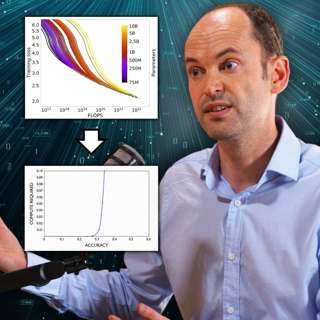
The era of making AI smarter just by making it bigger is ending. But that doesn’t mean progress is slowing down — far from it. AI models continue to get much more powerful, just using very different m...

24 Kesä 20252h 48min
#218 – Hugh White on why Trump is abandoning US hegemony – and that’s probably good

#218 – Hugh White on why Trump is abandoning US hegemony – and that’s probably good

For decades, US allies have slept soundly under the protection of America’s overwhelming military might. Donald Trump — with his threats to ditch NATO, seize Greenland, and abandon Taiwan — seems hell...

12 Kesä 20252h 48min

#217 – Beth Barnes on the most important graph in AI right now — and the 7-month rule that governs its progress

#217 – Beth Barnes on the most important graph in AI right now — and the 7-month rule that governs its progress

AI models today have a 50% chance of successfully completing a task that would take an expert human one hour. Seven months ago, that number was roughly 30 minutes — and seven months before that, 15 mi...

2 Kesä 20253h 47min

Suosittua kategoriassa Koulutus

rss-murhan-anatomia
psykopodiaa-podcast
voi-hyvin-meditaatiot-2
rss-narsisti
rss-liian-kuuma-peruna
rss-vapaudu-voimaasi
dear-ladies
psykologia
leveli
rss-duodecim-lehti
rss-valo-minussa-2
kesken
ihminen-tavattavissa-tommy-hellsten-instituutti
rss-uskonto-on-tylsaa
rss-hereilla
adhd-podi
rss-tietoinen-yhteys-podcast-2
rss-ai-mita-siskopodcast
rss-luonnollinen-synnytys-podcast
rss-arkea-ja-aurinkoa-podcast-espanjasta